


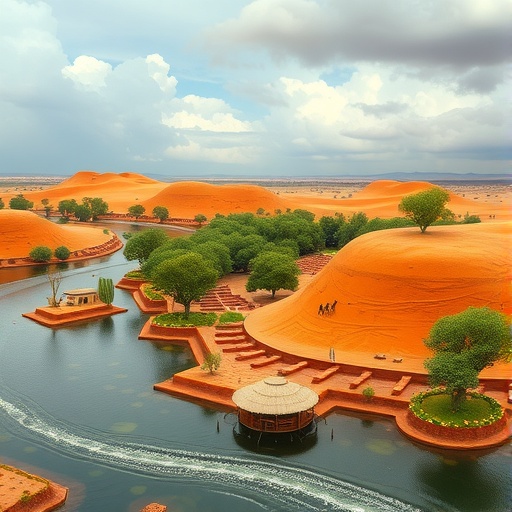
A desert in northern China may have been shaped not only by geology and long-term drying, but by the seasonal rhythm of the Asian summer monsoon—and that climate connection may help explain why Neolithic societies changed when they did. A study by Nie, Li, Zhang and colleagues argues that variability in summer monsoon strength drove episodes of vegetation expansion across the Mu Us Desert, creating environmental conditions that influenced human settlement and social transformation. The findings place climate at the center of a long-running story about how landscapes, ecosystems and early communities interacted in one of East Asia’s most environmentally sensitive regions.
The Mu Us Desert lies in northern China, near the transition between the arid interior of the continent and the more humid zones influenced by the East Asian summer monsoon. Today, it is recognized as a region of dunes, drylands and vulnerable grassland ecosystems. But deserts are not always biologically uniform or permanently fixed. Their boundaries can shift as rainfall, evaporation and plant productivity change. In a monsoon-controlled environment, even relatively modest changes in seasonal precipitation can determine whether grasses and other plants expand across sandy surfaces or whether open, sparsely vegetated conditions return.
The Asian summer monsoon is a vast atmospheric circulation system powered by the seasonal contrast between the rapidly warming Eurasian landmass and the surrounding oceans. During summer, moist air is drawn inland from the western Pacific and other moisture sources, bringing rainfall to large areas of eastern and northern China. The strength and reach of that circulation vary through time. A stronger monsoon generally delivers more summer moisture farther into northern China, while a weaker monsoon can shift rainfall southward and leave dryland regions exposed to intensified water stress. For ecosystems already balanced near the threshold between grassland and desert, those changes can have outsized consequences.
The new research identifies summer monsoon variability as a driver of “greening” in the Mu Us Desert. In this context, greening does not simply mean a temporary increase in the color of the landscape. It refers to a broader ecological transition in which greater water availability supports more continuous vegetation cover, stabilizes mobile dunes and increases biological productivity. Plants reduce wind erosion by binding sand with roots, while their stems and leaf litter slow surface winds and trap additional sediment. Once vegetation becomes established, these feedbacks can help maintain a more stable, productive landscape—at least while favorable moisture conditions persist.
That ecological shift would have mattered to Neolithic communities living in or near the desert margin. Early farming and herding societies depended on landscapes that could provide water, edible plants, grazing resources and cultivable soils. A greener Mu Us region may have offered more reliable opportunities for settlement, mobility and food production than the same area would have provided during a dry monsoon phase. Increased vegetation could also have reduced the movement of dunes, opening new land surfaces and making routes across the region easier to use. Climate-driven environmental improvement therefore had the potential to influence not only where people lived, but also how often they moved and how intensely they used local resources.
The study’s central significance lies in connecting environmental change with Neolithic societal change without treating climate as a single, direct cause of human history. Climate does not determine human behavior in a simple one-way chain. Communities make decisions, develop technologies, exchange goods and reorganize political relationships. Yet the environmental conditions available to them can expand or restrict those choices. A stronger summer monsoon may have created new possibilities for settlement and production, while later weakening or fluctuating monsoon conditions may have increased pressure on water and food systems. Social change could emerge from the interaction between those climatic opportunities and the strategies communities used to respond.
This interaction is especially important in northern China, where the boundary between farming and pastoral lifeways has long been dynamic. The region formed a cultural and ecological meeting zone rather than a rigid dividing line. When rainfall increased, cultivation and more permanent settlement could become more viable. When conditions became drier, communities may have relied more heavily on herding, mobility or exchange with neighboring groups. Such shifts would not necessarily represent abrupt collapses. They could reflect adaptation to a moving environmental frontier, as people adjusted land use and social organization to the changing balance between moisture, vegetation and desert exposure.
By emphasizing monsoon variability, the research also highlights the importance of seasonality. Annual rainfall totals alone can conceal the mechanisms that control ecological productivity. Summer precipitation is particularly influential in northern China because it arrives during the warm growing season, when plants can immediately use available water. Rainfall outside that period may contribute less to vegetation growth if temperatures are too low or evaporation and plant demand are mismatched. A change in the timing, intensity or geographic reach of monsoon rains can therefore transform ecosystems even without a dramatic change in yearly precipitation. This seasonal connection provides a physically plausible explanation for why Mu Us vegetation and human activity could have shifted together.
The findings offer a deep-time perspective on a question that is increasingly urgent today: how do dryland societies respond when climate pushes ecosystems across critical thresholds? Modern desertification is often discussed as a consequence of overgrazing, cultivation, water extraction or other human pressures, and those factors remain essential. But the history of the Mu Us Desert shows that natural climate variability also has the power to reorganize vegetation and land stability. Understanding how monsoon changes once affected the region can help researchers distinguish climate-driven landscape shifts from purely human-driven degradation and can improve interpretations of how drylands may respond to future warming.
The study does not suggest that climate alone created or transformed Neolithic society. Rather, it presents the Mu Us Desert as an active participant in human history: a landscape whose ecological condition changed with the summer monsoon and, in turn, altered the options available to communities. By linking atmospheric circulation, vegetation dynamics and archaeological change, Nie and colleagues provide a picture of northern China in which environmental variability was not background scenery but a force shaping settlement and adaptation. The result is a compelling reminder that the roots of societal change may lie partly in seasonal winds arriving from distant oceans, carrying enough moisture to turn shifting dunes into habitable ground.
Cite Scienmag News
Violet Maxwell. (August 21, 2026). Monsoon variability drove Mu Us Desert greening and Neolithic societal change. Scienmag. https://scienmag.com/monsoon-variability-drove-mu-us-desert-greening-and-neolithic-societal-change/
Violet Maxwell. "Monsoon variability drove Mu Us Desert greening and Neolithic societal change." Scienmag, 21 August 2026, https://scienmag.com/monsoon-variability-drove-mu-us-desert-greening-and-neolithic-societal-change/. Accessed 3 September 2026.
Violet Maxwell. "Monsoon variability drove Mu Us Desert greening and Neolithic societal change." Scienmag. August 21, 2026. https://scienmag.com/monsoon-variability-drove-mu-us-desert-greening-and-neolithic-societal-change/


