


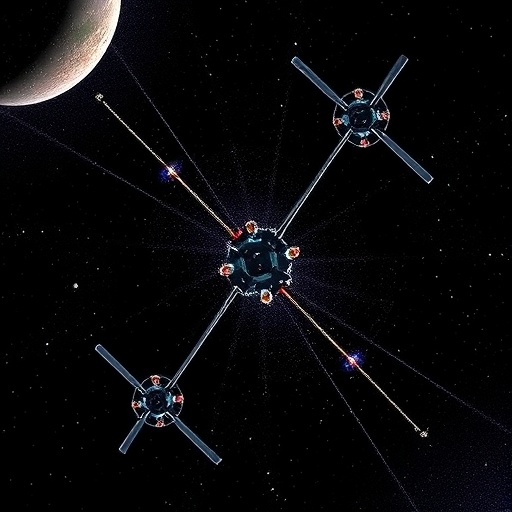
Geostationary orbit is becoming an increasingly crowded and strategically sensitive region of space, where satellites responsible for communications, missile warning, weather monitoring, and military operations share a narrow belt more than 35,000 kilometers above Earth. In this environment, the ability to inspect another spacecraft from close range could provide valuable information about its structure, payloads, operating condition, and mission. A new study proposes a fuel-conscious way for an observing spacecraft to move through several distinct relative flight patterns, allowing it to collect images from multiple angles without relying on repeated, energy-intensive attitude maneuvers.
The research, led by Meng Yunhe of the School of Artificial Intelligence at Sun Yat-sen University, addresses a difficult problem in spacecraft proximity operations: how to combine different observation geometries into one coordinated mission. Existing studies have often treated individual formations—such as hovering or fly-around trajectories—as separate control problems. Real missions, however, may require a spacecraft to transition from one configuration to another while maintaining safe separation, conserving propellant, and maximizing the time during which its cameras can view a non-cooperative target. The new method treats the complete observation campaign as a strategic sequence rather than as a collection of isolated maneuvers.
The researchers based their analysis on the Clohessy–Wiltshire equations, a classical mathematical model used to describe the relative motion of two nearby spacecraft in nearly circular orbits. In a local vertical, local horizontal coordinate system, the target spacecraft is treated as the reference body while the observing spacecraft’s position and velocity are expressed relative to it. Under idealized assumptions, the equations provide analytical solutions for unforced relative motion. By selecting suitable initial positions, velocities, relative distances, and phase angles, mission planners can generate stable trajectories that keep the observing vehicle within a desired region around its target.
Four close-range operation models form the foundation of the proposed strategy. The first is a droplet-shaped relative trajectory, designed to provide repeated access to particular viewing regions and to support detailed inspection. The second is a coplanar fly-around pattern, in which the observing spacecraft travels around the target within approximately the same orbital plane. The third is a non-coplanar fly-around configuration, which introduces motion in a different orbital plane and exposes surfaces that may remain hidden during a planar pass. The fourth is a drifting flight mode, in which a sequence of controlled impulses gradually changes the relative position of the observing spacecraft and enables another form of close-range viewing.
These configurations serve complementary purposes. A droplet trajectory can support symmetric observation and revisits, while fly-around modes offer changing lines of sight around the target. The non-coplanar pattern is particularly important because a spacecraft’s solar arrays, antennas, sensors, and structural features may appear substantially different when viewed from above, below, or an oblique direction. Drifting flight, meanwhile, can reposition the observing vehicle without requiring it to maintain a tightly controlled closed orbit at all times. Together, the four models create a flexible set of viewing geometries for reconstructing the target’s external characteristics and assessing its operational state.
Switching between these modes is one of the most technically demanding aspects of the mission. An abrupt transition could produce excessive relative velocity, increase collision risk, or consume more propellant than the observation itself. To address this problem, the study introduces waypoint-based trajectory planning combined with a multi-impulse maneuver strategy. The transition is formulated using minimum integral squared control theory, which seeks to reduce the overall control effort over the maneuver interval. Instead of attempting to jump directly from one idealized trajectory to another, the spacecraft passes through carefully selected intermediate waypoints that smooth the change in position and velocity.
The central innovation is the use of sequential coalition game theory to select the order of operations. In the proposed framework, each candidate combination of an initial motion point and a close-range model represents a possible decision at a particular stage of the mission. These decisions are organized in a game tree, where every branch corresponds to a potential observation sequence. The algorithm evaluates the fuel required for transitions and the resulting observation opportunities, then selects a sequence that satisfies the mission constraints while seeking the greatest overall benefit. In this context, the “coalitions” are combinations of operation models that work together across successive stages rather than competing as independent choices.
The simulations show how the method can produce a four-stage observation plan under minimum-fuel constraints. In the example sequence, the spacecraft begins with an initial point and the droplet model, then transitions to drifting flight before continuing through coplanar and non-coplanar fly-around operations. The resulting three-dimensional relative trajectory demonstrates how different motion patterns can be connected into a single campaign. Rather than forcing one model to satisfy every observation requirement, the strategy assigns each configuration a specific role and uses controlled transitions to expand the target’s observable surface.
The study also examines how observation distance and camera field of view influence effective observation time. Effective observation time is defined as the total period during which the target remains visible while satisfying prescribed limits on range and viewing geometry. The simulations indicate that, within the tested conditions, increasing the allowable observation distance and widening the field of view can significantly extend this period. A larger field of view allows the target to remain inside the camera’s usable imaging region for longer, while a greater permitted separation can enlarge the portion of a relative trajectory that remains operationally useful. The researchers also report that reducing the number of model configurations can improve performance in some circumstances, suggesting that a shorter sequence may reduce transition costs and simplify mission execution.
The findings arrive as close-range space operations attract growing attention from governments, commercial operators, and space-security researchers. Programs such as the United States’ Geosynchronous Space Situational Awareness Program have demonstrated the strategic importance of inspecting objects near geostationary orbit, where even small relative motions can unfold over long periods and where rescue, servicing, or surveillance missions face severe logistical constraints. The proposed approach does not depend on cooperation from the observed spacecraft, making it relevant to situations in which the target does not provide navigation data or agree to maneuver. By combining analytical relative-motion models, fuel-efficient transitions, and game-based sequence planning, the work offers a framework for turning multi-angle spacecraft inspection into a coordinated optimization problem. Its authors argue that the method could support future space situational awareness missions that must gather more information while preserving limited propellant and maintaining safe proximity to potentially hazardous targets.
News Publication Date: 30 June 2026
Web References: https://doi.org/10.34133/space.0419
References: Space: Science & Technology, DOI: 10.34133/space.0419
Keywords
Geostationary orbit, spacecraft proximity operations, space situational awareness, non-cooperative spacecraft, Clohessy–Wiltshire equations, relative motion, fly-around trajectories, fuel optimization, sequential coalition game theory, satellite inspection
Cite Scienmag News
Grant Pearson. (August 20, 2026). Researchers Design Cooperative Strategy for Sequential Spacecraft Proximity Observations. Scienmag. https://scienmag.com/researchers-design-cooperative-strategy-for-sequential-spacecraft-proximity-observations/
Grant Pearson. "Researchers Design Cooperative Strategy for Sequential Spacecraft Proximity Observations." Scienmag, 20 August 2026, https://scienmag.com/researchers-design-cooperative-strategy-for-sequential-spacecraft-proximity-observations/. Accessed 4 September 2026.
Grant Pearson. "Researchers Design Cooperative Strategy for Sequential Spacecraft Proximity Observations." Scienmag. August 20, 2026. https://scienmag.com/researchers-design-cooperative-strategy-for-sequential-spacecraft-proximity-observations/


