


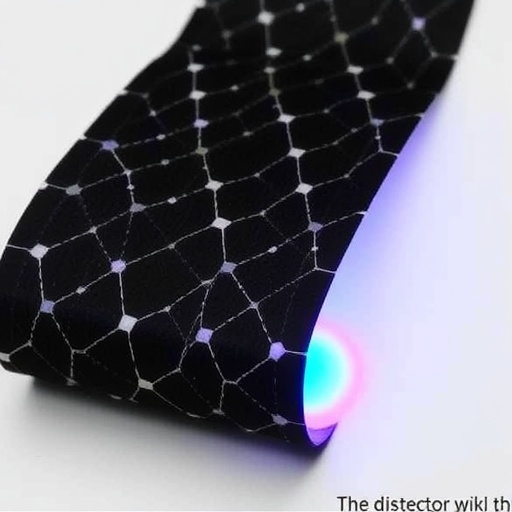
A new study reported in npj Flexible Electronics is drawing attention to the possibility of producing entire light-sensing systems with the same high-speed printing technology used to place patterns on paper, packaging, and emerging electronic materials. Led by D. Koh, H. Im, J. Kim, and colleagues, the research presents a fully inkjet-printed flexible photodetector array designed to detect light color through hybrid structures made from carbon nanotubes and organic macrocycles. The work brings together two fast-moving fields—printed electronics and nanoscale optical sensing—and points toward lightweight, bendable devices that could be manufactured without the rigid silicon platforms traditionally associated with cameras and photodetectors.
Photodetectors are electronic components that convert incoming light into electrical signals. They are found in cameras, optical communication systems, medical instruments, environmental sensors, industrial automation equipment, and countless consumer devices. Conventional photodetectors are often fabricated on inflexible substrates using complex semiconductor-processing methods. Although these technologies can deliver excellent performance, they may involve high temperatures, vacuum systems, multiple lithography steps, and materials that are difficult to integrate onto plastic, paper, textiles, or other unconventional surfaces. A fully inkjet-printed alternative could simplify fabrication while opening new possibilities for electronics that conform to curved or moving objects.
Inkjet printing offers a fundamentally different approach to manufacturing. Instead of removing material from a solid layer through etching, an inkjet system deposits tiny droplets of functional ink precisely where electronic features are required. The inks can contain conductive materials, semiconducting compounds, insulating polymers, or other components that form useful structures after drying or thermal treatment. Because the process is digitally controlled, patterns can be changed without manufacturing a new physical mask. This design flexibility is particularly valuable for prototypes, customized sensors, large-area devices, and applications in which electronic circuits must be deposited directly onto flexible substrates.
The study’s central innovation is the use of a hybrid sensing material that combines carbon nanotubes with organic macrocycles. Carbon nanotubes are cylindrical structures formed from carbon atoms arranged in a nanoscale lattice. Their electronic and optical properties can support efficient charge transport, while their small dimensions allow them to form interconnected networks in printed films. Organic macrocycles, meanwhile, are ring-shaped molecules with extended structures capable of interacting with light, other molecules, and nearby electronic materials. By combining these two classes of material, researchers can engineer a sensing layer in which light absorption and electrical response are influenced by interactions at the nanoscale.
Color detection is more complicated than simply determining whether light is present. A photodetector must respond differently to different wavelengths, because color is directly related to the wavelength distribution of incoming light. A material that absorbs or responds strongly in one spectral region and weakly in another can provide information about the color of the light reaching the device. In an array, multiple sensing elements can be designed or processed to produce distinct response patterns. Electronics can then compare the signals from these elements and infer the color composition of the illumination, creating a simplified form of spectral recognition without requiring a conventional glass-and-silicon camera system.
The researchers’ decision to fabricate the array entirely by inkjet printing is significant because the manufacturing method affects more than appearance. Printing can determine the thickness, geometry, spacing, and connectivity of functional layers, all of which influence a photodetector’s sensitivity and reliability. In flexible electronics, the printed material must also remain electrically connected when the substrate bends, twists, or moves. A device that performs well only when flat would have limited practical value. By developing the photodetector array through a solution-based, digitally patterned process, the work addresses the broader challenge of integrating optical sensing with surfaces that cannot tolerate the processing conditions used in conventional electronics manufacturing.
The hybrid architecture also reflects a growing effort to use molecular design as a tool for controlling sensor behavior. Carbon nanotubes can create pathways through which photogenerated charges move, but their response may depend on how they interact with surrounding molecules and interfaces. Organic macrocycles can introduce selective optical or electronic interactions, potentially modifying how the composite absorbs light and responds to different wavelengths. The performance of such a system depends on factors including the distribution of nanotubes, the organization of the macrocyclic molecules, the quality of the printed film, and the electrical contacts connecting each sensing element. These details determine whether a printed array produces clear, distinguishable signals rather than a weak or ambiguous response.
Flexible color-sensitive photodetectors could eventually support applications in wearable technology, robotic vision, smart packaging, portable diagnostics, environmental monitoring, and interactive surfaces. A sensor embedded in clothing could monitor light exposure without adding the bulk of a rigid circuit board. A printed array on packaging could help indicate changes in environmental conditions or authenticate a product. In robotics, lightweight color sensors could be distributed across curved surfaces to provide localized optical information. Large-area printed detectors might also be integrated into displays, architectural materials, or low-cost devices where conventional imaging hardware would be unnecessarily complex.
The research arrives as printed electronics moves from laboratory demonstrations toward systems that combine sensing, computation, energy management, and communication on flexible substrates. For that transition to succeed, individual components must be compatible with scalable fabrication and must deliver reproducible performance across many printed devices. The reported photodetector array is therefore important not only because it detects light color, but because it demonstrates how nanoscale functional materials can be incorporated into a manufacturing process designed for patterned, flexible electronics. The approach could help reduce the gap between promising laboratory materials and practical devices produced over larger areas.
The study also highlights the broader potential of hybrid materials in next-generation sensors. Neither carbon nanotubes nor organic macrocycles alone represents the entire solution to flexible color detection. Their combination creates a platform in which optical absorption, charge transport, and device geometry can be coordinated through materials engineering and printing. As researchers continue refining ink formulations, printing accuracy, film uniformity, and signal-processing methods, systems based on this concept could become more compact, customizable, and adaptable than many conventional alternatives. The work by Koh, Im, Kim, and colleagues presents a striking example of how molecular materials and digital manufacturing can converge to create a new generation of bendable optical electronics.
Cite Scienmag News
Denise Maddox. (August 20, 2026). Inkjet-Printed Flexible Photodetectors Detect Light Colors Using Carbon Nanotube–Macrocycle Hybrids. Scienmag. https://scienmag.com/inkjet-printed-flexible-photodetectors-detect-light-colors-using-carbon-nanotube-macrocycle-hybrids/
Denise Maddox. "Inkjet-Printed Flexible Photodetectors Detect Light Colors Using Carbon Nanotube–Macrocycle Hybrids." Scienmag, 20 August 2026, https://scienmag.com/inkjet-printed-flexible-photodetectors-detect-light-colors-using-carbon-nanotube-macrocycle-hybrids/. Accessed 3 September 2026.
Denise Maddox. "Inkjet-Printed Flexible Photodetectors Detect Light Colors Using Carbon Nanotube–Macrocycle Hybrids." Scienmag. August 20, 2026. https://scienmag.com/inkjet-printed-flexible-photodetectors-detect-light-colors-using-carbon-nanotube-macrocycle-hybrids/


