


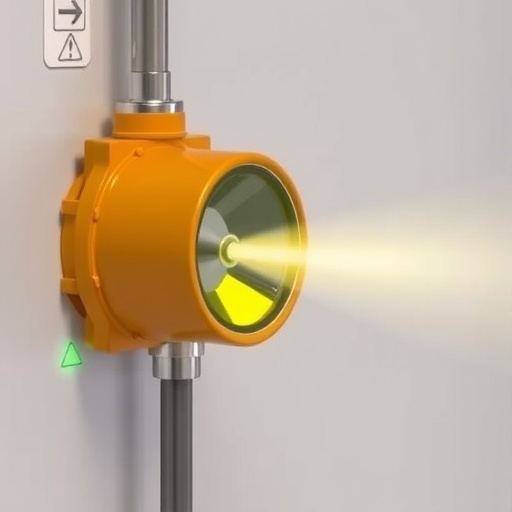
CHANGWON, South Korea — A lead-free perovskite material that changes into a flower-like structure when exposed to ammonia could provide a safer and more sensitive way to detect leaks in the emerging hydrogen economy. Researchers at the Korea Institute of Materials Science (KIMS), working with scientists at Pusan National University, Incheon National University, and Macquarie University in Australia, have developed an ammonia sensor capable of detecting concentrations as low as one part per million. The device combines the high sensitivity associated with perovskite materials with an environmentally friendlier chemical composition that avoids toxic lead.
The sensor addresses a growing challenge in energy infrastructure. Ammonia is increasingly being considered a practical carrier for hydrogen because it can be liquefied, stored, and transported more easily than hydrogen gas itself. It is also being investigated as a fuel for ships, power-generation systems, and industrial equipment. Yet ammonia is hazardous when released into the air. Even exposure to concentrations in the tens of parts per million can affect human health, while larger leaks can rapidly become dangerous for workers and nearby communities. Detecting a leak at its earliest stage is therefore essential at production plants, storage terminals, pipelines, ports, power stations, and transportation facilities.
Perovskites have attracted intense interest as sensing materials because their electronic properties can change dramatically when they interact with surrounding gases. Many of the most effective perovskite ammonia sensors, however, rely on lead-containing compounds. Lead can pose serious risks to human health and ecosystems, creating regulatory and commercial obstacles for devices intended for widespread deployment. To overcome this limitation, the KIMS-led team used formamidinium antimony bromide, a lead-free perovskite with the chemical formula FA₃Sb₂Br₉. The material was deposited as a thin film and incorporated into a gas-sensing device using a relatively simple solution-based spin-coating process.
In laboratory tests, the new sensor responded consistently across a range of ammonia concentrations, allowing the magnitude of its electrical signal to be used to estimate the amount of gas present. When the device was exposed to 100 parts per million of ammonia, its response time was approximately 13 seconds. Its electrical signal increased by as much as 235 percent, a substantial change that makes the gas easier to distinguish from background noise. Most importantly, the sensor remained capable of detecting ammonia at concentrations down to one part per million, a threshold that could enable warning systems to identify leaks before they become obvious or dangerous.
The researchers also tested the device against several gases that might be present in industrial environments, including methane, carbon monoxide, nitrogen oxides, hydrogen, and methanol. These substances produced much smaller responses than ammonia, indicating that the sensor has strong selectivity. Selectivity is a critical property in real-world gas detection because industrial sites rarely contain a single chemical species. A sensor that reacts similarly to several gases could generate false alarms or fail to identify the source of a leak. By producing a particularly strong response to ammonia, the antimony-based material could improve the reliability of automated monitoring systems.
The device demonstrated stability as well as sensitivity. After being stored for two months, it retained approximately 97 percent of its original performance. That result is significant because gas sensors may be installed in locations where frequent replacement or recalibration is difficult, including pipelines, ships, storage tanks, and remote industrial facilities. The solution-processing method used to fabricate the thin films could also support production over large areas and reduce manufacturing costs compared with more complex techniques. In the future, the same material platform could potentially be adapted for portable detectors, distributed sensor networks, and flexible monitoring devices attached directly to industrial equipment.
Beyond the performance figures, the study offers a new explanation for how this type of perovskite detects ammonia. Conventional models often describe gas sensing as a surface process: ammonia molecules attach to the outside of a semiconductor and modify the movement of electrical charges near the surface. The KIMS team found evidence that the molecules do more than simply remain on the exterior. They reversibly enter, or intercalate into, the layered perovskite structure. This process changes the electronic state of the material and induces p-type doping, increasing its ability to conduct electrical current.
That mechanism helps explain the unusually large electrical response observed during ammonia exposure. In a p-type semiconductor, the primary charge carriers are positively charged vacancies known as holes. When ammonia intercalates into the antimony-based perovskite, it alters the balance of charge carriers and raises the material’s conductivity. When the ammonia is removed, the structure can return toward its original state, allowing the sensor to operate reversibly. The finding is important because it shifts the design strategy for perovskite gas sensors away from surface chemistry alone and toward controlled molecular movement within the crystal lattice. Engineering the pathways, spacing, and chemical stability of those structures could lead to sensors with even greater sensitivity and selectivity.
The researchers believe the technology could support safety systems across the ammonia and hydrogen supply chain. Potential applications include early-warning detectors at ammonia production and storage facilities, monitoring equipment for fertilizer and chemical plants, and leak-detection systems aboard ships that use ammonia as fuel or as a hydrogen carrier. Power plants and industrial sites could deploy networks of these sensors to provide continuous measurements and trigger alarms before workers are exposed to harmful concentrations. Because ammonia-based energy infrastructure is expanding while many high-performance sensors remain dependent on imported components, a scalable lead-free platform could also strengthen domestic manufacturing and reduce maintenance costs.
Myungkwan Song, principal researcher at KIMS and leader of the project, said the study is notable both for producing a highly sensitive sensor without lead and for identifying its sensing mechanism at the atomic level. The research was supported by South Korea’s Ministry of Science and ICT, the National Research Foundation of Korea, and the National Research Council of Science and Technology. The findings were published online on July 27, 2026, in Small Structures under the title “Antimony-Based Lead-Free Perovskite Thin Films for Highly Sensitive Ammonia (NH₃) Gas Detection.” By combining low-level detection, rapid response, long-term stability, and a newly revealed intercalation-based mechanism, the work points toward a new generation of safer sensors for the rapidly developing ammonia and hydrogen energy economy.
Web References: Korea Institute of Materials Science (KIMS); DOI: 10.1002/sstr.70516
References: Small Structures, published online July 27, 2026; DOI: 10.1002/sstr.70516
Keywords
Ammonia sensor, lead-free perovskite, antimony perovskite, FA₃Sb₂Br₉, gas detection, hydrogen economy, ammonia safety, p-type doping, molecular intercalation, materials science
Cite Scienmag News
Denise Maddox. (August 19, 2026). Sensor detects ammonia leaks at just one part per million. Scienmag. https://scienmag.com/sensor-detects-ammonia-leaks-at-just-one-part-per-million/
Denise Maddox. "Sensor detects ammonia leaks at just one part per million." Scienmag, 19 August 2026, https://scienmag.com/sensor-detects-ammonia-leaks-at-just-one-part-per-million/. Accessed 4 September 2026.
Denise Maddox. "Sensor detects ammonia leaks at just one part per million." Scienmag. August 19, 2026. https://scienmag.com/sensor-detects-ammonia-leaks-at-just-one-part-per-million/


