


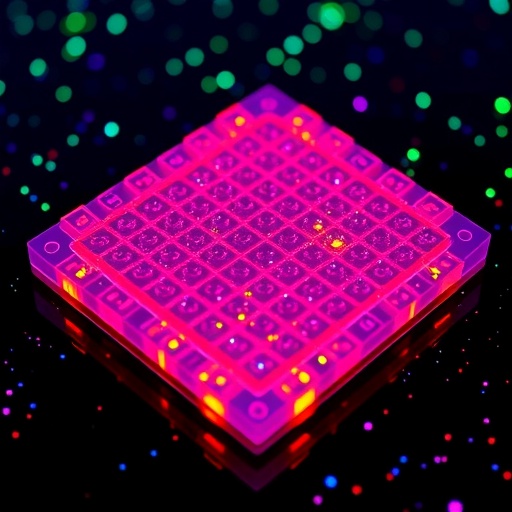
A new on-chip terahertz metasensor could bring a powerful laboratory technique for identifying complex mixtures of biomolecules closer to compact, rapid and potentially portable diagnostic devices. In a study published in Light: Science & Applications, Xu, Duan, Lu and colleagues describe an integrated sensing platform designed for quantitative multi-component biomolecular identification. The work targets one of the central challenges in modern biosensing: determining not only whether a biological molecule is present, but also which molecules are present, how much of each exists, and how their signals overlap within the same sample.
The device is based on terahertz radiation, an electromagnetic range positioned between microwaves and infrared light. Terahertz waves can interact with collective molecular motions, weak intermolecular forces and other low-energy excitations that are difficult to observe using conventional optical methods. In principle, these interactions create spectral signatures that can distinguish one substance from another. Biological samples, however, are rarely clean or simple. They may contain proteins, nucleic acids, metabolites and other compounds at different concentrations, producing signals that overlap and complicate interpretation. A sensor capable of separating those contributions could offer a new route to biochemical analysis.
The researchers’ approach combines terahertz sensing with a metasurface, a deliberately engineered arrangement of subwavelength structures that manipulates electromagnetic fields. Rather than relying on the natural interaction between a weak terahertz beam and a tiny quantity of biomaterial, a metasurface can concentrate electromagnetic energy into localized regions near its surface. These “hot spots” increase the interaction between the incoming radiation and molecules captured or deposited in the sensing area. Even when the analyte layer is extremely thin, changes in the local environment can shift or reshape the metasurface’s resonant response, producing a measurable signal.
The “on-chip” aspect is equally important. Traditional terahertz systems often depend on bulky emitters, detectors, optical components and free-space alignment. Such arrangements are valuable in research laboratories but can be difficult to translate into instruments used at clinics, field stations or industrial facilities. Integrating the sensing architecture onto a chip aims to reduce the optical path, simplify packaging and make the system more compatible with electronic readout. In the longer term, this type of integration could support arrays containing many sensing elements, each optimized for a different target or measurement condition.
Quantitative multi-component identification is more demanding than conventional detection. A single target can sometimes be recognized by monitoring one characteristic spectral change. In a mixture, however, the measured response is a combination of several molecular contributions, the sensor’s own resonance behavior and variations caused by the sample environment. The problem resembles separating several voices recorded by one microphone. The device must generate sufficiently distinctive and reproducible signals, while the analysis must determine how much of each component contributed to the final response.
Metasensors address this problem by converting subtle molecular changes into larger shifts in electromagnetic behavior. When molecules bind to or accumulate near the engineered surface, they alter the local refractive index and can modify the amplitude, frequency or linewidth of a resonance. These changes can be measured in the terahertz domain and compared with calibration data or computational models. By examining multiple features rather than relying on a single signal, an algorithm can estimate the composition of a mixture. The approach is particularly relevant to biomolecular systems, where different compounds may be present at low concentrations and share similar chemical signatures.
One obstacle is water. Terahertz radiation is strongly absorbed by liquid water, and biological samples are commonly water-rich. This absorption can reduce the distance over which the radiation travels and obscure weak molecular signals. A practical terahertz biosensor therefore has to control the sample geometry, limit the effective optical path or use surface-bound molecules so that the measurement occurs close to the sensing interface. The on-chip metasurface architecture is designed around that constraint, concentrating the field where the biological material is located rather than depending on a long transmission path through a liquid sample.
The significance of the study lies in bringing several difficult requirements together: terahertz operation, electromagnetic enhancement, chip-scale integration and analysis of more than one biomolecular component. Each element addresses a separate limitation of established sensing technologies. Terahertz measurements can provide information unavailable from visible-light assays; metasurfaces can amplify weak interactions; on-chip construction can support miniaturization; and multi-component analysis moves beyond the one-target-at-a-time format of many biosensors. The combination could eventually be useful for complex samples in which the biological meaning depends on a profile rather than a single marker.
Such a platform could have implications for medical diagnostics, environmental monitoring, food safety and pharmaceutical manufacturing, although translation will depend on further validation. Real-world samples introduce challenges that controlled laboratory mixtures may not capture, including nonspecific adsorption, temperature fluctuations, changes in pH, uneven sample distribution and interference from abundant background molecules. Quantitative measurements also require rigorous calibration, reference standards and statistical methods capable of distinguishing genuine biochemical variation from sensor drift. Reproducibility across chips and batches will be essential if the technology is to move from a promising device concept to a dependable analytical tool.
The researchers’ work points toward a future in which a small chip could interrogate several biomolecular signals at once and deliver a compositional readout without requiring a large analytical instrument. That vision is not the same as an immediate replacement for established laboratory methods, but it represents a significant direction for terahertz photonics and biosensing. By engineering the interaction between light and matter at the chip surface, the technology seeks to make molecular information more accessible, more compact and more quantitative. If subsequent studies demonstrate robust performance in complex biological samples, on-chip terahertz metasensors could become an important building block for next-generation diagnostics and rapid chemical analysis.
Cite Scienmag News
Denise Maddox. (August 18, 2026). On-chip terahertz metasensor enables quantitative identification of multiple biomolecules. Scienmag. https://scienmag.com/on-chip-terahertz-metasensor-enables-quantitative-identification-of-multiple-biomolecules/
Denise Maddox. "On-chip terahertz metasensor enables quantitative identification of multiple biomolecules." Scienmag, 18 August 2026, https://scienmag.com/on-chip-terahertz-metasensor-enables-quantitative-identification-of-multiple-biomolecules/. Accessed 4 September 2026.
Denise Maddox. "On-chip terahertz metasensor enables quantitative identification of multiple biomolecules." Scienmag. August 18, 2026. https://scienmag.com/on-chip-terahertz-metasensor-enables-quantitative-identification-of-multiple-biomolecules/


