


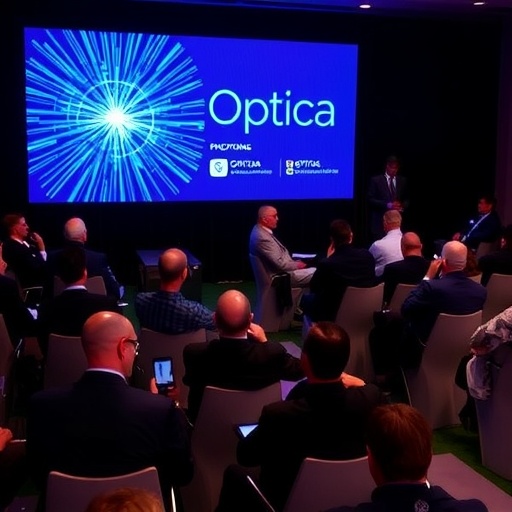
WASHINGTON, 17 August 2026 — More than 400 executives, investors, policymakers and research leaders are expected to gather in Málaga, Spain, on 24–25 September for the Global Photonics Economic Forum 2026, an international meeting focused on the business, economic and strategic future of optics and photonics. The event arrives as technologies based on the generation, control and detection of light move from specialized research laboratories into the core infrastructure of artificial intelligence, quantum computing, advanced manufacturing, healthcare, aerospace and high-speed communications. Organized by Optica, the forum will examine how photonics is reshaping global markets and why control over optical technologies is increasingly being treated as an issue of national competitiveness.
Photonics is the technological discipline that uses photons—the fundamental particles of light—to transmit information, sense physical conditions, process data and manufacture materials. Optical fiber networks can carry enormous volumes of information with low signal loss, while lasers enable precision cutting, semiconductor fabrication, medical imaging and surgical procedures. In artificial intelligence systems, optical components are becoming essential for connecting processors, memory and data centers at speeds that conventional electrical links may struggle to sustain efficiently. As AI models demand ever greater computing power, the energy consumed by moving data between chips has become a major engineering challenge, creating new opportunities for optical interconnects, silicon photonics and other light-based architectures.
The forum will address the growing connection between photonics and AI infrastructure, where optical communication may help reduce bottlenecks in increasingly dense computing systems. Electrical signals traveling through metal conductors encounter resistance and generate heat, particularly as data rates and transmission distances rise. Photonic systems can move information through light, potentially improving bandwidth and energy efficiency across data centers and high-performance computing platforms. However, transforming these advantages into commercially scalable products requires advances in packaging, manufacturing, thermal management, reliability and cost reduction. These challenges illustrate why photonics is no longer viewed solely as a component technology, but as a strategic layer linking semiconductor production, cloud computing and global telecommunications.
Quantum technologies will also be a major focus of discussion. Photonic systems can generate, manipulate and detect individual photons, making them important for quantum communication, quantum sensing and some approaches to quantum computing. In quantum networks, photons may carry quantum states across optical fibers, although those states are extremely sensitive to loss and environmental disturbance. Researchers and companies are therefore developing improved single-photon sources, detectors, repeaters and methods for preserving quantum information over long distances. The commercial future of these technologies remains uncertain, but their potential applications—including secure communications, ultra-sensitive measurements and distributed quantum computing—are drawing significant investment from governments and industry.
The executive program will feature leaders from major technology companies, including Andreas Bechtolsheim, co-founder and chief architect of Arista Networks; Satish Dhanasekaran, president and CEO of Keysight Technologies; Michael Hurlston, president and CEO of Lumentum; Holly Hulse, president and CEO of Lightera; Aldo Kamper, CEO of ams OSRAM; Mark Gitin, CEO of IPG Photonics; John Morris, chief technology officer of Seagate; and Julie Eng, chief technology officer of Coherent. Their participation reflects the breadth of the photonics economy, which spans optical networking, laser manufacturing, semiconductor testing, data storage, illumination, industrial systems and advanced materials. Together, these sectors form a supply chain that supports many of the digital and industrial systems used worldwide.
Semiconductor manufacturing and industrial resilience are expected to receive particular attention as nations seek greater control over critical technologies. Photonics is embedded in several stages of chip production, including lithography, inspection, metrology and laser-based processing. Extreme ultraviolet lithography, for example, depends on highly sophisticated light sources and optical systems to create microscopic patterns on semiconductor wafers. Other photonic tools measure defects and structural variations that cannot be reliably detected with conventional methods. Because these systems require specialized components, precision manufacturing and international expertise, disruptions in the supply chain can affect the production of processors, communications equipment and other strategic technologies.
The meeting will also examine investment trends, industrial policy and the changing geography of technological competition. Governments in North America, Europe and Asia are increasing support for semiconductor production, quantum research, optical communications and advanced manufacturing. Such policies can accelerate innovation, but they may also intensify competition for skilled workers, manufacturing capacity, raw materials and intellectual property. For companies, the challenge is to convert scientific breakthroughs into products that can be manufactured consistently and adopted at scale. For policymakers, the central question is how to support domestic capabilities while preserving the international partnerships that have historically driven progress in optics and photonics.
During the forum, Optica will recognize the 2026 Optica i4 Prize recipients. Michael Hurlston, president and CEO of Lumentum, will receive the Individual Award, while TRUMPF will receive the Corporate Award. The awards recognize leadership and innovation in the photonics industry, including the development and commercialization of technologies that influence communications, manufacturing and other major markets. Lumentum is known for optical and photonic products used in telecommunications, industrial applications and data infrastructure, while TRUMPF develops laser systems and machine tools used in advanced manufacturing. Their recognition highlights the increasingly close relationship between research, engineering leadership and commercial deployment.
According to José Pozo, chief technology officer at Optica, photonics is increasingly being recognized as a strategic technology underpinning economic growth, national competitiveness and technological leadership. He said the forum would provide an environment for leaders to discuss not only emerging technologies, but also the business strategies, partnerships and policies needed to bring innovation to market. Beyond formal sessions, participants will take part in an industry exhibition, executive receptions and networking activities intended to connect companies, investors, researchers and government representatives. These interactions are important in a field where progress often depends on cooperation among organizations with different expertise, from universities developing new materials to manufacturers producing reliable optical systems.
Early Bird registration for the Global Photonics Economic Forum remains available through 4 September 2026. Optica corporate members can register for €390, while the rate for non-members is €600; beginning 5 September, those prices will rise to €770 and €1,191, respectively, with value-added tax applied where applicable. Now in its third edition, the forum is positioned by its organizers as a dedicated international platform for high-level discussion of the global photonics economy. As AI systems expand, quantum technologies move toward commercialization and nations compete to secure advanced manufacturing capabilities, the meeting will offer a view of how light-based technologies could influence the next phase of industrial and digital development.
News Publication Date: 17 August 2026
Web References: https://www.optica.org/events/industry_events/2026/global_photonics_economic_forum/
References: Optica; Global Photonics Economic Forum 2026 announcement; statements and event information supplied by Optica.
Cite Scienmag News
Katie Riggs. (August 17, 2026). Global CEOs gather at Optica’s photonics forum as early registration deadline nears. Scienmag. https://scienmag.com/global-ceos-gather-at-opticas-photonics-forum-as-early-registration-deadline-nears/
Katie Riggs. "Global CEOs gather at Optica’s photonics forum as early registration deadline nears." Scienmag, 17 August 2026, https://scienmag.com/global-ceos-gather-at-opticas-photonics-forum-as-early-registration-deadline-nears/. Accessed 4 September 2026.
Katie Riggs. "Global CEOs gather at Optica’s photonics forum as early registration deadline nears." Scienmag. August 17, 2026. https://scienmag.com/global-ceos-gather-at-opticas-photonics-forum-as-early-registration-deadline-nears/


