


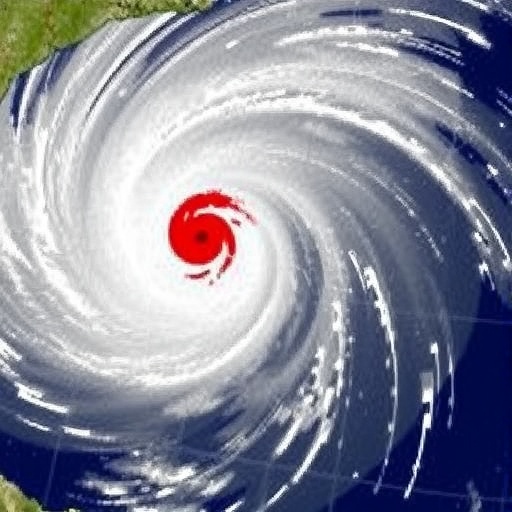

up (left) with those that stay leaning (right). Aligning storms have a stronger, more compact low-level circulation and more vigorous rising air near the low-level center, which helps pull the tilted storm upright.
view more
Credit: Michael S. Fischer, Ph.D.
Hurricane Hunter data reveal early signs of strengthening tropical cyclones
Nearly three decades of airborne radar observations identify four features that help storms align before they intensify
MIAMI — Before tropical cyclones can significantly strengthen, they generally must first become vertically aligned, with their rotating centers stacked through the atmosphere. New research using nearly three decades of NOAA Hurricane Hunter observations identifies four features that can help a tilted storm become aligned and more capable of intensifying.
Led by scientists at the University of Miami Rosenstiel School of Marine, Atmospheric, and Earth Science, and colleagues at NOAA’s Atlantic Oceanographic and Meteorological Laboratory, the study found that vertical alignment depends on a combination of storm structure, wind orientation and surrounding environmental conditions.
Rapidly intensifying storms can leave coastal residents and emergency managers with little time to prepare. A better understanding of these structural changes could help forecasters recognize when a disorganized tropical cyclone is more likely to strengthen, giving communities more time for evacuation decisions and other essential preparations.
“A tropical cyclone has to stand up straight before it can intensify,” said Michael S. Fischer, the lead author and an assistant professor in the Department of Atmospheric Sciences at the Rosenstiel School. “Strong winds higher in the atmosphere can push the top of a storm’s circulation away from the center near the ocean surface. Until those centers come back together, the storm usually cannot intensify substantially.”
Four features that favor alignment
The study identifies four features that help explain whether a tilted tropical cyclone is likely to become vertically aligned: a tight circulation near the sea surface; a tilt that is favorably oriented relative to wind shear; stronger upward motion and heavier rainfall near the low-level center; and warm ocean water, abundant atmospheric moisture and relatively weak midlevel winds.
Meteorologists refer to the separation between a storm’s lower- and middle-level circulation centers as “tilt.” Vertical wind shear, or changes in wind speed or direction at different heights, can disrupt storm organization by pushing those centers out of alignment.
The researchers analyzed observations from the Tropical Cyclone Radar Archive of Doppler Analyses with Recentering, known as TC-RADAR, a database developed by Fischer and colleagues that contains 1,510 radar analyses collected by NOAA Hurricane Hunter aircraft during 28 hurricane seasons from 1997 through 2024.
“The storms that aligned already looked different about a day beforehand,” said Fischer, who also is a core faculty member of the Frost Institute for Data Science and Computing. “They had stronger, more tightly wound circulations near the surface and more widespread, vigorous thunderstorms lifting air near that center. Our findings suggest those thunderstorms are not simply a sign of organization. They may also help pull the storm’s leaning circulation upright.”
Because reconnaissance aircraft can measure low-level wind strength, storm size, thunderstorm coverage and tilt direction during operational missions, the findings also provide a way to test whether high-resolution hurricane models accurately reproduce the alignment process.
“Even a modest increase in forecast confidence a day earlier can provide more usable preparation time for communities in a storm’s path,” Fischer said. “This study gives us real-world evidence about what separates a storm that is becoming organized from one that remains tilted and less capable of strengthening.”
The study, “To Align or Not to Align? That Is the Question,” was published in the Journal of Geophysical Research: Atmospheres. In addition to Fischer, the authors are George R. Alvey III of the Cooperative Institute for Marine and Atmospheric Studies and NOAA’s Atlantic Oceanographic and Meteorological Laboratory; Deelan Jariwala, who earned bachelor’s degrees in meteorology and mathematics from the University of Miami in spring 2026; and Paul D. Reasor of NOAA’s Atlantic Oceanographic and Meteorological Laboratory Hurricane Research Division.
The research was supported by the National Science Foundation under award No. 2241605.
ABOUT UNIVERSITY OF MIAMI
The University of Miami was established in 1925 as a private institution with a public mission: to transform the region and lives we touched. Today, we are a global force for breakthrough research, educational excellence, and life-changing opportunities. The University is a member of the Association of American Universities (AAU), with more than $521 million in research and sponsored program expenditures annually.
The University’s vibrant academic community comprises 12 schools and colleges serving more than 19,000 undergraduate and graduate students in more than 180 majors and programs. Located within one of the most dynamic and multicultural cities in the world, the University is building new bridges across geographic, cultural, and intellectual borders, bringing a passion for scholarly excellence, a spirit of innovation, a respect for including and elevating diverse voices, and a commitment to tackling the challenges facing our world. Together, we’re building the future.
Founded in the 1940s, the Rosenstiel School of Marine, Atmospheric, and Earth Science has grown into one of the world’s premier marine and atmospheric research institutions. Offering dynamic interdisciplinary academics, the Rosenstiel School is dedicated to helping communities to better understand the planet, participating in the establishment of environmental policies, and aiding in the improvement of society and quality of life.
Journal
Journal of Geophysical Research Atmospheres
Method of Research
Data/statistical analysis
Subject of Research
Not applicable
Article Title
To Align or Not to Align? That Is the Question
Article Publication Date
17-Jul-2026
COI Statement
None
Diana Udel
University of Miami Rosenstiel School of Marine, Atmospheric, and Earth Science
dudel@rsmas.miami.edu
Office: 305-421-4704
Cell: 786-256-4446
Journal
Journal of Geophysical Research Atmospheres
Method of Research
Data/statistical analysis
Subject of Research
Not applicable
Article Title
To Align or Not to Align? That Is the Question
Article Publication Date
17-Jul-2026
COI Statement
None
Tags
Cite Scienmag News
Violet Maxwell. (August 12, 2026). Hurricane Hunter Data Reveal Early Warning Signs of Tropical Cyclone Intensification. Scienmag. https://scienmag.com/hurricane-hunter-data-reveal-early-warning-signs-of-tropical-cyclone-intensification/
Violet Maxwell. "Hurricane Hunter Data Reveal Early Warning Signs of Tropical Cyclone Intensification." Scienmag, 12 August 2026, https://scienmag.com/hurricane-hunter-data-reveal-early-warning-signs-of-tropical-cyclone-intensification/. Accessed 3 September 2026.
Violet Maxwell. "Hurricane Hunter Data Reveal Early Warning Signs of Tropical Cyclone Intensification." Scienmag. August 12, 2026. https://scienmag.com/hurricane-hunter-data-reveal-early-warning-signs-of-tropical-cyclone-intensification/

