


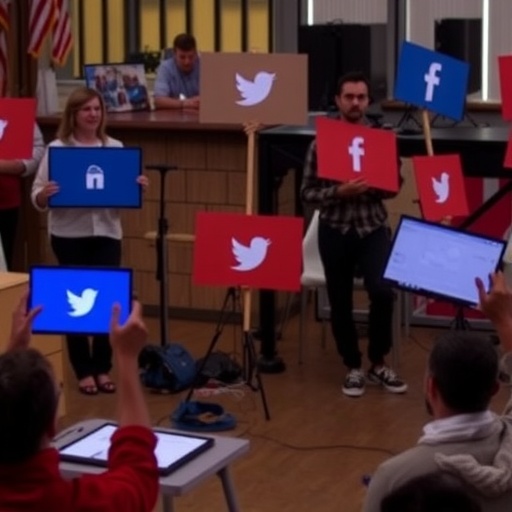
Social media have transformed how the world talks about climate change, but a major review of two decades of research suggests that their democratic promise has been only partly realized. Platforms such as X, TikTok, YouTube, Weibo, WeChat, Bilibili and ShareChat have lowered the technical barriers to publishing and sharing information. Yet the climate conversation remains heavily shaped by governments, political organizations, news outlets and other established institutions. At the same time, climate-change skeptics have gained a level of visibility that exceeds their representation among many other newly empowered voices.
The findings come from a systematic review by Mike S. Schäfer of the University of Zurich and Julia Metag of the University of Münster. Published in Nature Climate Change, the analysis examined international research on climate communication across a wide range of social media environments. Rather than treating “social media” as a single technological system, the researchers compared platforms with different algorithms, moderation policies, business models, user communities and political contexts. Their central conclusion is that there is no universal social-media effect on public understanding of climate change.
When social platforms first became widespread, researchers and advocates expected them to democratize climate communication. Anyone with an internet connection could, in principle, bypass traditional media gatekeepers, communicate directly with scientists and policymakers, organize campaigns and share local experiences of environmental change. Early studies found evidence that citizens, grassroots organizations, environmental movements and other civil-society groups were indeed becoming more visible. Social media also enabled rapid coordination during extreme weather events, environmental protests and political campaigns.
Over time, however, the structure of online attention proved more complicated. Established actors adapted quickly to the new environment and often possessed the resources needed to dominate it. Government agencies, politicians, professional communicators and news organizations can produce content at high volume, employ specialists and use paid promotion or sophisticated audience-targeting tools. Their messages are also more likely to be amplified by journalists, influencers and other high-reach accounts. As a result, social media have expanded the number of participants in climate discussions without necessarily distributing influence equally among them.
The review identifies a particularly important imbalance in the visibility of climate skepticism. Social platforms reward content that generates reactions, including anger, surprise and conflict. These engagement-based algorithms do not evaluate whether a claim is scientifically accurate before deciding how widely it should circulate. Posts that challenge established scientific findings can therefore receive disproportionate attention when they provoke controversy or encourage users to interact. Visibility is not the same as public support, but repeated exposure can make minority positions appear more common or credible than they are.
The researchers also warn that the next phase of online polarization may increasingly occur between platforms rather than only within them. Traditional studies of echo chambers have focused on users who encounter mostly like-minded content on the same service. Newer developments suggest that entire platform communities may be separating from one another. Changes in moderation and fact-checking policies, the rebranding of Twitter as X and the growth of alternative services such as Gab, 8kun, BitChute and Truth Social have encouraged some users to migrate into more ideologically homogeneous digital spaces.
This platform-level fragmentation could make it harder for societies to develop a shared understanding of climate risks. On a single platform, recommendation systems can already narrow the range of viewpoints a user sees. When users occupy separate platform ecosystems, the divisions can become structural: different communities may rely on different sources, interpret the same evidence through incompatible narratives and rarely encounter corrective information from outside their network. Even carefully designed climate messages may have limited impact if they never reach audiences living in a different information environment.
Climate journalism is facing a related double pressure. Digital advertising has shifted substantial revenue away from newspapers and broadcasters toward technology companies such as Meta and Google, weakening the financial foundations of many news organizations. At the same time, platform algorithms often give less prominence to posts containing links that take users to external websites. This can reduce traffic to professionally reported climate stories and make it more difficult for news organizations to convert online attention into sustainable income. The consequences may be most severe in countries with weak public-service broadcasting or fragile independent media sectors.
The review further shows that access to climate information is not evenly distributed according to interest. Highly engaged users can find an unprecedented amount of scientific material, including high-quality explanations, data visualizations and reporting. People who are less interested in climate change, however, may encounter the subject less often than they did through legacy media, whose editors once placed climate stories within general news schedules. Climate content remains a small proportion of overall social-media communication, far behind entertainment, lifestyle and personal-interest material. This creates a paradox: information has never been more available, yet it may be less likely to reach people who are not actively seeking it.
Whether social media improve climate knowledge remains unresolved. Research findings vary across countries and platforms, and users often overestimate how much they understand about climate change. The apparent effectiveness of a message depends on platform design, regulation, media systems, political conditions and existing public attitudes. What happens on X in the United States cannot automatically explain communication on Weibo in China or TikTok in another region. The researchers argue that future studies must therefore move beyond broad claims about social media and examine the specific digital ecosystems in which climate information is produced, recommended, disputed and consumed.
News Publication Date: 4-Aug-2026
Web References: https://doi.org/10.1038/s41558-026-02680-3
References: Schäfer, M. S., and Metag, J. “Social Media and the Changing Landscape of Climate Change Communication.” Nature Climate Change. DOI: 10.1038/s41558-026-02680-3
Cite Scienmag News
Courtney Benton. (August 11, 2026). Social Media Have Only Partly Democratized Climate Communication. Scienmag. https://scienmag.com/social-media-have-only-partly-democratized-climate-communication/
Courtney Benton. "Social Media Have Only Partly Democratized Climate Communication." Scienmag, 11 August 2026, https://scienmag.com/social-media-have-only-partly-democratized-climate-communication/. Accessed 4 September 2026.
Courtney Benton. "Social Media Have Only Partly Democratized Climate Communication." Scienmag. August 11, 2026. https://scienmag.com/social-media-have-only-partly-democratized-climate-communication/


