


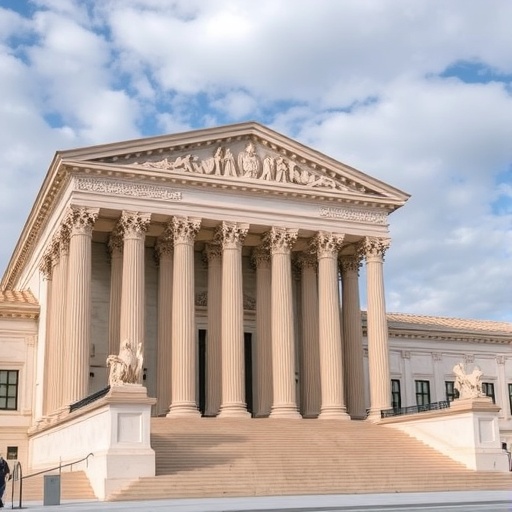
A new Viewpoint in JAMA argues that the United States’ public health system relies on a carefully balanced relationship between federal health agencies and state governments—and that this balance is being destabilized by recent Supreme Court decisions. The authors, led by Lawrence O. Gostin, JD, of Georgetown University’s O’Neill Institute for National and Global Health Law, warn that three recent rulings have weakened the independence of federal agencies, increased political control over their work, and narrowed the ability of states to adopt stronger protections when federal standards fall short.
The analysis describes federal and state regulation as parallel layers of protection rather than competing systems. Federal agencies establish nationwide requirements for areas such as food safety, infectious disease control, environmental health, workplace safety, pharmaceuticals, and medical devices. States, meanwhile, often serve as laboratories for public health policy, creating additional safeguards tailored to local conditions. This structure allows the country to maintain common minimum standards while permitting states to respond more aggressively to emerging threats.
That system depends heavily on administrative agencies, which translate broad congressional statutes into detailed technical rules. Agencies such as the Centers for Disease Control and Prevention, the Food and Drug Administration, the Environmental Protection Agency, and the Occupational Safety and Health Administration employ scientific experts who evaluate evidence, assess risks, consult stakeholders, and issue regulations. The process is designed to convert complex scientific findings into enforceable standards, although it also makes agencies vulnerable to political interference and legal challenges.
According to the Viewpoint, recent Supreme Court decisions have altered the legal environment in which these agencies operate. One major shift concerns the degree of deference courts give to agency interpretations of ambiguous statutes. For decades, the so-called Chevron framework allowed courts, in certain circumstances, to accept a reasonable agency interpretation when Congress had not clearly resolved a technical question. The Court’s rejection of that approach has transferred greater interpretive authority from specialized agencies to the judiciary, potentially making health regulations more difficult to develop and defend.
The authors argue that this change is not merely a technical dispute over administrative law. Public health rules frequently involve highly specialized questions, including acceptable levels of chemical exposure, vaccine safety monitoring, disease transmission, drug manufacturing, and the evaluation of statistical evidence. Federal judges may review these issues, but they generally do not have the same institutional expertise, scientific staff, or continuing responsibility for monitoring a health threat. Removing agency deference could therefore encourage more litigation and produce inconsistent interpretations of national health requirements.
The Viewpoint also highlights rulings that make it easier to challenge federal regulations and that constrain the mechanisms agencies use to enforce them. These decisions may expand the time available for regulated entities to bring lawsuits, increase judicial scrutiny of agency procedures, and limit the ability of agencies to impose penalties or resolve disputes internally. In practice, the authors say, such changes can delay implementation of protections even after agencies have completed scientific assessments and formal rule-making procedures.
Political control is another central concern. Federal health agencies are intended to operate under presidential oversight, but their credibility depends on a degree of professional independence. Scientists and regulators must be able to evaluate evidence, communicate risks, and enforce standards without pressure to produce politically convenient conclusions. The authors warn that when courts narrow agency authority while executive officials gain greater control over personnel and policy, public health decisions may become more vulnerable to short-term political priorities.
The consequences could extend beyond Washington. States often rely on federal rules as a baseline, but they also use their traditional public health powers to enact stronger protections. State authority has historically supported measures such as stricter tobacco controls, additional environmental requirements, expanded disease-reporting systems, and consumer protections that exceed federal minimums. The Viewpoint contends that recent judicial decisions have curtailed some of these state-level tools, making it harder for states to challenge federal decisions or supplement them with more protective policies.
This tension is especially important during national emergencies, when scientific evidence changes rapidly and governments must act before every question has been resolved. A federal agency may issue a temporary rule or emergency measure to reduce exposure to a pathogen, chemical, or unsafe product. If the rule is quickly blocked in court, or if states are prevented from adopting stronger measures, the result may be a regulatory gap during the period when protection is most urgently needed. The authors call for renewed attention to institutional design, scientific expertise, and the constitutional role of states in protecting population health.
The JAMA analysis does not portray federal agencies as immune from error or political accountability. Instead, it argues that oversight should improve agency performance without dismantling the expertise-based system that makes modern public health regulation possible. Gostin and colleagues suggest that Congress, courts, federal officials, and state governments must clarify their respective responsibilities and preserve meaningful avenues for evidence-based action. As legal battles over agency authority continue, the authors warn that the outcome will shape more than bureaucratic procedure: it may determine how quickly and effectively the United States can respond to the next infectious disease outbreak, environmental hazard, unsafe product, or public health emergency.
Web References: https://doi.org/10.1001/jama.2026.15473
References: Gostin LO et al. JAMA. DOI: 10.1001/jama.2026.15473.
Cite Scienmag News
Phoebe Ingram. (August 10, 2026). How the Supreme Court Is Dismantling Independent Science and Public Health Regulation. Scienmag. https://scienmag.com/how-the-supreme-court-is-dismantling-independent-science-and-public-health-regulation/
Phoebe Ingram. "How the Supreme Court Is Dismantling Independent Science and Public Health Regulation." Scienmag, 10 August 2026, https://scienmag.com/how-the-supreme-court-is-dismantling-independent-science-and-public-health-regulation/. Accessed 4 September 2026.
Phoebe Ingram. "How the Supreme Court Is Dismantling Independent Science and Public Health Regulation." Scienmag. August 10, 2026. https://scienmag.com/how-the-supreme-court-is-dismantling-independent-science-and-public-health-regulation/


