


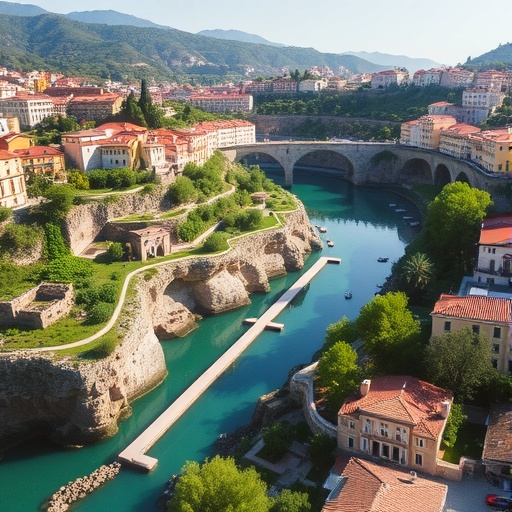
Cities across the Mediterranean are entering a dangerous new era of heatwaves, flash floods, drought and water scarcity. As concrete expands and climate extremes intensify, researchers are looking beyond seawalls, drainage tunnels and air-conditioning toward a different kind of urban infrastructure: nature itself. A new study of 12 Mediterranean cities identifies four pathways that can help nature-based solutions move from isolated experiments to mainstream climate adaptation—grounding, capitalising, embedding and anticipating.
Nature-based solutions, or NBS, use ecosystems and ecological processes to address social and environmental challenges. Urban forests can reduce surface temperatures through shade and evapotranspiration. Wetlands and restored waterways can slow stormwater, filter pollutants and reduce flood peaks. Green roofs can retain rainfall, improve building insulation and create habitat, while permeable pavements allow water to infiltrate the ground rather than overwhelm drainage systems. These interventions are often presented as simple additions to the city, but the study shows that their success depends on much more than planting trees or creating parks.
Writing in npj Urban Sustainability, researchers Eva Wolff, Katharina Hölscher and Niki Frantzeskaki examine how NBS become accepted, funded, governed and expanded across Mediterranean urban contexts. Their analysis focuses on the political and institutional processes that determine whether a promising project remains a one-off demonstration or becomes part of routine urban planning. The cities differ in climate, governance structures, development pressures and local priorities, yet they reveal recurring ways of building support for ecological adaptation.
The first pathway, grounding, is about connecting NBS to the specific realities of a place. Climate risks are not experienced uniformly: one neighbourhood may face extreme heat, another coastal flooding, and another water shortages or soil erosion. Grounding means linking an intervention to local landscapes, histories, communities and knowledge. A shaded public space, for example, is more likely to gain public support when it responds to residents’ daily exposure to heat, while a restored stream can become more valuable when it reconnects fragmented habitats and addresses recurring flood damage. This approach treats local context not as background information, but as the foundation of adaptation design.
The second pathway, capitalising, involves turning the multiple benefits of NBS into political, financial and social support. A green corridor may reduce temperatures, absorb stormwater, improve air quality, support biodiversity, provide recreation and increase the attractiveness of surrounding neighbourhoods. These benefits are technically connected but often managed by separate departments, budgets and professional communities. Capitalising on them requires making the value of these combined outcomes visible. Researchers point to the importance of communicating co-benefits, building coalitions and identifying funding mechanisms that recognise ecological infrastructure as an investment rather than an optional beautification project.
This is particularly significant because conventional infrastructure is often evaluated through narrowly defined performance indicators. A drainage pipe may be judged by how much water it carries, while a wetland must demonstrate flood protection, habitat value, public access and long-term maintenance to compete for funding. The study’s framework suggests that cities can strengthen the case for NBS by using broader assessment methods, including ecosystem-service analysis, climate-risk modelling, cost-benefit comparisons and distributional assessments. Such tools can reveal who benefits, who pays and whether a project reduces vulnerability or simply shifts climate risks elsewhere.
The third pathway, embedding, describes the integration of NBS into the rules and routines that shape urban development. Pilot projects can demonstrate technical feasibility, but mainstreaming requires changes to planning regulations, procurement systems, infrastructure standards, municipal strategies and maintenance responsibilities. It also requires coordination between departments that traditionally operate separately, including water management, transport, housing, parks, public health and emergency planning. Without this institutional embedding, green infrastructure may be vulnerable to political turnover, budget cuts or redevelopment pressures.
Embedding also raises questions about equity. New parks and attractive green corridors can improve health and reduce heat exposure, but they may also increase land values and contribute to displacement if housing protections are absent. A nature-based project that benefits one district while leaving another exposed does not automatically constitute fair adaptation. Mainstreaming therefore involves not only expanding the number of NBS projects, but also establishing procedures for participation, monitoring and accountability. The researchers’ approach places governance at the centre of ecological design, recognising that adaptation outcomes are produced through social decisions as much as through biological processes.
The fourth pathway, anticipating, focuses on preparing NBS for uncertain and changing futures. Mediterranean cities are likely to face combinations of hazards that are difficult to predict precisely. A tree species selected for today’s climate may struggle under future drought, while a coastal wetland may need room to migrate as sea levels rise. Anticipatory planning can address these uncertainties through scenario analysis, adaptive management and flexible designs. Instead of treating a project as a finished object, cities can monitor its performance, revise management practices and preserve space for future ecological change.
Together, the four pathways present mainstreaming as an ongoing process rather than a single policy decision. Grounding establishes relevance, capitalising builds support, embedding gives solutions institutional durability, and anticipating keeps them capable of responding to changing conditions. The framework also challenges the idea that NBS are universally beneficial by definition. Their effectiveness depends on design quality, ecological suitability, maintenance, governance and the distribution of benefits. As Mediterranean cities confront a rapidly warming climate, the study suggests that the most powerful urban adaptation may not come from choosing nature instead of technology, but from combining ecological systems with strong planning, finance and public institutions.
Cite Scienmag News
Gavin Prescott. (August 10, 2026). How 12 Mediterranean Cities Can Mainstream Nature-Based Solutions for Climate Adaptation. Scienmag. https://scienmag.com/how-12-mediterranean-cities-can-mainstream-nature-based-solutions-for-climate-adaptation/
Gavin Prescott. "How 12 Mediterranean Cities Can Mainstream Nature-Based Solutions for Climate Adaptation." Scienmag, 10 August 2026, https://scienmag.com/how-12-mediterranean-cities-can-mainstream-nature-based-solutions-for-climate-adaptation/. Accessed 4 September 2026.
Gavin Prescott. "How 12 Mediterranean Cities Can Mainstream Nature-Based Solutions for Climate Adaptation." Scienmag. August 10, 2026. https://scienmag.com/how-12-mediterranean-cities-can-mainstream-nature-based-solutions-for-climate-adaptation/


