


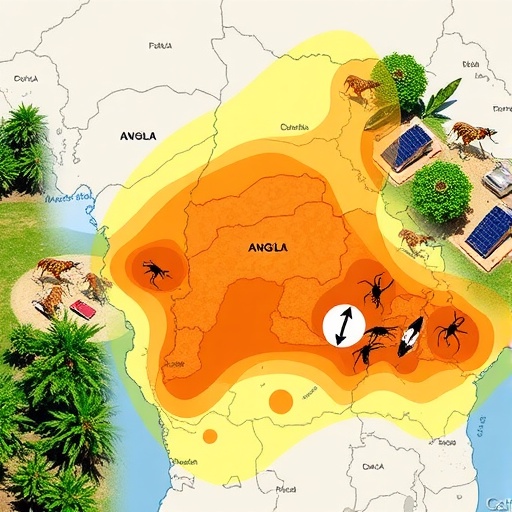
Dengue transmission has been documented along the border between the Democratic Republic of the Congo and Angola, where researchers also identified a remarkably diverse collection of viruses carried by local Aedes mosquitoes. The findings, reported by He, Bobanga, Piantadosi and colleagues in Nature Communications, provide new evidence that dengue is circulating in a region where surveillance has historically been limited and highlight the complex viral ecosystems maintained by mosquitoes beyond the pathogens routinely targeted by public-health programs.
Dengue is caused by four closely related but antigenically distinct viruses, known as dengue virus serotypes 1 through 4. Infection can produce anything from a mild, fever-like illness to severe dengue, in which increased vascular permeability, bleeding and shock can develop. The virus is transmitted primarily by Aedes aegypti and, in some settings, Aedes albopictus. These mosquitoes thrive in human-associated environments, breeding in small collections of stagnant water and moving efficiently between urban, peri-urban and rural communities.
The study’s focus on the Congo–Angola border is significant because border regions can act as epidemiological bridges. People, goods and animals move across them, while health systems and disease-reporting structures may differ on either side. In such settings, infections can circulate without being recognized as part of a sustained transmission chain. Detecting dengue virus or evidence of recent infection therefore does more than confirm individual cases: it can reveal an established, and potentially underdiagnosed, transmission ecology.
The researchers combined evidence from human and mosquito investigations to assess whether dengue transmission was occurring locally. Human surveillance can identify exposure through antibodies, molecular tests or clinical patterns, while mosquito surveillance can detect viral genetic material directly in the insects that transmit disease. Each approach answers a different question. Antibodies may persist after an infection has ended, whereas viral RNA in a mosquito points more directly to recent acquisition of virus, although detecting genetic material does not by itself prove that every infected mosquito is capable of transmitting it.
A central element of the work is its examination of the Aedes mosquito virome. The term virome refers to the complete collection of viruses associated with an organism or environment. In mosquitoes, this includes not only human pathogens such as dengue virus, but also insect-specific viruses, bacteriophages and other viral sequences whose biological roles remain poorly understood. Modern sequencing methods can recover fragments of this hidden viral diversity, allowing scientists to compare the viral communities found in mosquitoes from different locations and to search for known and previously uncharacterized viruses.
This broader perspective matters because mosquito-associated viruses may influence the behavior of important pathogens. Some insect-specific viruses can replicate in mosquito cells without infecting humans, yet they may compete with, inhibit or alter the replication of arboviruses such as dengue. Other members of the virome could affect mosquito physiology, immune responses or vector competence—the ability of a mosquito to acquire a virus, support its multiplication and transmit it during a later blood meal. These interactions are scientifically plausible but often difficult to demonstrate in field samples, making the characterization of local viromes an important first step.
The reported diversity also underscores how incomplete current knowledge remains about mosquito-borne viruses in Central Africa. A virus sequence recovered from a mosquito may represent a known lineage extending into a new geographic area, or it may belong to a deeply divergent group that has not previously been described. Genetic discovery does not automatically indicate a threat to humans. Determining zoonotic potential requires additional work, including genome analysis, laboratory culture where possible, tissue studies and epidemiological investigation. Nevertheless, cataloguing these viruses creates a baseline for recognizing future changes.
For public-health authorities, the findings support a shift from disease response toward integrated surveillance. Dengue monitoring based only on patients presenting with fever is likely to miss infections because symptoms overlap with malaria, chikungunya, yellow fever and other febrile illnesses. Combining clinical testing with mosquito sampling, viral sequencing and environmental monitoring can provide earlier warning of transmission. It can also help distinguish imported infections from local spread, an essential distinction for deciding whether vector-control measures should be intensified around households, markets, transport routes or health facilities.
The study also illustrates why genomic surveillance is becoming increasingly important in viral science. Sequencing can identify viral lineages, reveal genetic relationships between samples and detect changes that may affect transmission or diagnostic performance. Yet genomic data are most powerful when linked to reliable field information, including the mosquito species collected, location, season, host contact and clinical status of nearby communities. The Congo–Angola border investigation brings these strands together, showing how pathogen detection and virome research can illuminate the same transmission landscape from different angles.
Evidence of dengue transmission in this region does not mean that a large outbreak is inevitable, but it does signal a need for sustained attention. Climate, urban growth, mobility and changing patterns of water storage can all influence Aedes populations and the movement of dengue virus. By documenting both the presence of dengue and the broader viral communities carried by mosquitoes, the researchers provide a foundation for more precise surveillance and future studies into how local ecological conditions shape arbovirus emergence. The message is clear: understanding dengue risk requires looking not only for one virus, but also at the mosquito ecosystems that allow it to persist.
Cite Scienmag News
Kristina Jarvis. (August 10, 2026). Dengue Transmission Evidence and Diverse Aedes Mosquito Virome Found on Congo-Angola Border. Scienmag. https://scienmag.com/dengue-transmission-evidence-and-diverse-aedes-mosquito-virome-found-on-congo-angola-border/
Kristina Jarvis. "Dengue Transmission Evidence and Diverse Aedes Mosquito Virome Found on Congo-Angola Border." Scienmag, 10 August 2026, https://scienmag.com/dengue-transmission-evidence-and-diverse-aedes-mosquito-virome-found-on-congo-angola-border/. Accessed 4 September 2026.
Kristina Jarvis. "Dengue Transmission Evidence and Diverse Aedes Mosquito Virome Found on Congo-Angola Border." Scienmag. August 10, 2026. https://scienmag.com/dengue-transmission-evidence-and-diverse-aedes-mosquito-virome-found-on-congo-angola-border/


