


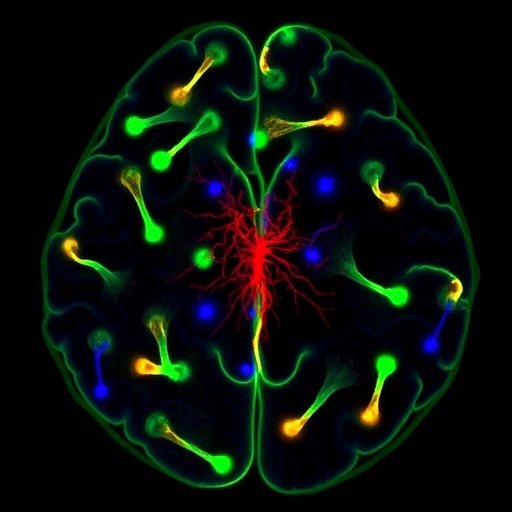
A new study has identified and characterized a population of cells in the brain’s subventricular zone that may resemble the cells thought to initiate glioblastoma, the most aggressive primary brain tumor in adults. The findings, reported by Oh, Choi, Jo and colleagues in Experimental & Molecular Medicine, offer a closer look at a possible cellular reservoir linked to glioblastoma development. Although the researchers describe the cells as “putative” origin-like cells, the work raises important questions about how tumors arise, recur and resist treatment within the brain’s own tissue environment.
Glioblastoma is notorious for its rapid growth, invasive behavior and limited response to current therapies. Surgery, radiation and chemotherapy can reduce the visible tumor burden, but malignant cells often infiltrate surrounding brain tissue, making complete removal difficult. The disease also frequently returns after treatment. Scientists have increasingly focused on tumor-initiating cells, often called glioblastoma stem-like cells, because these cells may possess the ability to self-renew, generate diverse tumor cell populations and survive conditions that eliminate more differentiated cancer cells.
The subventricular zone, or SVZ, is a narrow region lining the lateral ventricles of the brain. It is one of the areas most closely associated with neural stem and progenitor cells, particularly in experimental models and during specific stages of human brain development. These cells can divide, migrate and produce different neural cell types. Because of their long-term self-renewal capacity and proximity to regions connected by brain fluid pathways, researchers have proposed that the SVZ could provide a cellular or environmental context in which malignant transformation occurs.
The new research addresses this possibility by focusing on cells isolated from the SVZ and examining whether they display characteristics associated with glioblastoma origin or tumor-initiating populations. Isolation is a critical step in this type of investigation because brain tissue contains many cell types, including mature neurons, glial cells, vascular cells, immune cells and resident progenitors. Separating a rare population from this complex mixture allows researchers to study its growth behavior, morphology and molecular profile without immediately conflating normal neural stem cells with cancer cells.
Characterization of such cells typically involves several complementary approaches. Researchers may assess whether cells can survive and expand under defined culture conditions, form stem-like clusters, or generate progeny with different cellular features. They may also examine the expression of proteins associated with neural stemness, glial identity, proliferation and malignancy. Molecular comparisons with established glioblastoma cells or tumor specimens can help determine whether the isolated population shares a meaningful biological signature with cancer-associated cells. The value of the study lies in combining these observations rather than relying on a single marker.
The term “origin-like” is especially important. It does not establish that the isolated SVZ cells directly give rise to glioblastoma in patients. Demonstrating a true cell of origin requires evidence that a defined normal cell population undergoes specific genetic or epigenetic changes and initiates tumors in appropriate experimental systems. Similarities in morphology, growth or gene expression can indicate developmental relationships, but they cannot by themselves prove a direct lineage. The authors’ cautious wording reflects the complexity of distinguishing a normal neural precursor from a transformed cell with tumor-forming potential.
The findings are nevertheless significant because glioblastoma biology may depend not only on mutations within tumor cells but also on the tissue in which those cells emerge. The SVZ contains signaling molecules, extracellular structures and neighboring cells that can influence proliferation and differentiation. If a subset of SVZ cells is unusually susceptible to malignant transformation, or if the local environment supports the survival of early tumor cells, that could help explain why glioblastoma sometimes appears near ventricular regions and why infiltrating disease can extend along anatomically connected pathways.
A better understanding of these cells could also influence the search for new treatments. Conventional therapies often target rapidly dividing tumor cells, while stem-like populations may remain relatively resistant because they divide slowly, repair DNA damage efficiently or occupy protective microenvironments. Identifying the signals that maintain SVZ-derived, glioblastoma-like cells could reveal vulnerabilities distinct from those found in the bulk tumor. Future strategies might aim to block self-renewal pathways, disrupt interactions with surrounding brain cells, or force malignant stem-like cells into states that make them more sensitive to treatment.
The study may also provide a useful experimental platform for investigating glioblastoma before a fully developed tumor forms. Patient-derived models often capture advanced disease, but they can make it difficult to reconstruct the earliest steps of transformation. Cells with origin-like properties could allow researchers to compare normal neural progenitors, pre-malignant populations and established tumor cells under controlled conditions. Such comparisons could clarify which molecular changes initiate malignancy, which changes support invasion and which are acquired later as the tumor adapts to therapy.
The researchers emphasize a promising but still incomplete link between the SVZ and glioblastoma biology. Their work does not redefine the disease as originating from one universal cell type, nor does it imply that every SVZ neural stem cell is at risk of becoming cancerous. Instead, it adds evidence that specific cells in this specialized brain region may share properties with glioblastoma-initiating populations. Confirming their role will require lineage-tracing studies, genomic analysis, transplantation experiments and validation in patient samples. For now, the discovery strengthens a growing scientific focus on where glioblastoma begins—and on the rare cells that may allow it to return.
Cite Scienmag News
Cassandra Pierce. (August 7, 2026). Scientists isolate and characterize putative glioblastoma-origin cells from the brain’s subventricular zone. Scienmag. https://scienmag.com/scientists-isolate-and-characterize-putative-glioblastoma-origin-cells-from-the-brains-subventricular-zone/
Cassandra Pierce. "Scientists isolate and characterize putative glioblastoma-origin cells from the brain’s subventricular zone." Scienmag, 7 August 2026, https://scienmag.com/scientists-isolate-and-characterize-putative-glioblastoma-origin-cells-from-the-brains-subventricular-zone/. Accessed 5 September 2026.
Cassandra Pierce. "Scientists isolate and characterize putative glioblastoma-origin cells from the brain’s subventricular zone." Scienmag. August 7, 2026. https://scienmag.com/scientists-isolate-and-characterize-putative-glioblastoma-origin-cells-from-the-brains-subventricular-zone/


