


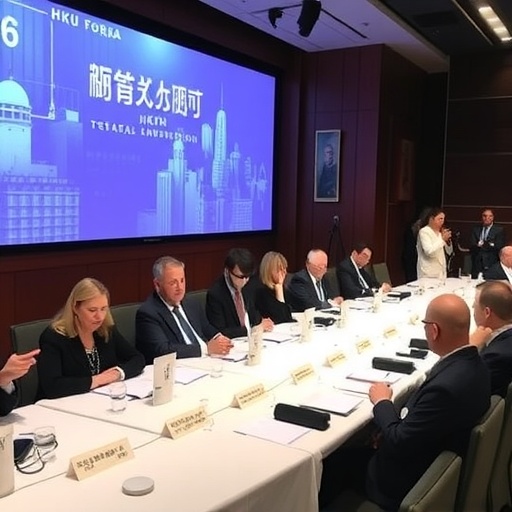
At a time when artificial intelligence, export controls and geopolitical tensions are reshaping the world economy, more than 10,000 online participants joined the 11th HKU Quarterly Forum on Chinese Economy to examine whether technological innovation can create a new model of growth for China. Hosted by the Institute of China Economy at the University of Hong Kong’s Business School in partnership with the Shanghai Jiao Tong University Hong Kong Alumni Association, the forum was held on 31 July at HKU iCube in Central, Hong Kong. More than 400 business leaders, academics, alumni and students attended in person or registered for the event.
The forum focused on “Technological Innovation, Opening-up, and New Logic of Economic Growth,” a theme shaped by intensifying competition over advanced technologies and what economists describe as K-shaped economic divergence. The term refers to an economy in which different sectors, regions or groups move in sharply different directions: some experience rapid expansion while others stagnate or decline. In China, the contrast is increasingly visible between high-tech industries, which continue to attract investment and policy support, and traditional drivers such as consumption, property development and infrastructure investment, which remain under pressure.
Professor Hongbin Cai, Dean of HKU Business School and Director of the Institute of China Economy, said the forum had developed into an influential platform for interpreting China’s economic policies and their consequences. He emphasised the importance of timely analysis, open discussion and collaboration among academics, policymakers and business leaders. The forum’s wider objective is to connect economic research with practical decision-making while using Hong Kong as a base for examining both mainland China’s development and its expanding role in the global economy.
The event’s keynote report was delivered by Professor Zhenhua Mao, Professor of Practice in Economics at HKU Business School and a member of the Chief Executive’s Policy Unit Expert Group in the Hong Kong Special Administrative Region. His presentation, titled “The Dual Effects of Technology and Policy Coordination under K-Shaped Divergence — Can Technology Reshape the New Logic of China’s Economic Growth?”, examined the limits as well as the benefits of rapid technological progress.
Mao argued that China’s high-tech industries have shown substantial growth, but that this expansion has not yet provided sufficient support for weaker parts of the economy. Advanced manufacturing, artificial intelligence and other technology-intensive sectors can raise productivity by allowing companies to produce more output with fewer resources. However, productivity gains are not automatically transmitted to industries facing weak demand, excessive debt or falling property investment. The result can be a widening gap between technologically advanced sectors and the traditional economy.
Artificial intelligence may intensify this division. While AI can improve efficiency, automate routine tasks and accelerate research, its adoption can also place pressure on workers whose jobs are vulnerable to technological substitution. Mao therefore cautioned that technology alone cannot resolve structural problems such as subdued domestic consumption and mounting debt burdens. He called for technological development and macroeconomic policy to reinforce each other, with conventional tools—including fiscal measures, interest-rate policy and targeted support for traditional sectors—continuing to play a role alongside innovation.
The forum also addressed how Chinese companies are adapting to a more fragmented global technology system. Professor Heiwai Tang, Associate Vice-President (Global) of the University of Hong Kong, Associate Dean for External Relations at HKU Business School and Victor and William Fung Professor in Economics, described a new strategy combining domestic capability building with overseas expansion. As export controls on high-tech products become increasingly important instruments of geopolitical competition, Chinese enterprises are investing more heavily in research and development, strengthening local supply chains and pursuing domestic substitution.
At the same time, many companies are expanding their international operations to diversify geopolitical and commercial risks. Tang noted a growing preference for greenfield investment, in which firms construct new factories and production capacity from the ground up rather than acquiring existing businesses. Although this approach often requires more time and capital, it may be more acceptable to host governments because it creates new employment, infrastructure and industrial capacity. The combination of stronger domestic supply chains and wider overseas networks could allow Chinese enterprises to remain competitive while reducing their exposure to disruption in any single market.
Financial markets formed another major part of the discussion. Professor Jie Hu, Professor of Practice at the Shanghai Advanced Institute of Finance, Director of the FinTech Innovation Base in Nanjing and Executive Director of the Southeast Asia Centre, examined how the United States Federal Reserve’s monetary framework has shaped global finance since the 2008 financial crisis. When conventional interest-rate reductions were no longer sufficient to stabilise markets, the Fed introduced quantitative easing, purchasing financial assets to inject liquidity and lower borrowing costs.
According to Hu, repeated rounds of quantitative easing, combined with changes in interest rates, expanded the amount of money held within the financial sector and helped support an extended rise in US equities. He argued that this effect went beyond the Fed’s statutory objectives of price stability and maximum employment. Hu expects the central bank eventually to reduce its balance sheet and move closer to the pre-2008 framework, in which interest-rate management was the principal policy instrument. The timing and direction of future rate changes, however, will depend on incoming economic data and decisions by the Federal Open Market Committee.
A roundtable moderated by Cai brought together Professor Min Song of Shenzhen University of Advanced Technology, Dr Yong Kang of the Beijing ByteDance Research Institute, Dr Mo Ji of DBS Bank, Dr Xiangrong Yu of Citigroup and Dr Le Xia of BBVA Research and the International Monetary Institute at Renmin University of China. Their discussion explored China’s macroeconomic trajectory, the future of high-tech industries and the rapid expansion of AI. The speakers also considered China’s position in a changing international order and the implications for global growth. The central message of the forum was that technology is becoming an essential engine of economic development, but its benefits will depend on demand, labour-market adjustment, financial stability and policies capable of connecting the digital economy with the sectors that remain under strain.
Web References: https://drive.google.com/drive/folders/1Bwe-sCaiLe0veJYQYbWIqo6WjbZClyAb?usp=sharing
Cite Scienmag News
Courtney Benton. (August 5, 2026). HKU Forum Explores China’s Next Growth Phase Through Innovation and Opening-Up. Scienmag. https://scienmag.com/hku-forum-explores-chinas-next-growth-phase-through-innovation-and-opening-up/
Courtney Benton. "HKU Forum Explores China’s Next Growth Phase Through Innovation and Opening-Up." Scienmag, 5 August 2026, https://scienmag.com/hku-forum-explores-chinas-next-growth-phase-through-innovation-and-opening-up/. Accessed 4 September 2026.
Courtney Benton. "HKU Forum Explores China’s Next Growth Phase Through Innovation and Opening-Up." Scienmag. August 5, 2026. https://scienmag.com/hku-forum-explores-chinas-next-growth-phase-through-innovation-and-opening-up/


