


Researchers from the RIKEN Center for Brain Science (CBS) in Japan have discovered a region of the brain that encodes where an animal is planning to be in the near future. Linked to internal maps of spatial locations and past movements, activity in the newly discovered grid cells accurately predicts future locations as an animal travels around its environment. Published in Science on August 15, the study helps explain how planned spatial navigation is possible.
It might seem effortless, but navigating the world requires quite a bit of under-the-hood brain activity. For example, simply walking around a supermarket picking up groceries requires internalized maps of the outside world, information about one’s own changing position and speed, and memories about where one has been and what one is trying to buy.
Much of this kind of information is contained in cells within two connected parts of the brain – the hippocampus and the medial entorhinal cortex, or MEC for short – which are extremely similar in all mammals, from rats to humans. In particular, the MEC contains maps of an animal’s current location in space, a discovery that won the Nobel Prize for Physiology or Medicine in 2014.
The new study focuses on the MEC, but not on the stored information needed for spatial navigation or an animal’s current location. Instead, the experiments performed by Shigeyoshi Fujisawa and Ayako Ouchi from RIKEN CBS concentrate on how this brain region creates maps of future positions, which are continuously updated as animals move. While rats traversed an open square field in search of freely available water that was moved around to different locations, the researchers recorded all movements, which included hundreds of trajectories. At the same time, they recorded the activity from individual brain cells in the MEC. Afterward, they checked how well the brain activity over time matched the rats’ changing positions.
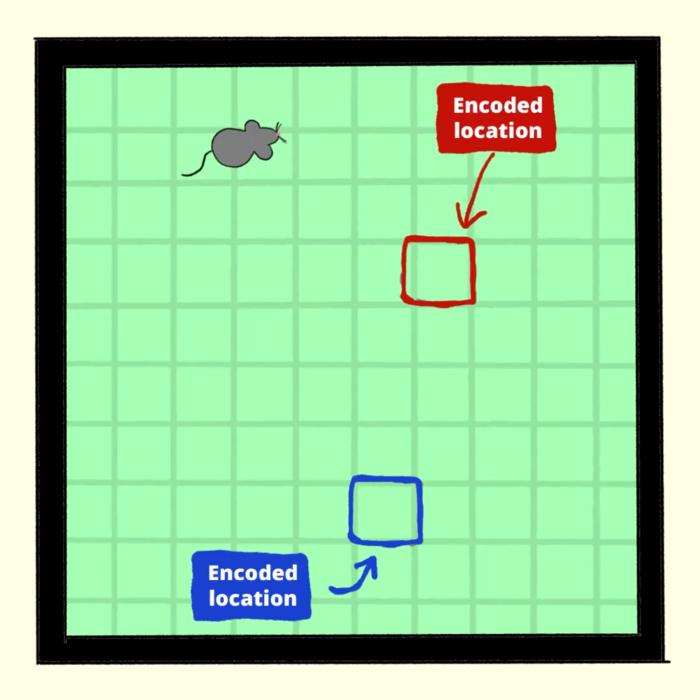
They found that the activity of some brain cells in the MEC created an internal grid that mapped future positions within the field. For example, an MEC cell might encode a certain location in the field, but only when a rat reached a spot 30 cm to 40 cm earlier in a route that eventually crossed that location—regardless of which direction the rat was coming from. This is very different from the grid cells that helped win the Nobel Prize, which become active only when an animal is currently in a particular location. The authors call the newly discovered neurons “predictive grid cells”, and conducted several follow up experiments to get a better idea of what exactly they encode.
First, they tested whether the newly discovered grid cells predicted the future location in terms of distance or time from the present. They found that both were encoded, although the “gridness” of the cells was higher when considering distance. They also found that future positions were faithfully encoded in different situations, whether the rats were trying to go to specific targets or if they were randomly foraging for food. This means that the function of the predictive grid cells is not limited to goal-directed behavior.
“This study provides important insights into the mechanisms of spatial navigation and episodic memory formation in hippocampal and entorhinal cortical circuits,” says Fujisawa. “In the future, we would like to clarify the mechanism by which such predictive grid cells are organized.”

Credit: RIKEN
Researchers from the RIKEN Center for Brain Science (CBS) in Japan have discovered a region of the brain that encodes where an animal is planning to be in the near future. Linked to internal maps of spatial locations and past movements, activity in the newly discovered grid cells accurately predicts future locations as an animal travels around its environment. Published in Science on August 15, the study helps explain how planned spatial navigation is possible.
It might seem effortless, but navigating the world requires quite a bit of under-the-hood brain activity. For example, simply walking around a supermarket picking up groceries requires internalized maps of the outside world, information about one’s own changing position and speed, and memories about where one has been and what one is trying to buy.
Much of this kind of information is contained in cells within two connected parts of the brain – the hippocampus and the medial entorhinal cortex, or MEC for short – which are extremely similar in all mammals, from rats to humans. In particular, the MEC contains maps of an animal’s current location in space, a discovery that won the Nobel Prize for Physiology or Medicine in 2014.
The new study focuses on the MEC, but not on the stored information needed for spatial navigation or an animal’s current location. Instead, the experiments performed by Shigeyoshi Fujisawa and Ayako Ouchi from RIKEN CBS concentrate on how this brain region creates maps of future positions, which are continuously updated as animals move. While rats traversed an open square field in search of freely available water that was moved around to different locations, the researchers recorded all movements, which included hundreds of trajectories. At the same time, they recorded the activity from individual brain cells in the MEC. Afterward, they checked how well the brain activity over time matched the rats’ changing positions.
They found that the activity of some brain cells in the MEC created an internal grid that mapped future positions within the field. For example, an MEC cell might encode a certain location in the field, but only when a rat reached a spot 30 cm to 40 cm earlier in a route that eventually crossed that location—regardless of which direction the rat was coming from. This is very different from the grid cells that helped win the Nobel Prize, which become active only when an animal is currently in a particular location. The authors call the newly discovered neurons “predictive grid cells”, and conducted several follow up experiments to get a better idea of what exactly they encode.
First, they tested whether the newly discovered grid cells predicted the future location in terms of distance or time from the present. They found that both were encoded, although the “gridness” of the cells was higher when considering distance. They also found that future positions were faithfully encoded in different situations, whether the rats were trying to go to specific targets or if they were randomly foraging for food. This means that the function of the predictive grid cells is not limited to goal-directed behavior.
“This study provides important insights into the mechanisms of spatial navigation and episodic memory formation in hippocampal and entorhinal cortical circuits,” says Fujisawa. “In the future, we would like to clarify the mechanism by which such predictive grid cells are organized.”
Journal
Science
Article Title
Predictive grid coding in the medial entorhinal cortex
Article Publication Date
16-Aug-2024
Cite Scienmag News
Cassandra Pierce. (August 15, 2024). Navigating the future: brain cells that plan where to go. Scienmag. https://scienmag.com/navigating-the-future-brain-cells-that-plan-where-to-go/
Cassandra Pierce. "Navigating the future: brain cells that plan where to go." Scienmag, 15 August 2024, https://scienmag.com/navigating-the-future-brain-cells-that-plan-where-to-go/. Accessed 5 September 2026.
Cassandra Pierce. "Navigating the future: brain cells that plan where to go." Scienmag. August 15, 2024. https://scienmag.com/navigating-the-future-brain-cells-that-plan-where-to-go/

