


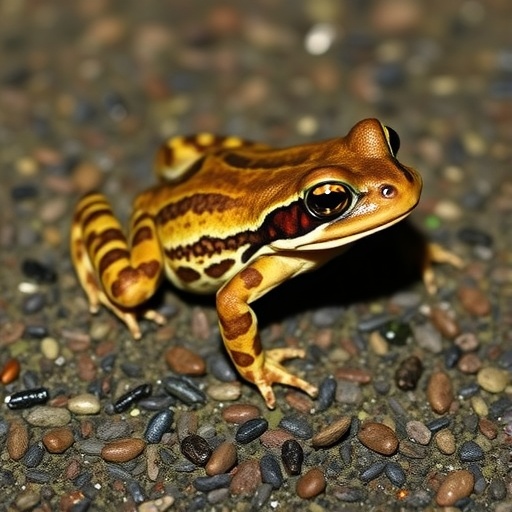
Los Angeles has yielded a new Ice Age species from one of its most famous fossil sites: a spadefoot toad that lived in the region thousands of years ago, long before the city’s streets, skyscrapers, and freeways transformed the landscape. Named Spea labreae, the extinct amphibian was identified in the long-studied collections of the La Brea Tar Pits, where its small bones had remained largely overlooked since they were excavated in the 1950s. The discovery adds a rare amphibian to the North American Pleistocene fossil record and offers scientists a new window into the environmental conditions that shaped Los Angeles at the end of the last Ice Age.
The species is described in the Journal of Vertebrate Paleontology by Dr. Alberto Cruz, a paleoecologist and paleogeographer who reviewed the Tar Pits’ understudied reptiles and amphibians while working as a postdoctoral fellow at La Brea Tar Pits. Cruz did not initially suspect that he was looking at an unknown animal. The unusual features of one specimen appeared so distinctive that he first considered whether the toad had suffered an injury or disease during its lifetime. Only after comparing the fossil material repeatedly with modern spadefoot toads did he conclude that the differences represented a previously unrecognized species.
“I’m really more of a paleoecologist, paleogeographer, not a taxonomist,” Cruz said, explaining that the discovery emerged unexpectedly during a broader review of the collection. The fossil material was originally collected decades ago, but detailed anatomical comparisons revealed characteristics that had escaped earlier investigations. Cruz examined the shape and size of the bones and compared the La Brea specimens with approximately 80 modern amphibian specimens held by the Natural History Museum of Los Angeles County and the Museum of Vertebrate Zoology at the University of California, Berkeley. The analysis distinguished S. labreae from the living spadefoot toad that inhabits the region today, Spea hammondii.
Although the new toad was far smaller than the mammoths, ground sloths, and saber-toothed cats associated with La Brea, its scientific importance may be considerably larger than its size suggests. Amphibians are highly sensitive to temperature, moisture, vegetation, and the availability of suitable breeding habitats. They also tend to have small home ranges, meaning that their presence in a fossil deposit can provide unusually localized information about past environmental conditions. For paleontologists, frogs and toads can therefore function as biological climate indicators, revealing ecological changes that may be difficult to detect from large, wide-ranging mammals alone.
The anatomy and distribution of Spea labreae point to an ecosystem unlike modern Los Angeles. Spadefoot toads are adapted to environments in which seasonal rainfall creates temporary pools, allowing them to reproduce rapidly before the water disappears. A species restricted to a particular combination of soil, moisture, temperature, and vegetation can vanish when those conditions change. The extinction of S. labreae therefore suggests that the habitats surrounding Rancho La Brea were reorganized as the Pleistocene ended and Southern California shifted toward the ecological conditions seen today.
The study also reports the first fossil record of the Mexican burrowing toad, Rhinophrynus, from the southwestern United States. Living members of this lineage are absent from modern Los Angeles, and their nearest populations occur nearly 2,500 kilometers away in southern Mexico. Finding evidence of the group in Ice Age Los Angeles indicates that its historical range once extended dramatically farther north. Together, the northward ancient presence of Rhinophrynus and the disappearance of S. labreae describe a complex ecological transition rather than a simple story of warming or cooling.
That transition is especially significant because amphibians are poorly represented in most fossil deposits. Their skeletons are delicate and often decay or are destroyed before burial. Asphaltic environments such as the La Brea Tar Pits can preserve fragile remains that would rarely survive elsewhere, trapping and protecting bones alongside the remains of much larger animals. Even so, the discovery of an entirely new Pleistocene amphibian is extraordinary. Before S. labreae, only one other extinct Pleistocene amphibian species had been identified from North America: a tree frog from Florida.
Researchers believe the La Brea collections may contain more surprises. The specimens analyzed by Cruz had been available for decades, yet the amphibian and reptile material had not received a comprehensive assessment in nearly 30 years. This underscores how museum collections can continue generating discoveries long after excavation ends. New imaging technologies, quantitative comparisons, and renewed taxonomic work may reveal additional species or clarify how ancient amphibian populations responded to environmental upheaval.
The discovery arrives as La Brea Tar Pits begins a major transformation through the Samuel Oschin Global Center for Ice Age Research, founded in 2026 with support from the Mr. and Mrs. Samuel Oschin Family Foundation. The center will combine excavation, laboratory analysis, collections management, and public education within Hancock Park and the George C. Page Museum. For scientists, Spea labreae is more than a new name in a catalog: it is evidence that even a century after research began at La Brea, the site still contains biological stories capable of reshaping our understanding of climate change, extinction, and the future of sensitive species.
News Publication Date: 5 August 2026
Web References: https://doi.org/10.1080/02724634.2026.2689465
References: Journal of Vertebrate Paleontology; DOI: 10.1080/02724634.2026.2689465
Cite Scienmag News
Violet Maxwell. (August 5, 2026). New Ice Age spadefoot toad species discovered at La Brea Tar Pits. Scienmag. https://scienmag.com/new-ice-age-spadefoot-toad-species-discovered-at-la-brea-tar-pits/
Violet Maxwell. "New Ice Age spadefoot toad species discovered at La Brea Tar Pits." Scienmag, 5 August 2026, https://scienmag.com/new-ice-age-spadefoot-toad-species-discovered-at-la-brea-tar-pits/. Accessed 3 September 2026.
Violet Maxwell. "New Ice Age spadefoot toad species discovered at La Brea Tar Pits." Scienmag. August 5, 2026. https://scienmag.com/new-ice-age-spadefoot-toad-species-discovered-at-la-brea-tar-pits/


