


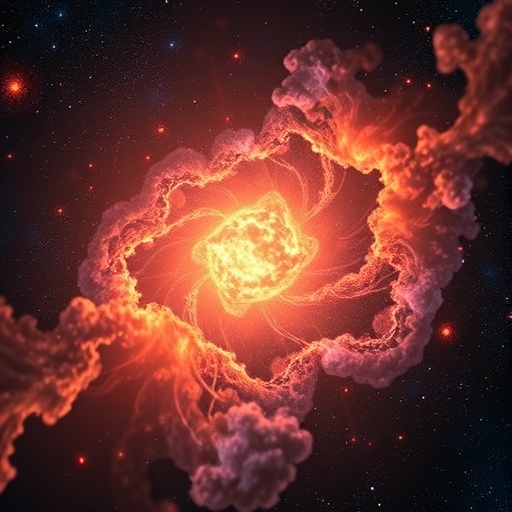
A hidden reservoir of gas surrounding dense stellar filaments may be helping build the largest stars in the Milky Way, according to a new study from Kyushu University. Researchers have found that diffuse, lower-density gas between the filaments of the Monoceros R2 star-forming region is not simply an inactive background. Instead, it appears to stream toward the region’s central hub, while also feeding material sideways into denser filaments. By tracing these previously overlooked flows, the team estimates that the hub may be receiving about 50 percent more material than earlier calculations suggested.
Stars are born inside enormous clouds of gas and dust, but the process by which these clouds gather enough material to produce massive stars remains one of astronomy’s major unanswered questions. Within many stellar nurseries, the gas is organized into long, thread-like structures called filaments. Several filaments can converge on a compact, dense region known as a hub. These hubs act as gathering points for material and are often where clusters—and particularly massive stars—begin to emerge. Astronomers have long suspected that gas travels along the filaments toward these hubs, but the spaces between the filaments have received far less attention.
The new research focuses on Monoceros R2, a nearby stellar nursery with a striking hub–filament structure. Led by Assistant Professor Jihye Hwang of Kyushu University’s Institute for Advanced Study, the team worked with Associate Professor Doris Arzoumanian and an international group of researchers to map the movement of gas across the system. Their findings, published in The Astrophysical Journal Letters on June 10, 2026, offer one of the clearest observational indications yet that inter-filament gas can actively participate in the assembly of star-forming hubs.
To distinguish gas at different densities, the researchers used observations of two carbon monoxide isotopes, ^13CO and C^18O, collected with the Nobeyama 45-meter radio telescope in Japan. Carbon monoxide molecules emit radio waves at characteristic frequencies, allowing astronomers to determine where gas is located and how it is moving. The two isotopes are useful because they trace somewhat different environments: C^18O is more closely associated with relatively dense gas, while ^13CO can reveal more extended and diffuse material. Combining both tracers enabled the researchers to examine not only the prominent filaments, but also the gas surrounding them.
The analysis identified three dense filaments and three inter-filament regions within Monoceros R2. Gas inside the dense filaments was found to move toward the central hub considerably faster than gas in the surrounding areas. This difference suggests that the filaments act as efficient channels, funneling material inward under the influence of gravity and the overall structure of the cloud. But the observations also revealed a second process: at least 30 percent of the gas in the inter-filament regions appears to be moving sideways into neighboring filaments.
That lateral movement could be crucial to the long-term growth of the system. Rather than flowing directly into the hub, some diffuse gas first enters a dense filament, replenishing the material that the filament loses as it streams inward. The gas can therefore take a two-stage journey: it moves from the broad, low-density environment into a filament and then continues along the filament toward the hub. Other portions may travel directly toward the central region. When both pathways are included, the estimated mass inflow onto the hub rises by approximately 50 percent compared with estimates based only on the dense filaments.
“Previous studies mainly focused on the dense filaments because complementary observations tracing the diffuse gas were not included in their analysis,” Hwang said. “Our combined analysis based on observations tracing both the dense gas, using C^18O, and the diffuse gas, using ^13CO, shows that the inter-filamentary diffuse gas also contributes significantly to feeding the hub, either directly or by first replenishing the dense filaments.”
The result changes the way astronomers may need to think about the architecture of stellar nurseries. The visible filaments are not necessarily isolated structures that formed and evolved independently. They may instead be embedded within a larger, connected flow of gas, with diffuse material continuously supplying them from the surrounding cloud. This means that the mass available for star formation may be distributed across a far wider region than the brightest, densest structures suggest. A cloud that appears to contain only modest amounts of dense gas could still possess a substantial reservoir capable of sustaining star formation.
The researchers also examined dense cores, compact concentrations of gas that can collapse under their own gravity to form individual stars. Cores located inside the hub were generally more massive and warmer than those found outside it. These properties are consistent with an environment where gas is continuously accumulating, increasing the pressure and density needed to support the birth of higher-mass stars. The findings suggest that the hub’s ability to produce massive stars may depend not only on what is already concentrated inside it, but also on the ongoing delivery of fresh material from the surrounding cloud.
The team cautions that Monoceros R2 is a single system, and further observations will be needed to determine how common this pattern is throughout the Galaxy. Studies of additional hub–filament regions, combined with computer simulations of gravitational gas flows, could reveal whether sideways replenishment and direct diffuse inflow are widespread features of star formation. For now, the study provides a more complete picture of how stellar nurseries grow: the dense filaments may be the visible highways to a star-forming hub, but the diffuse gas between them may be the larger supply network that keeps those highways open and continuously delivers the raw material for new stars.
News Publication Date: 10-Jun-2026
Web References: https://doi.org/10.3847/2041-8213/ae6f0f
References: Jihye Hwang, Doris Arzoumanian, Yoshito Shimajiri, Masahiro N. Machida, Shu-ichiro Inutsuka, M. S. N. Kumar, Shingo Nozaki, and Kazuki Tokuda, “From Interfilamentary Gas to Filaments and Hubs: Gas Flows in the Monoceros R2 Hub–Filament System,” The Astrophysical Journal Letters. DOI: 10.3847/2041-8213/ae6f0f
Keywords
Star formation, Monoceros R2, molecular clouds, hub–filament systems, inter-filament gas, massive stars, gas flows, ^13CO, C^18O, radio astronomy
Cite Scienmag News
Bethany Barker. (August 5, 2026). Diffuse gas flows replenish filaments, sustain hub accretion, promoting massive star formation. Scienmag. https://scienmag.com/diffuse-gas-flows-replenish-filaments-sustain-hub-accretion-promoting-massive-star-formation/
Bethany Barker. "Diffuse gas flows replenish filaments, sustain hub accretion, promoting massive star formation." Scienmag, 5 August 2026, https://scienmag.com/diffuse-gas-flows-replenish-filaments-sustain-hub-accretion-promoting-massive-star-formation/. Accessed 3 September 2026.
Bethany Barker. "Diffuse gas flows replenish filaments, sustain hub accretion, promoting massive star formation." Scienmag. August 5, 2026. https://scienmag.com/diffuse-gas-flows-replenish-filaments-sustain-hub-accretion-promoting-massive-star-formation/


