


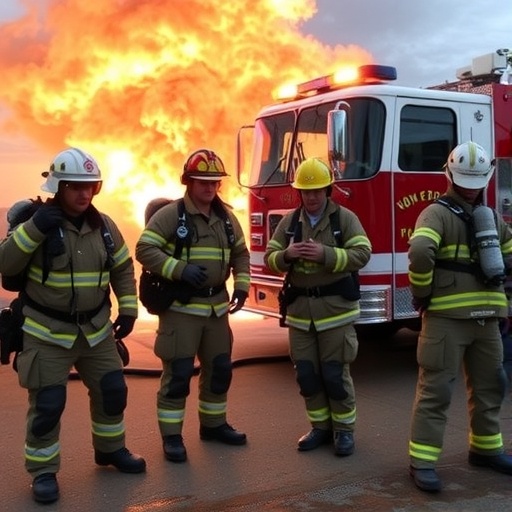
Fire department leaders may be one of the most influential forces shaping firefighter fitness, according to new research examining physical readiness across nearly 100 stations. The study found that firefighters tended to achieve better fitness-test results when their captains and lieutenants were themselves physically fit, suggesting that leadership behavior may help determine whether exercise becomes a routine part of station life. The findings offer a new perspective on occupational fitness, shifting attention from individual motivation to the social and organizational environments in which firefighters train, work and respond to emergencies.
The international research collaboration analyzed annual fitness-testing data from 838 firefighters working across 99 fire stations in the United States. Researchers, including Dr Lee Brown of the University of East London, compared the physical performance of firefighters with the fitness profiles of their station’s crew leaders. The leadership group included captains and lieutenants, whose responsibilities often extend beyond operational command to setting expectations for training, teamwork and daily professional standards.
The results showed a clear association between leadership fitness and crew fitness. Firefighters assigned to stations with physically fit and actively engaged captains and lieutenants recorded higher levels of physical readiness than those working in stations where leaders were less fit or less comprehensively represented. The strongest results appeared in crews staffed by both a captain and a lieutenant, while fitness outcomes were significantly lower in crews led by a captain alone. Although the study does not prove that leadership fitness directly causes better performance among firefighters, the pattern suggests that a complete and engaged leadership structure may create conditions in which healthy routines are easier to establish and maintain.
For firefighters, physical readiness is not simply a matter of athletic performance. Emergency response can involve heavy protective clothing, breathing apparatus, ladders, hoses, forcible entry tools, unstable surfaces, extreme heat and prolonged exertion. These demands place substantial stress on the cardiovascular, muscular and metabolic systems. Adequate aerobic capacity helps firefighters sustain work during extended incidents, while strength and power support tasks such as climbing, dragging equipment and rescuing casualties. Fitness can also contribute to injury prevention and long-term health by improving the body’s ability to tolerate repeated occupational strain.
The researchers interpret their findings through the idea of “leading from the front.” When officers train alongside their crews, participate in fitness activities and visibly maintain their own readiness, they may establish a shared expectation that physical preparation is part of the job rather than an optional personal pursuit. This process can operate through several mechanisms. Leaders may influence how time is allocated during shifts, determine whether training is treated as legitimate work activity and provide social reinforcement for exercise. Their example may also reduce the stigma associated with training and make fitness a collective responsibility instead of an isolated individual behavior.
Dr Lee Brown said the findings indicate that departments seeking to improve operational readiness should consider interventions aimed at entire crews and the leaders who supervise them. Traditional wellness programs have frequently focused on personal behavior, including nutrition, exercise habits and weight management. Such approaches can be useful, but they may have limited reach when the surrounding workplace does not support regular training. A station environment in which officers prioritize physical preparation could help firefighters overcome practical barriers such as fatigue, irregular schedules, competing duties and uncertainty about how to train effectively.
The study’s lead author, Joel Martin, said fire services already possess strong evidence that physical fitness is connected with firefighter health, injury prevention and occupational performance. The more difficult question, he argued, is how organizations can build and sustain a culture of fitness over time. Crew culture and the attitudes of company officers are frequently cited by firefighters as important influences on whether physical training becomes part of the daily routine. The research did not directly measure those attitudes or observe leadership behavior, but the statistical relationship between leader fitness and crew fitness provides quantitative support for investigating those factors more closely.
The findings also highlight the importance of interpreting the results carefully. Because the research examined existing annual fitness data rather than assigning stations to different leadership or training programs, it cannot establish a direct cause-and-effect relationship. Stations with fitter crews may differ from other stations in many ways, including staffing levels, equipment, local policies, access to training facilities, workload and community resources. It is also possible that highly motivated firefighters are more likely to work in stations where leaders are already fit and engaged. Future research could track stations over time, measure officer participation in training directly and test whether structured leadership-based fitness programs produce measurable improvements.
Despite these limitations, the study could influence how fire and rescue organizations design readiness initiatives. Its conclusions have been shared with Kent Fire and Rescue Service, presented to the National Fire Chiefs Council and the Fire Brigades Union, and incorporated into work on an industry white paper concerning firefighter tactical readiness for the National Strength and Conditioning Association. If the association is confirmed by intervention studies, a relatively simple strategy—ensuring that station leaders actively participate in well-designed, job-specific training—could become an important component of firefighter wellness programs. The research suggests that the path to a fitter fire service may begin not only with individual firefighters, but with the people standing beside them during training.
Web References: University of East London research news release; https://www.researchgate.net/publication/410624399_Leading_From_the_Front_Leadership_Fitness_Is_Associated_with_Fire_Station_Crew_Fitness
References: Journal of Occupational and Environmental Medicine, DOI: 10.1097/JOM.0000000000003830
Cite Scienmag News
Ophelia Keating. (August 4, 2026). Fire department leaders boost crew fitness, study finds. Scienmag. https://scienmag.com/fire-department-leaders-boost-crew-fitness-study-finds/
Ophelia Keating. "Fire department leaders boost crew fitness, study finds." Scienmag, 4 August 2026, https://scienmag.com/fire-department-leaders-boost-crew-fitness-study-finds/. Accessed 4 September 2026.
Ophelia Keating. "Fire department leaders boost crew fitness, study finds." Scienmag. August 4, 2026. https://scienmag.com/fire-department-leaders-boost-crew-fitness-study-finds/


