


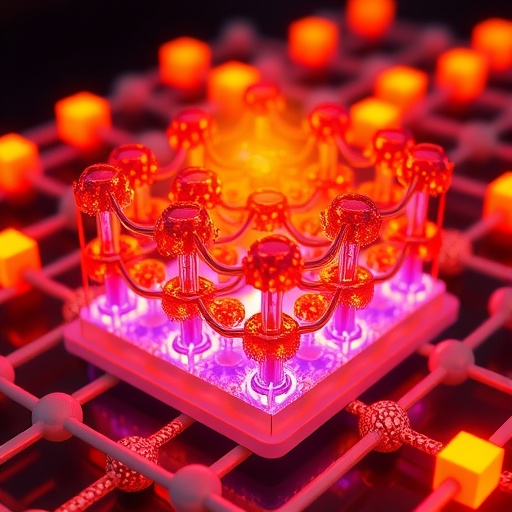
Green hydrogen has long been promoted as a key component of a low-carbon energy system, but its expansion has been constrained by a stubborn economic problem: the catalysts used to split water efficiently often rely on expensive precious metals. A new study published in Nano Research reports an electrocatalyst designed to reduce that dependence while delivering the speed and durability required for practical hydrogen production. The material, known as RuP₂-Ni₂P/NPC, combines ruthenium phosphide and nickel phosphide inside hollow carbon spheres, creating a structure that researchers say can operate efficiently across both acidic and alkaline environments.
Hydrogen production by water electrolysis depends on two complementary electrochemical reactions. At the cathode, the hydrogen evolution reaction, or HER, converts protons or water molecules into hydrogen gas. Although platinum remains one of the most effective materials for accelerating this reaction, its scarcity and price complicate the development of large electrolyzer systems. Researchers have therefore been searching for catalysts that use smaller quantities of precious metals or replace them entirely without sacrificing activity, stability, or performance under industrially relevant current densities.
The team’s approach centers on an “embedded heterojunction” architecture. In the reported material, ultrafine RuP₂ and Ni₂P nanoparticles form closely connected interfaces and are embedded within the shells of hollow nitrogen-doped porous carbon spheres. A heterojunction is a boundary between two different solid materials, and it can alter how electrons move and how chemical intermediates bind to the catalyst surface. According to the study, the contact between RuP₂ and Ni₂P causes electron redistribution from RuP₂ toward Ni₂P, modifying the electronic structure of the active sites and tuning their interaction with hydrogen-containing intermediates.
That electronic adjustment is crucial because HER catalysts must bind hydrogen neither too weakly nor too strongly. If hydrogen does not attach readily, the reaction becomes slow; if it binds too tightly, the catalyst struggles to release hydrogen molecules and regenerate its active surface. The researchers report that the RuP₂-Ni₂P interface shifts the d-band characteristics of the catalyst and produces a near-ideal hydrogen adsorption energy. This interfacial modulation is intended to accelerate the reaction pathway while reducing the amount of ruthenium needed to achieve high activity.
The hollow carbon framework provides a second layer of engineering. Its porous shell increases the accessible surface area and allows electrolyte and reactant molecules to reach the embedded nanoparticles. At the same time, the carbon confinement physically restrains the active particles, reducing the likelihood that they will migrate, merge into larger particles, dissolve, or detach from the electrode during electrolysis. Such degradation mechanisms are major obstacles for non-platinum catalysts, particularly when they are exposed to strongly acidic or alkaline solutions for extended periods.
In laboratory measurements, the optimized catalyst required an overpotential of only 3 millivolts to reach a current density of 10 milliamperes per square centimeter in 1-molar potassium hydroxide. In 0.5-molar sulfuric acid, it required 17.3 millivolts at the same current density. Overpotential is the additional voltage beyond the thermodynamic minimum that an electrolyzer must supply to drive a reaction; lower values generally indicate a more efficient catalyst. The reported results place the material among the strongest RuP₂-based HER catalysts described by the researchers, particularly because it maintains high activity in both alkaline and acidic media.
The stability results may be even more significant for real-world applications. The catalyst operated for more than 500 hours in alkaline conditions and more than 300 hours in acidic conditions at a current density of 100 milliamperes per square centimeter without substantial performance loss, according to the study. These tests do not by themselves establish full industrial readiness, since commercial electrolyzers can require different electrode configurations, higher operating loads, gas-management systems, and long-term testing over thousands of hours. Nevertheless, sustained operation at elevated current density is an important demonstration that the catalyst is not merely optimized for a brief laboratory measurement.
The researchers also report superior noble-metal mass activity compared with commercial platinum-on-carbon, or Pt/C, under the tested conditions. Mass activity measures how much catalytic output is obtained from a given quantity of precious metal, making it especially relevant when the goal is to reduce material costs. Ruthenium is less expensive and more accessible than platinum in some applications, but it remains a valuable metal rather than a truly abundant resource. The significance of the design therefore lies not only in substituting one metal for another, but in using nanoscale interfaces and confinement to extract more catalytic performance from a smaller precious-metal inventory.
Prof. Zhong, the study’s corresponding author, described the work as a design strategy rather than simply the creation of a new compound. By combining electronic modulation at the RuP₂-Ni₂P interface with the mechanical protection of a hollow carbon architecture, the team seeks to solve two problems simultaneously: insufficient intrinsic reaction activity and structural instability during operation. The same principle could potentially be adapted to other electrocatalytic systems in which interfaces control reaction energetics and porous frameworks protect vulnerable nanomaterials.
The next challenge is moving beyond controlled laboratory experiments. The team plans to scale up synthesis and evaluate the catalyst in practical electrolyzer devices, where electrode thickness, water transport, gas bubbles, electrical resistance, manufacturing consistency, and operating cost all affect performance. If the reported activity and durability can be reproduced in larger electrodes and maintained under realistic workloads, the RuP₂-Ni₂P/NPC architecture could help make hydrogen production more economical. More broadly, the study highlights how precise control over electron distribution and nanoscale structure is turning catalyst design into an increasingly powerful tool in the race to build cleaner energy technologies.
News Publication Date:
19-May-2026
Web References:
https://doi.org/10.26599/NR.2026.94908616
https://www.sciopen.com/journal/1998-0124
References:
Nano Research, DOI: 10.26599/NR.2026.94908616
Keywords
Green hydrogen, water electrolysis, hydrogen evolution reaction, electrocatalyst, RuP₂-Ni₂P/NPC, heterojunction, ruthenium phosphide, nickel phosphide, nanotechnology, renewable energy, pH-universal catalysis, electrolyzers
Cite Scienmag News
Gavin Prescott. (August 4, 2026). Embedded heterojunction enables superior pH-universal hydrogen evolution catalysis. Scienmag. https://scienmag.com/embedded-heterojunction-enables-superior-ph-universal-hydrogen-evolution-catalysis/
Gavin Prescott. "Embedded heterojunction enables superior pH-universal hydrogen evolution catalysis." Scienmag, 4 August 2026, https://scienmag.com/embedded-heterojunction-enables-superior-ph-universal-hydrogen-evolution-catalysis/. Accessed 3 September 2026.
Gavin Prescott. "Embedded heterojunction enables superior pH-universal hydrogen evolution catalysis." Scienmag. August 4, 2026. https://scienmag.com/embedded-heterojunction-enables-superior-ph-universal-hydrogen-evolution-catalysis/


