


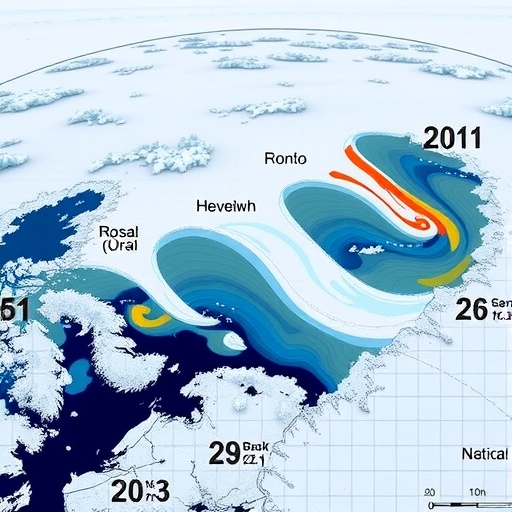
A new study of the Ross Sea has revealed how dramatically Antarctic waves may respond when sea ice retreats, offering a glimpse into the powerful ocean-atmosphere feedbacks that shaped the region thousands of years ago. Published in Nature Communications, the research examines extreme wave heights during the early to mid-Holocene, a period when Earth’s climate was warmer than today and Antarctic sea-ice conditions were undergoing major changes.
The findings point to a direct relationship between the presence of sea ice and the intensity of ocean waves. When the Ross Sea was more extensively covered by ice, wave growth was strongly restricted. As the ice retreated, open water expanded, allowing winds to transfer energy across a much larger stretch of ocean. That additional distance, known as fetch, enabled waves to become higher, longer and more powerful before reaching the Antarctic coastline.
This process is familiar from modern storms, but its significance in Antarctica is particularly striking. Sea ice is not simply a frozen lid covering the ocean. It acts as a dynamic barrier that absorbs, scatters and disrupts wave energy. Even fragmented ice can reduce the distance over which waves develop. When the ice edge moves poleward or breaks apart, the ocean suddenly becomes more responsive to strong winds, creating conditions capable of generating extreme waves.
The Ross Sea is an ideal natural laboratory for studying this transformation. Located between the Antarctic Peninsula and the Ross Ice Shelf, it is one of the most climatically sensitive regions of the Southern Ocean. Its sea ice influences ocean circulation, the exchange of heat and gases between the ocean and atmosphere, and the stability of nearby ice shelves. Changes in wave activity therefore have consequences far beyond the immediate shoreline.
The study’s focus on the early-mid Holocene provides an important perspective on how the Antarctic system behaves during periods of natural warming. The Holocene began roughly 11,700 years ago, after the end of the last ice age. During its early and middle stages, changing sunlight patterns, declining ice sheets and evolving ocean circulation altered the balance between atmosphere, sea ice and the Southern Ocean. The new research suggests that these shifts were recorded not only in temperatures or ice extent, but also in the height of the largest waves.
Extreme waves are especially valuable climate indicators because they respond to several environmental factors at once. Their size depends on wind speed, wind direction, storm duration, water depth and the amount of open water available for wave development. In polar regions, sea ice adds another critical control. By linking past wave heights to changing ice conditions, researchers can investigate how the entire climate system worked together rather than treating sea ice as an isolated variable.
The researchers also identify the importance of ocean-atmosphere interactions. As the ocean loses its protective ice cover, more heat and moisture can move between the water and the air. Open water can intensify local exchanges of energy, influence atmospheric pressure patterns and modify storm behavior. At the same time, stronger waves can break up remaining ice, accelerate its dispersal and expose still more ocean. This creates a feedback loop in which retreating ice enables larger waves, and larger waves can help sustain further ice retreat.
That feedback matters today because the Ross Sea is already experiencing rapid environmental change. Although Antarctic sea-ice trends vary from year to year and from region to region, long-term shifts in ocean temperature, wind patterns and ice dynamics are reshaping the Southern Ocean. The historical record reconstructed in this study indicates that wave conditions may change sharply once the ice edge retreats beyond a critical point. A relatively modest reduction in ice cover could therefore produce a disproportionate increase in wave exposure.
The implications extend to Antarctic ice shelves, coastal ecosystems and future climate projections. Larger waves can deliver more mechanical energy to the edge of floating ice, potentially contributing to fracture, flexure and the breakup of vulnerable sections. Waves also affect the transport and mixing of heat in the upper ocean, processes that influence marine life and the formation of new sea ice. By showing that ancient wave extremes tracked sea-ice retreat and coupled ocean-atmosphere changes, the study adds a new dimension to efforts to understand Antarctica’s climate future.
The Ross Sea record ultimately delivers a vivid warning: in a warming world, the disappearance of sea ice can amplify more than sunlight reaching the ocean. It can transform the character of the sea itself. As open water expands, storms may gain a larger arena in which to build destructive waves, while those waves feed back into the fragile polar environment. The ancient signal described by Wang, Wang, Zhang and colleagues suggests that Antarctica’s wave climate is not a passive consequence of warming, but an active and potentially accelerating part of the system.
Cite Scienmag News
Violet Maxwell. (August 3, 2026). Early–mid Holocene Ross Sea extreme waves tied to sea-ice retreat, ocean-atmosphere interactions. Scienmag. https://scienmag.com/early-mid-holocene-ross-sea-extreme-waves-tied-to-sea-ice-retreat-ocean-atmosphere-interactions/
Violet Maxwell. "Early–mid Holocene Ross Sea extreme waves tied to sea-ice retreat, ocean-atmosphere interactions." Scienmag, 3 August 2026, https://scienmag.com/early-mid-holocene-ross-sea-extreme-waves-tied-to-sea-ice-retreat-ocean-atmosphere-interactions/. Accessed 3 September 2026.
Violet Maxwell. "Early–mid Holocene Ross Sea extreme waves tied to sea-ice retreat, ocean-atmosphere interactions." Scienmag. August 3, 2026. https://scienmag.com/early-mid-holocene-ross-sea-extreme-waves-tied-to-sea-ice-retreat-ocean-atmosphere-interactions/


