


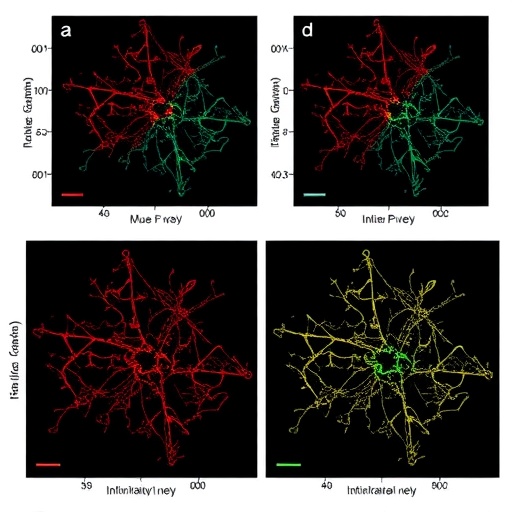
In the developing mouse brain, inhibitory neurons do not emerge as a single, uniform population. Instead, they diversify through multiple developmental routes that gradually produce the specialized cell types required for precise control of neural activity. A study published in Nature Neuroscience presents a single-cell transcriptomic view of this process, revealing that the formation of inhibitory neuron identities follows distinct modes rather than one universal developmental program.
The research, led by Liu, Restelli, Micoli and colleagues, focuses on the molecular identities of inhibitory neurons as they develop. These cells, which commonly use the neurotransmitter gamma-aminobutyric acid, or GABA, act as the brain’s regulatory network. By suppressing or constraining the activity of neighboring neurons, they help determine when circuits fire, how signals are coordinated and whether neural activity remains balanced. Disruptions in inhibitory-cell development have been associated with conditions including epilepsy, autism and other neurological disorders.
To investigate how these neurons acquire their identities, the researchers used single-cell transcriptomics, a method that measures gene activity separately in thousands of individual cells. Unlike conventional approaches that average molecular signals across large tissue samples, single-cell analysis can distinguish closely related cell populations and identify subtle differences in their developmental states. Each cell is represented by a molecular profile, allowing researchers to trace relationships among immature cells, transitional states and mature inhibitory neuron types.
The study’s central finding is that inhibitory neuron diversification in the developing mouse brain occurs through distinct modes. In biological terms, this suggests that different neuronal classes may not simply follow the same sequence of molecular instructions at different speeds. Some may be generated through early decisions that establish their identity rapidly, while others may pass through more flexible intermediate states in which their eventual characteristics remain partly open to further developmental signals.
This distinction is important because neuronal identity is not defined by a single gene or feature. It emerges from coordinated changes in transcription factors, signaling pathways, neurotransmitter machinery, connectivity programs and cellular morphology. A developing neuron must not only become inhibitory; it must also acquire the molecular equipment and anatomical properties needed to communicate with particular partners in a specific circuit. Single-cell transcriptomes provide a way to observe these layers of identity as they appear and change over time.
The findings also challenge a simple view of cell-type formation in which every mature neuron can be traced through one neatly ordered developmental tree. The data instead point toward a more varied landscape, with some cell types potentially arising through relatively direct programs and others being shaped through progressive diversification. Such trajectories may include branching decisions, transient gene-expression states or parallel developmental routes that eventually converge on related mature identities.
For neuroscientists, the work offers a framework for comparing how different inhibitory neuron classes are produced. Mature cells that appear similar under a microscope can have distinct developmental histories and molecular programs. Conversely, cells with different mature properties may share early transcriptional states before diverging. Identifying these relationships is essential for building accurate cell atlases and for understanding how the brain generates its enormous diversity from a limited set of progenitor populations.
The study may also have implications for efforts to repair or reproduce neural circuits. Researchers developing stem-cell-derived neurons or designing treatments for disorders involving inhibitory circuitry need to know not only which genes define a mature cell, but also which developmental path is required to produce it. If different inhibitory neuron types are generated through different modes of diversification, a single recipe for producing “GABAergic neurons” may yield a mixture of cells with unequal functional properties. Reconstructing the appropriate developmental sequence could improve the precision of future cell-based and molecular therapies.
Because the work examines the developing mouse brain, its direct conclusions apply first to that experimental system. Mouse and human brains share many fundamental principles of neuronal development, but they also differ in timing, cell-type composition and circuit organization. Further studies will be needed to determine which developmental modes are conserved in humans and how environmental signals, activity and disease-related mutations influence these trajectories. Even so, the study provides a detailed conceptual advance: inhibitory neuron diversity is produced by more than one developmental strategy, and single-cell transcriptomics can reveal the molecular logic behind that complexity.
Cite Scienmag News
Cassandra Pierce. (August 3, 2026). Mouse inhibitory neuron transcriptomes reveal distinct cell-type diversification modes. Scienmag. https://scienmag.com/mouse-inhibitory-neuron-transcriptomes-reveal-distinct-cell-type-diversification-modes/
Cassandra Pierce. "Mouse inhibitory neuron transcriptomes reveal distinct cell-type diversification modes." Scienmag, 3 August 2026, https://scienmag.com/mouse-inhibitory-neuron-transcriptomes-reveal-distinct-cell-type-diversification-modes/. Accessed 3 September 2026.
Cassandra Pierce. "Mouse inhibitory neuron transcriptomes reveal distinct cell-type diversification modes." Scienmag. August 3, 2026. https://scienmag.com/mouse-inhibitory-neuron-transcriptomes-reveal-distinct-cell-type-diversification-modes/


