


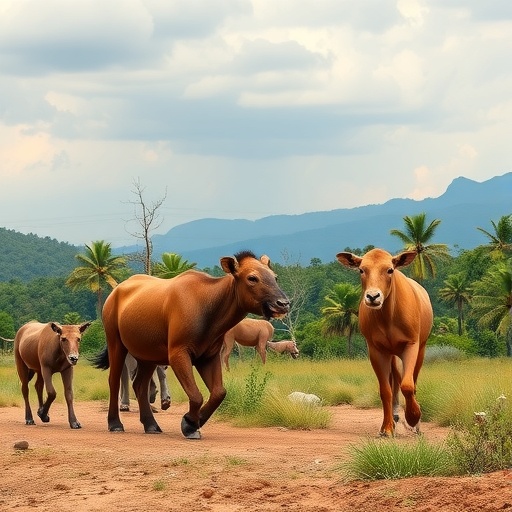
For decades, the story of how mammals conquered the Americas seemed straightforward: North and South America remained biologically separate until the Isthmus of Panama rose from the sea about 2.8 million years ago, creating a land bridge between the continents. Once that connection formed, animals moved in both directions during what scientists call the Great American Biotic Interchange, or GABI. But a new analysis of Mexican fossils suggests that the interchange began far earlier—and unfolded in stages rather than as a single biological flood.
Researchers led by University of California, Berkeley paleontologist Jack Tseng have assembled one of the most extensive databases of Mexican fossil mammals yet created. The collection includes fossils dating from roughly 12 million years ago to the present and nearly doubles the number previously available for this period. Their analysis indicates that mammals from northern North America had already entered Mexico by at least 10 million years ago, millions of years before the Panamanian land bridge is thought to have become fully passable.
Rather than immediately continuing into South America, many of these northern migrants appear to have remained in Mexico for several million years. Tseng describes this interval, lasting from approximately 10 to 7 million years ago, as a biogeographic “holding pen.” The region functioned as an ecological extension of North America, allowing northern mammals to establish populations, diversify and adapt to warmer, more seasonal environments without yet producing a continuous highway into the southern continent.
The fossil evidence shows that Mexico was not an isolated evolutionary laboratory generating entirely new mammal groups that later moved south. Many Mexican fossils closely resemble species known from the grasslands and dry habitats of what is now the United States. Large-bodied mammals adapted to relatively arid conditions appear to have expanded southward through ecological corridors resembling today’s Great Plains and U.S. Southwest. Once these animals reached the southern limit of the continent, however, their movement was constrained by geography and the absence of a permanent land connection.
The next stage began around 7 million years ago and lasted until roughly 3 million years ago. During this “lag phase,” limited movement between the continents became possible, but it was highly uneven. Small mammals—including raccoon relatives such as coatis and ringtails, along with rodents—appear to have reached South America. They may have crossed through temporary corridors, island-hopped across the Caribbean or rafted on floating vegetation carried by rivers and ocean currents. These routes would have favored small animals capable of surviving with limited food and water, rather than large terrestrial herbivores and predators.
The exchange was strongly biased toward the south. While several northern mammal lineages entered South America before the main interchange, only one major South American group, the sloths, is clearly documented as moving north during this early period. Over time, some sloths evolved into enormous ground-dwelling forms, including species that reached the size of small elephants. The success of northern mammals in the south and the rarity of southern migrants in the north reveal that geographic connection alone cannot explain the pattern. Body size, climate tolerance, reproductive biology and ecological competition all shaped which species could cross and survive.
About 2.8 million years ago, the formation of a more continuous Panamanian land bridge transformed the exchange. The previous barriers that had limited movement largely disappeared, allowing large and small mammals to move between the continents with far fewer restrictions. This marked the classic GABI phase, when northward and southward dispersals accelerated dramatically. In South America, mammals arriving from the north diversified extensively and occupied ecological roles previously held by native groups. Many southern lineages declined or disappeared, contributing to a major restructuring of the continent’s ecosystems.
One possible explanation for this imbalance involves the contrasting reproductive strategies of marsupials and placental mammals. Marsupials give birth to highly undeveloped young that complete much of their development while attached to a nipple inside a pouch or protected fold of skin. Placental mammals generally retain their young longer before birth, supported by a complex placenta, and often produce offspring that become independent more quickly. Under intense competition, this difference in life history may have given placental mammals an advantage over South America’s marsupial fauna, although climate, habitat change and predation also contributed to extinction and replacement.
The findings challenge geological interpretations proposing that a land bridge existed as early as 15 million years ago or that climate alone controlled the timing of mammal movements. If a continuous terrestrial route had been available throughout the earlier period, researchers would expect broader and more frequent crossings between the continents. Instead, the fossil record points to a gradual buildup: northern mammals reached Mexico by 10 million years ago, limited exchanges began by about 7 million years ago, and unrestricted interchange followed the establishment of the Panamanian connection. The researchers are now expanding their work with South American fossils, whose record is less abundant but may reveal when specific groups crossed, why southern mammals lagged behind, and how ancient migrations produced the biodiversity patterns that humans encountered when they arrived in the Americas.
News Publication Date: 30-Jul-2026
Web References: https://doi.org/10.1126/science.aef2893
References: Science; DOI: 10.1126/science.aef2893
Cite Scienmag News
Violet Maxwell. (August 1, 2026). Mammals Intermingled Across the Americas Before North and South America Connected. Scienmag. https://scienmag.com/mammals-intermingled-across-the-americas-before-north-and-south-america-connected/
Violet Maxwell. "Mammals Intermingled Across the Americas Before North and South America Connected." Scienmag, 1 August 2026, https://scienmag.com/mammals-intermingled-across-the-americas-before-north-and-south-america-connected/. Accessed 3 September 2026.
Violet Maxwell. "Mammals Intermingled Across the Americas Before North and South America Connected." Scienmag. August 1, 2026. https://scienmag.com/mammals-intermingled-across-the-americas-before-north-and-south-america-connected/


