

Wednesday, July 29, 2026
Science
No Result
View All Result
  • Login
  • HOME
  • SCIENCE NEWS
  • CONTACT US
  • HOME
  • SCIENCE NEWS
  • CONTACT US
No Result
View All Result
Scienmag
No Result
View All Result
Home Science News Biology

Study Finds Small Genetic Mutation Causes Major Effects in Rare Heart Diseases

July 29, 2026
in Biology
Reading Time: 2 mins read
0
Study Finds Small Genetic Mutation Causes Major Effects in Rare Heart Diseases

Study Finds Small Genetic Mutation Causes Major Effects in Rare Heart Diseases

65
SHARES
587
VIEWS
Share on FacebookShare on Twitter
ADVERTISEMENT

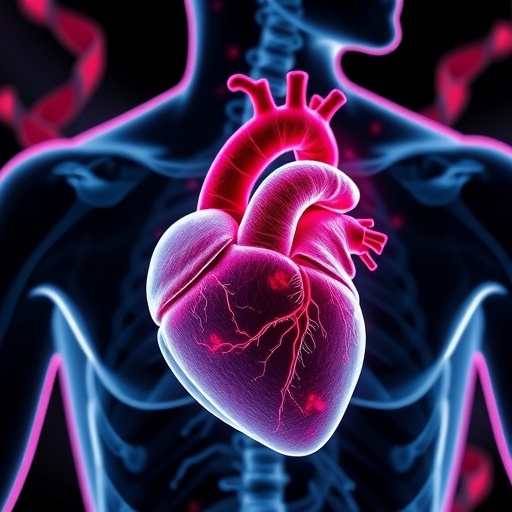
A new study suggests that two inherited cardiomyopathies—dilated cardiomyopathy (DCM) and left ventricular non-compaction (LVNC)—can diverge dramatically from an almost identical genetic change. The work, led largely by researchers from Würzburg, Heidelberg, and Göttingen, targets the RBM20 gene, whose mutations are known to drive rare heart failure syndromes.

Clinically, DCM features markedly enlarged heart chambers and impaired pumping, whereas LVNC is defined by spongy, honeycomb-like myocardium. Until now, patients carrying RBM20 variants have largely received standard heart-failure care, despite the possibility that this molecular subgroup might respond to more tailored therapies.

The researchers examined two families with RBM20 mutations that differ by just a single protein “letter” at the same critical site. In the DCM family, an arginine is replaced by tryptophan; in the LVNC family, the same arginine is replaced by leucine. The subtlety of the difference makes the contrasting phenotypes especially striking.

To explain how one residue shift could remodel cardiac physiology, the team probed calcium handling in patient-derived material. They found distinct calcium-system failures: LVNC models showed heightened calcium-cycle activity and an energetically costly calcium regime, while DCM models behaved as if internal calcium stores leak, disrupting rhythmic contraction–relaxation coupling.

The study used pluripotent stem cell technology to recreate disease-relevant heart muscle in vitro. Induced pluripotent stem cells (iPSCs) were differentiated into beating cardiomyocytes, and the researchers further generated organoid-like spherical models as well as engineered micro–heart muscle tissues to better mimic tissue-scale behavior.

To establish causality rather than correlation, CRISPR/Cas9 was applied as “gene scissors” to correct defective RBM20 in diseased cells. The team then reintroduced the DCM mutation into repaired LVNC backgrounds, demonstrating that the specific RBM20 change at that single site is sufficient to generate the divergent calcium phenotypes.

From these mechanistic insights, the researchers mapped potential “molecular players” that may guide precision drug targeting. Among the candidates, verapamil—an established calcium-effect blocker used clinically for arrhythmias—showed partial improvement of contractile performance in laboratory experiments.

The authors emphasize that translating these findings to patients will require extensive preclinical validation. Still, the results outline a roadmap for individualized therapies, where genetic diagnosis could inform which calcium-related pathway to modulate in RBM20-associated disease.

Subject of Research: Cells
Article Title: RBM20 variants disrupt Ca2+ handling and metabolism in dilated and non-compaction cardiomyopathy stem cell models
News Publication Date: 14-Jul-2026
Web References: http://dx.doi.org/10.1038/s41392-026-02838-7
References: 10.1038/s41392-026-02838-7
Image Credits: Katrin Streckfuß-Bömeke / University of Würzburg

Keywords: cardiomyopathy, RBM20, calcium homeostasis, LVNC, DCM, iPSCs, CRISPR/Cas9, stem cell models, verapamil

Tags: calcium handling in heart diseasesdilated cardiomyopathy geneticsgenetic mutationgenotype-phenotype correlation in heart diseaseheart failure disease mechanismsimpact of single nucleotide changes on heart functioninherited cardiomyopathiesleft ventricular non-compactionmolecular basis of cardiac structural abnormalitiespersonalized therapy for inherited heart diseasesRBM20 gene mutationsstem cell modeling of cardiomyopathies
Share26Tweet16
Previous Post

Study tracks mosaic chromosome changes to reveal factors shaping blood cell clones

Next Post

Study reveals when conspiracy beliefs may prompt real-world actions

Related Posts

Gut Microbiota Limits Intestinal Fat Uptake by Altering Bile Phosphatidylcholine in Mice
Biology

Gut Microbiota Limits Intestinal Fat Uptake by Altering Bile Phosphatidylcholine in Mice

July 29, 2026
Phage Hijacks Bacterial DNA Phosphorothioate Machinery to Evade Ssp Defenses
Biology

Phage Hijacks Bacterial DNA Phosphorothioate Machinery to Evade Ssp Defenses

July 29, 2026
New Strategy Enables Oxidation-Free, Efficient Oligonucleotide Synthesis
Biology

New Strategy Enables Oxidation-Free, Efficient Oligonucleotide Synthesis

July 29, 2026
How Organisms Balance Memory, Thought, and Sensing Costs
Biology

How Organisms Balance Memory, Thought, and Sensing Costs

July 29, 2026
Biology

Merging Metasurfaces with Image Sensors Enables Ultra-Compact Optoelectronics

July 28, 2026
Software Enables Researchers to Decode Lymphoma’s Cellular Architecture
Biology

Software Enables Researchers to Decode Lymphoma’s Cellular Architecture

July 28, 2026
Next Post
Study reveals when conspiracy beliefs may prompt real-world actions

Study reveals when conspiracy beliefs may prompt real-world actions

  • Mothers who receive childcare support from maternal grandparents show more

    Mothers who receive childcare support from maternal grandparents show more parental warmth, finds NTU Singapore study

    27656 shares
    Share 11059 Tweet 6912
  • University of Seville Breaks 120-Year-Old Mystery, Revises a Key Einstein Concept

    1061 shares
    Share 424 Tweet 265
  • Bee body mass, pathogens and local climate influence heat tolerance

    682 shares
    Share 273 Tweet 171
  • Researchers record first-ever images and data of a shark experiencing a boat strike

    546 shares
    Share 218 Tweet 137
  • Groundbreaking Clinical Trial Reveals Lubiprostone Enhances Kidney Function

    531 shares
    Share 212 Tweet 133
Science

Embark on a thrilling journey of discovery with Scienmag.com—your ultimate source for cutting-edge breakthroughs. Immerse yourself in a world where curiosity knows no limits and tomorrow’s possibilities become today’s reality!

RECENT NEWS

  • Psychosocial Stress Increases Opioid Self-Administration in Healthy People, Trial Finds
  • Short ACE2 Isoform Increases in Adipose Tissue of Women With Obesity
  • Quorum sensing enables nitrite-oxidizing bacteria to fuel nitritation via altruism
  • Gut Microbiota Limits Intestinal Fat Uptake by Altering Bile Phosphatidylcholine in Mice

Categories

  • Agriculture
  • Anthropology
  • Archaeology
  • Athmospheric
  • Biology
  • Biotechnology
  • Blog
  • Bussines
  • Cancer
  • Chemistry
  • Climate
  • Earth Science
  • Editorial Policy
  • Marine
  • Mathematics
  • Medicine
  • Pediatry
  • Policy
  • Psychology & Psychiatry
  • Science Education
  • Social Science
  • Space
  • Technology and Engineering

Subscribe to Blog via Email

Enter your email address to subscribe to this blog and receive notifications of new posts by email.

Join 5,147 other subscribers

© 2025 Scienmag - Science Magazine

Welcome Back!

Login to your account below

Forgotten Password?

Retrieve your password

Please enter your username or email address to reset your password.

Log In
No Result
View All Result
  • HOME
  • SCIENCE NEWS
  • CONTACT US

© 2025 Scienmag - Science Magazine

Discover more from Science

Subscribe now to keep reading and get access to the full archive.

Continue reading
