


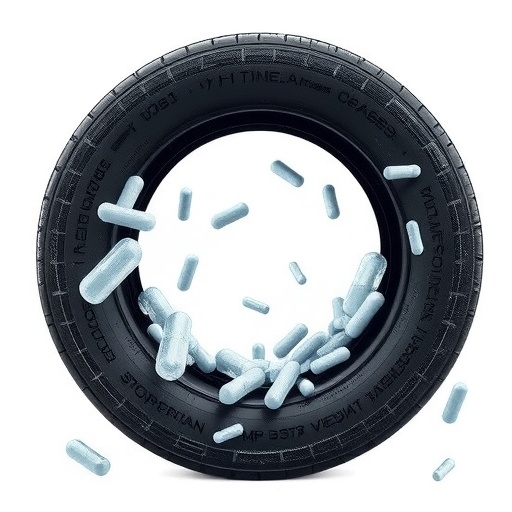
Tiny fragments generated as tires wear down may be more than an urban nuisance. A new perspective argues that tire-derived microplastics can create environmental hotspots that help antibiotic resistance genes persist, traffic between bacteria, and ultimately spread across city ecosystems.
Published in Biocontaminant, the article synthesizes emerging evidence that links tire particles to antimicrobial resistance—an issue spanning human health, animal health, and environmental systems. Because tire particles are continuously produced by tire–road friction, they can enter the atmosphere, be washed into stormwater networks, and accumulate in sediments or remain in urban soils.
Rather than behaving as inert carriers, the authors emphasize that tire particles may actively shape microbial evolution. Surfaces, chemical additives, and aging processes may act in concert to change local conditions, enabling resistance genes to survive longer and move more effectively through bacterial populations.
The perspective outlines three interacting pathways. First, tire particles can develop dense microbial biofilms, sometimes described as a “tire plastisphere,” placing cells in close proximity and increasing the opportunities for horizontal gene transfer.
Second, tire materials can leach complex chemical mixtures, including metals, antioxidants, and benzothiazoles. In some settings, these compounds may impose selective pressure, encouraging resistant microbes to outcompete susceptible ones and maintain corresponding genetic elements.
Third, weathering can intensify chemical reactivity. Sunlight and oxidation may generate reactive oxygen species and persistent free radicals, which can stress cells, alter membrane permeability, and modulate biofilm development—conditions that can influence gene transfer efficiency. The authors note, however, that extreme oxidative stress could also damage bacteria or genetic material, meaning outcomes may depend strongly on exposure intensity.
A central limitation remains the evidence base: only a small number of studies have directly tested tire particles or tire-associated chemicals against antibiotic resistance genes, resistant bacteria, or gene-transfer rates.
To clarify which compounds matter most, the team proposes adapting toxicity identification evaluation strategies. By fractionating tire leachates and testing their effects on plasmid transfer in controlled experiments, researchers could pinpoint drivers more precisely.
Overall, the work calls for source reduction and interception before runoff reaches waterways. Practical options include stormwater filtration, roadside capture systems, green infrastructure, and nature-based treatment. It also urges coordinated monitoring that connects environmental measurements with public-health surveillance of antimicrobial resistance.
Subject of Research:
Antibiotic resistance genes in the environment driven by tire microplastics
Article Title:
Tire microplastics amplify the risk of antibiotic resistance genes in the environment
News Publication Date:
19-May-2026
Web References:
https://doi.org/10.48130/biocontam-0026-0007
References:
Yang Y, Pan X, Yu Y, Lin L, Wang Q, et al. 2026. Tire microplastics amplify the risk of antibiotic resistance genes in the environment. Biocontaminant 2: e010. doi: 10.48130/biocontam-0026-0007
Image Credits:
Yuyi Yang, Xiong Pan, Yongxiang Yu, Li Lin, Qun Wang & Hans-Peter Grossart
Cite Scienmag News
Denise Maddox. (July 29, 2026). Tire Microplastics Could Speed Up Antibiotic Resistance Spread in Cities. Scienmag. https://scienmag.com/tire-microplastics-could-speed-up-antibiotic-resistance-spread-in-cities/
Denise Maddox. "Tire Microplastics Could Speed Up Antibiotic Resistance Spread in Cities." Scienmag, 29 July 2026, https://scienmag.com/tire-microplastics-could-speed-up-antibiotic-resistance-spread-in-cities/. Accessed 5 September 2026.
Denise Maddox. "Tire Microplastics Could Speed Up Antibiotic Resistance Spread in Cities." Scienmag. July 29, 2026. https://scienmag.com/tire-microplastics-could-speed-up-antibiotic-resistance-spread-in-cities/


