


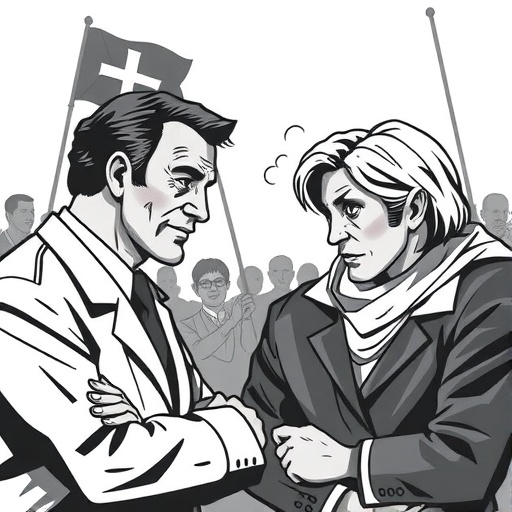
In today’s polarized political climate, people may judge moderates as untrustworthy whenever opposing groups appear threatening, according to new research from the American Psychological Association. The study suggests that the “middle” is not simply overlooked—it can be reclassified as an out-group, triggering the same suspicion typically reserved for ideological rivals.
“Democratic systems rely heavily on compromise, negotiation and coalition building, and moderates are often seen as the ‘glue’ that helps bridge ideological divides,” said lead researcher Giulia Maimone, PhD. “If moderates are rejected by both sides, compromise itself may begin to look suspicious or disloyal.”
Across five online experiments in the United States, more than 3,200 participants evaluated politically divisive topics including abortion policy, views related to Israel and Palestine, and the 2024 U.S. presidential election choices. Participants reported the strength of their own liberal or conservative beliefs, allowing the researchers to test how ideology and perceived threat interact with moral judgments.
In one experiment, participants considered a “moderate” abortion stance permitting first-trimester abortions. Both pro-life and pro-choice participants interpreted that compromise position as supporting the other side, indicating that moderation can be socially decoded as endorsement rather than balance.
Another experiment, conducted five days before the 2024 election, asked participants to evaluate a hypothetical person who equally supported Donald Trump and Kamala Harris. Participants also assessed whether voting preference is a moral issue and whether they anticipated threats if the opposing candidate won.
The pattern emerged most strongly among participants with more extreme beliefs, higher perceived threat from the other side, and a moralized framing of politics. Maimone describes this as a “moderate as out-group effect,” driven by the perception that moderates fail to repudiate or condemn opponents.
When moderates are treated as belonging to the opposing camp, distrust can become self-perpetuating—extending beyond extremists to those trying to bridge divides. The study also raises a secondary risk: moderates may eventually feel rejected by all sides and shift toward choosing a faction, potentially deepening polarization.
Still, the findings point to possible interventions. Lowering moralized rhetoric in political debate and reducing demonization of opponents may make cooperation feel socially safer, enabling more authentic dialogue in which nuance and compromise are valued rather than punished.
Cite Scienmag News
Courtney Benton. (July 27, 2026). Moderates Face Suspicion as Both Sides View Them as Disloyal. Scienmag. https://scienmag.com/moderates-face-suspicion-as-both-sides-view-them-as-disloyal/
Courtney Benton. "Moderates Face Suspicion as Both Sides View Them as Disloyal." Scienmag, 27 July 2026, https://scienmag.com/moderates-face-suspicion-as-both-sides-view-them-as-disloyal/. Accessed 4 September 2026.
Courtney Benton. "Moderates Face Suspicion as Both Sides View Them as Disloyal." Scienmag. July 27, 2026. https://scienmag.com/moderates-face-suspicion-as-both-sides-view-them-as-disloyal/


