


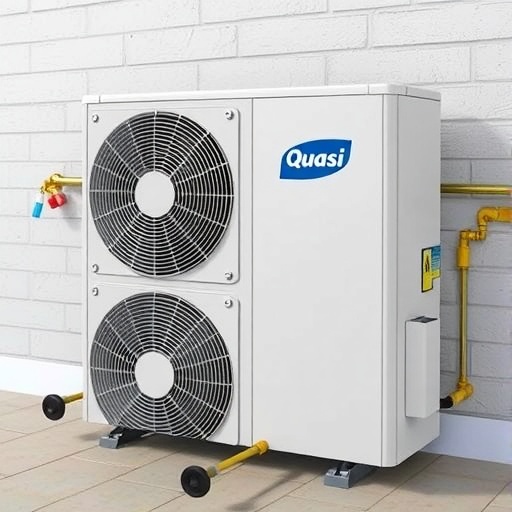
A new study published in Communications Engineering reports a quasi-two-stage heat pump designed to tackle a stubborn energy problem: how to deliver both space heating and domestic hot water efficiently, even when buildings demand different temperatures at the same time. Instead of forcing one system to behave like two separate devices, the approach restructures the heating cycle so the equipment can better match real-world thermal needs.
The core idea is a quasi-two-stage configuration, which effectively creates an “adaptive” pathway for lifting heat to higher temperatures when hot water is required. By managing how the refrigerant transitions through its operating regime, the system can reduce unnecessary work—an issue that often plagues conventional heat pumps when they must repeatedly overshoot temperature targets.
In typical dual-service setups, maintaining comfort can trigger additional compressor effort, particularly during periods when space heating temperatures are moderate but hot water requires a much higher delivery temperature. The new design aims to minimize that mismatch. By improving thermal utilization across the load profile, the heat pump can deliver domestic hot water with less efficiency loss, while still supporting steady indoor heating.
The researchers also emphasize system-level performance, not only component behavior. Heat exchangers and control logic play a central role in ensuring that the quasi-two-stage behavior is activated under the right operating conditions. In other words, the system “chooses” when to operate closer to lower-stage efficiency and when to transition toward higher-temperature lifting.
From an engineering perspective, the work suggests that careful staging—without fully committing to a complex two-unit architecture—can preserve simplicity while capturing much of the energy benefit. That balance matters for real installations, where reliability, serviceability, and cost sensitivity are as important as raw efficiency metrics.
If validated in broader testing, the concept could make heat pumps more attractive for building retrofits. Many existing heating systems struggle to achieve hot water requirements efficiently, and homeowners can be reluctant to adopt new hardware when performance drops during peak hot-water demand.
For energy policy and electrification strategies, the potential impact is straightforward: reducing electricity consumption in buildings is one of the fastest routes to lower emissions. A dual-temperature supply system that stays efficient across changing loads could help utilities and grid operators manage demand more responsibly.
The research, authored by Ouderji, Abid, and Yu, links the technology to the published DOI and frames it as a practical step toward smarter, more responsive thermal systems. With heat pumps already central to decarbonization efforts, innovations that improve dual-service efficiency are especially timely.
Cite Scienmag News
Denise Maddox. (July 27, 2026). Quasi Two-Stage Heat Pump Enables Efficient Dual-Temperature Heating and Hot Water. Scienmag. https://scienmag.com/quasi-two-stage-heat-pump-enables-efficient-dual-temperature-heating-and-hot-water/
Denise Maddox. "Quasi Two-Stage Heat Pump Enables Efficient Dual-Temperature Heating and Hot Water." Scienmag, 27 July 2026, https://scienmag.com/quasi-two-stage-heat-pump-enables-efficient-dual-temperature-heating-and-hot-water/. Accessed 3 September 2026.
Denise Maddox. "Quasi Two-Stage Heat Pump Enables Efficient Dual-Temperature Heating and Hot Water." Scienmag. July 27, 2026. https://scienmag.com/quasi-two-stage-heat-pump-enables-efficient-dual-temperature-heating-and-hot-water/


