

Friday, July 17, 2026
Science
No Result
View All Result
  • Login
  • HOME
  • SCIENCE NEWS
  • CONTACT US
  • HOME
  • SCIENCE NEWS
  • CONTACT US
No Result
View All Result
Scienmag
No Result
View All Result
Home Science News Technology and Engineering

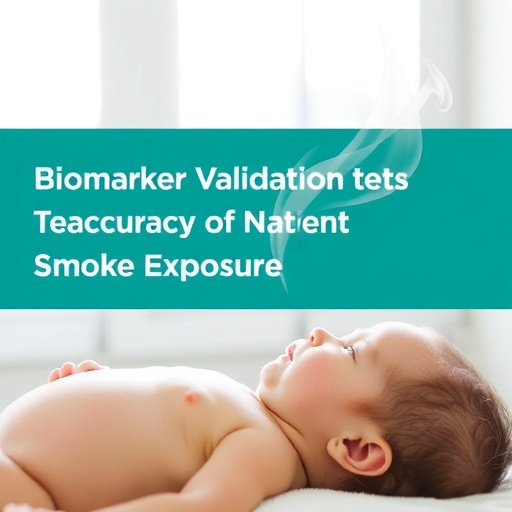
Biomarker Validation Tests Accuracy of Maternal Reports on Infant Smoke Exposure

July 17, 2026
in Technology and Engineering
Reading Time: 2 mins read
0
Biomarker Validation Tests Accuracy of Maternal Reports on Infant Smoke Exposure

Biomarker Validation Tests Accuracy of Maternal Reports on Infant Smoke Exposure

65
SHARES
587
VIEWS
Share on FacebookShare on Twitter
ADVERTISEMENT

A new biomarker-based analysis is shining a spotlight on a subtle statistical trap in studies that try to reconstruct infants’ exposure to secondhand smoke. The work focuses on maternal reports given either concurrently—around the time exposure occurs—or retrospectively, after months or years have passed. Because such evidence often informs public-health guidance, the reliability of “did your baby breathe smoke?” answers matters.

The central finding is not that every retrospective report is wrong. Instead, the threat lies in a specific pattern of error: mothers who deny that their infants were exposed may be unreliable in a nontrivial subset of cases. In other words, misclassification is asymmetric. Missing exposures are more likely to be missed than falsely reported.

This asymmetry can quietly distort prevalence estimates. If true exposure is undercounted, studies may conclude that fewer infants were harmed—or that harms are milder—than reality suggests. The bias does not just shift numbers; it can also mask developmental risks that researchers are trying to detect in early-life populations.

Using biomarker validation as a reference point, the study evaluates how closely self-report aligns with measurable evidence. Biomarkers provide a more objective snapshot of exposure, allowing researchers to estimate which reporting modes perform better and under what conditions errors emerge. The analysis argues that retrospective designs are particularly vulnerable when researchers treat “no exposure” answers as equally trustworthy.

The implications are broad for long-term cohort studies, where exposure histories often rely on memory. If denial-based misclassification is common, then the analysis framework needs to acknowledge differential error. Otherwise, confidence intervals may look narrow while the underlying exposure distribution is wrong.

The authors suggest that accuracy-improving strategies could reduce bias, including adding contextual measures that corroborate reporting (such as household smoke-related factors). When objective verification is unavailable, triangulating self-report with supporting indicators may offer a practical substitute.

Ultimately, the study reframes a methodological question into a surveillance one: not whether retrospective recall is imperfect, but whether the specific direction of error systematically favors underestimation. That distinction could help reconcile conflicting findings across studies and sharpen estimates of early developmental harm.

If the results generalize, future research should incorporate models that explicitly account for asymmetric misclassification, rather than assuming symmetric reporting error. Doing so may help ensure that policies respond to the exposures infants truly face, not just the exposures researchers can reliably measure through memory.

Subject of Research: Maternal reporting validity of infant secondhand smoke exposure (concurrent vs retrospective) validated with biomarkers
Article Title: Insights into the validity of concurrent and retrospective maternal report of infant smoke exposure using biomarker-based validation.
Article References:

Micalizzi, L., Sokolovsky, A.W., Murphy, C.M. et al. Insights into the validity of concurrent and retrospective maternal report of infant smoke exposure using biomarker-based validation.
Pediatr Res (2026). https://doi.org/10.1038/s41390-026-05238-3

Image Credits: AI Generated
DOI: https://doi.org/10.1038/s41390-026-05238-3
Keywords: Biomarker validation, maternal recall, secondhand smoke exposure, misclassification bias, epidemiologic study design, early-life health outcomes

Tags: asymmetrical misclassification in infant smoke exposure databiomarker validation for infant smoke exposurebiomarker-based comparison of self-reported and measured smoke exposurechallenges in reconstructing infant secondhand smoke exposureearly-life developmental risk detection in secondhand smokeeffects of underreporting on prevalence estimates of infant smoke harmimpact of reporting errors on public health risk assessmentmaternal report accuracy in secondhand smoke studiesreliability of retrospective versus concurrent maternal smoking reportsstatistical bias in passive smoke exposure research
Share26Tweet16
Previous Post

Elevation-Driven Warming at High Altitudes Across the Westerly Tibetan Plateau

Next Post

Unraveling Europe’s Energy Crisis with Structural Causal Models

Related Posts

Researchers Identify Optimal Conditions for Safer, Longer-Lasting Lithium Metal Batteries
Technology and Engineering

Researchers Identify Optimal Conditions for Safer, Longer-Lasting Lithium Metal Batteries

July 17, 2026
Unraveling Europe’s Energy Crisis with Structural Causal Models
Technology and Engineering

Unraveling Europe’s Energy Crisis with Structural Causal Models

July 17, 2026
Smart Hydrogels and Scaffolds Engineer Microenvironments to Regenerate Tissues
Technology and Engineering

Smart Hydrogels and Scaffolds Engineer Microenvironments to Regenerate Tissues

July 17, 2026
All-optical computing advances toward 100-GHz clock speeds
Technology and Engineering

All-optical computing advances toward 100-GHz clock speeds

July 17, 2026
Machine Learning Predicts Bronchopulmonary Dysplasia Seven Days After Birth Using Respiratory Data
Technology and Engineering

Machine Learning Predicts Bronchopulmonary Dysplasia Seven Days After Birth Using Respiratory Data

July 17, 2026
Hybrid Positioning System Promises Reliable Tracking When GPS Fails
Technology and Engineering

Hybrid Positioning System Promises Reliable Tracking When GPS Fails

July 17, 2026
Next Post
Unraveling Europe’s Energy Crisis with Structural Causal Models

Unraveling Europe’s Energy Crisis with Structural Causal Models

  • Mothers who receive childcare support from maternal grandparents show more

    Mothers who receive childcare support from maternal grandparents show more parental warmth, finds NTU Singapore study

    27656 shares
    Share 11059 Tweet 6912
  • University of Seville Breaks 120-Year-Old Mystery, Revises a Key Einstein Concept

    1061 shares
    Share 424 Tweet 265
  • Bee body mass, pathogens and local climate influence heat tolerance

    682 shares
    Share 273 Tweet 171
  • Researchers record first-ever images and data of a shark experiencing a boat strike

    546 shares
    Share 218 Tweet 137
  • Groundbreaking Clinical Trial Reveals Lubiprostone Enhances Kidney Function

    531 shares
    Share 212 Tweet 133
Science

Embark on a thrilling journey of discovery with Scienmag.com—your ultimate source for cutting-edge breakthroughs. Immerse yourself in a world where curiosity knows no limits and tomorrow’s possibilities become today’s reality!

RECENT NEWS

  • Researchers Identify Optimal Conditions for Safer, Longer-Lasting Lithium Metal Batteries
  • Blood DNA test better selects patients for prostate cancer radiopharmaceutical therapy
  • Surface-Enhanced Raman Enables Ultra-Sensitive Detection of Pb2+ Ions
  • Lurie Children’s Program Builds Pediatric Expertise to Treat More Youth Depression, Study Finds

Categories

  • Agriculture
  • Anthropology
  • Archaeology
  • Athmospheric
  • Biology
  • Biotechnology
  • Blog
  • Bussines
  • Cancer
  • Chemistry
  • Climate
  • Earth Science
  • Editorial Policy
  • Marine
  • Mathematics
  • Medicine
  • Pediatry
  • Policy
  • Psychology & Psychiatry
  • Science Education
  • Social Science
  • Space
  • Technology and Engineering

Subscribe to Blog via Email

Enter your email address to subscribe to this blog and receive notifications of new posts by email.

Join 5,146 other subscribers

© 2025 Scienmag - Science Magazine

Welcome Back!

Login to your account below

Forgotten Password?

Retrieve your password

Please enter your username or email address to reset your password.

Log In
No Result
View All Result
  • HOME
  • SCIENCE NEWS
  • CONTACT US

© 2025 Scienmag - Science Magazine

Discover more from Science

Subscribe now to keep reading and get access to the full archive.

Continue reading
