


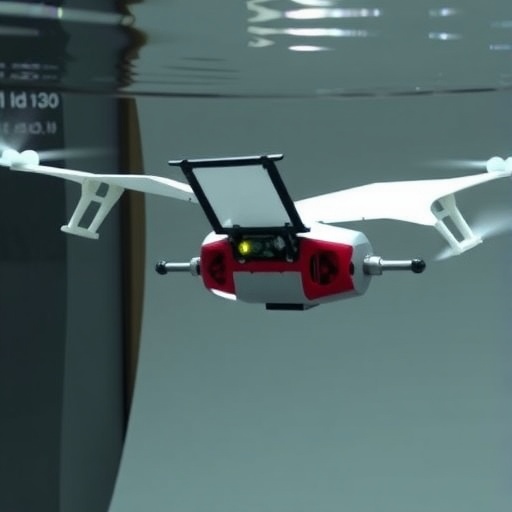
Inspired by the remarkable dual capabilities of diving birds, a collaborative team of engineers from MIT and EPFL in Lausanne, Switzerland, has developed a lightweight robot capable of both swimming underwater and flying through air. Weighing less than 300 grams, this flapping-wing aerial-aquatic vehicle (FAAV) draws directly on natural biomechanics to seamlessly transition between two fundamentally different mediums: water and air.
The challenge lies in the stark contrast between these environments. Water is approximately 1,000 times denser than air, demanding distinct mechanical approaches for propulsion in each. Yet, many bird species such as loons, puffins, and petrels have perfected the art of diving and flying, adapting their wing flapping frequencies and angles with precision. These insights inspired the FAAV’s design, which incorporates a central fuselage equipped with a waterproof electric motor and battery, two flexible, interchangeable wings, and a steerable tail for pitch control.
Testing the robot involved meticulous experimentation in both a controlled water tank and natural conditions at Lake Geneva. By varying wing sizes—small (60 cm), medium (80 cm), and large (100 cm)—flapping frequencies, and tail pitch angles, the researchers identified an optimal regime for smooth transition: flapping at about 5 Hz with medium-sized wings and tail pitched at 70 degrees. This configuration allows the FAAV to swim underwater at speeds approaching 1 m/s and to take flight in air at speeds up to 6 m/s, closely mirroring the performance of diving birds.
Interestingly, the FAAV achieves water-to-air transition without the need for a paddling action commonly employed by birds using their feet during takeoff. This finding challenges previous assumptions and points to the importance of wing flexibility and tail angle adjustments, which together generate sufficient lift and thrust to launch the robot out of water solely through wing flapping.
The wing membranes are coated with hydrophobic nanoparticles to minimize water adhesion, thus reducing drag and aiding in efficient flapping. The tail’s motorization is crucial in modulating pitch angle, enabling dynamic control necessary for both underwater swimming and aerial flight.
Looking ahead, the research team aims to enhance the robot’s maneuverability by enabling wing articulation beyond simple up-and-down flapping, allowing turns and improved responses to turbulent conditions like choppy waters and wind gusts. Such advancements could transform oceanographic research by providing a versatile, cost-effective tool for high-frequency, multi-location data collection. The FAAV could fly rapidly to points of interest, submerge to gather samples or measurements, and return to offload data, all autonomously and repeatedly.
This novel robot showcases how biomimicry combined with advanced engineering can overcome traditional barriers between aerial and aquatic locomotion. It opens exciting new avenues for environmental monitoring, coastal community safety, and marine biology studies, illustrating a future where robots explore the planet’s vast aquatic and aerial realms with unprecedented agility and efficiency.
Cite Scienmag News
Denise Maddox. (July 10, 2026). New flapping robot mimics diving bird’s swimming and flying abilities. Scienmag. https://scienmag.com/new-flapping-robot-mimics-diving-birds-swimming-and-flying-abilities/
Denise Maddox. "New flapping robot mimics diving bird’s swimming and flying abilities." Scienmag, 10 July 2026, https://scienmag.com/new-flapping-robot-mimics-diving-birds-swimming-and-flying-abilities/. Accessed 4 September 2026.
Denise Maddox. "New flapping robot mimics diving bird’s swimming and flying abilities." Scienmag. July 10, 2026. https://scienmag.com/new-flapping-robot-mimics-diving-birds-swimming-and-flying-abilities/


