

Thursday, July 9, 2026
Science
No Result
View All Result
  • Login
  • HOME
  • SCIENCE NEWS
  • CONTACT US
  • HOME
  • SCIENCE NEWS
  • CONTACT US
No Result
View All Result
Scienmag
No Result
View All Result
Home Science News Chemistry

Scientists Simulate Black Hole Phenomena in Laboratory Experiment

July 9, 2026
in Chemistry
Reading Time: 2 mins read
0
Scientists Simulate Black Hole Phenomena in Laboratory Experiment

Scientists Simulate Black Hole Phenomena in Laboratory Experiment

65
SHARES
587
VIEWS
Share on FacebookShare on Twitter
ADVERTISEMENT

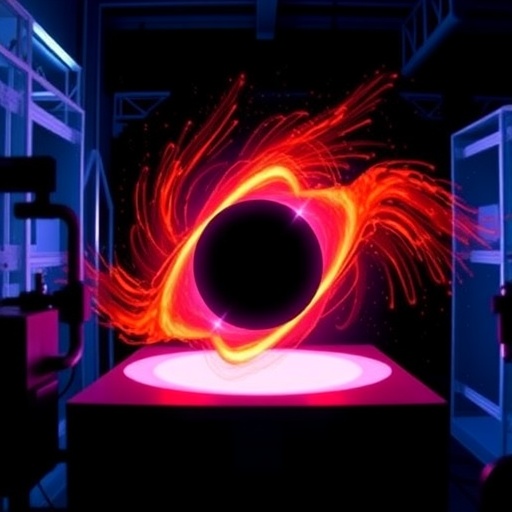
More than fifty years ago, Sir Roger Penrose proposed a fascinating concept where energy could be extracted from a rapidly spinning black hole. In his theory, a particle entering the black hole’s ergosphere—the region surrounding the black hole where space itself is dragged by its rotation—could split into two. One fragment would be absorbed by the black hole while the other could escape with more energy than the original particle. Building upon this, physicist Yakov Zel’dovich predicted that waves interacting with a fast-rotating object could similarly tap into its rotational energy and emerge amplified.

Now, a research team at the Advanced Science Research Center (CUNY ASRC) has turned these theoretical ideas into experimental reality. Publishing their findings in Nature, the scientists devised a novel radio-frequency device that mimics rotation at speeds unattainable by mechanical means. Instead of physically spinning matter, they engineered a synthetic rotation by modulating the device’s properties in space and time. This synthetic ultrafast rotation allows unprecedented exploration of wave amplification phenomena predicted by Penrose and Zel’dovich.

The device consists of a ring-shaped network of electronic resonators whose characteristics are rapidly and precisely modulated to create a traveling wave pattern around the loop. Although the physical device remains stationary, electromagnetic waves passing through perceive a system rotating at superluminal speeds. Under these conditions, waves with specific rotational patterns extract energy from this synthetic rotation, resulting in significant amplification akin to the Penrose–Zel’dovich effect.

According to Andrea Alù, the lead principal investigator, this approach establishes a new paradigm for wave-matter interaction, providing broadband selective amplification through engineered time-dependent metamaterials. The success of these experiments bridges the gap between abstract astrophysical concepts and practical laboratory applications. It also opens new frontiers for investigating wave dynamics under extreme rotational conditions, previously considered experimentally inaccessible.

Post-doctoral researcher Hadiseh Nasari emphasizes that this breakthrough has profound implications not only for fundamental physics but also for advanced applications in communications, optics, and photonics. The synthetic rotation framework offers a unique platform for simulating relativistic phenomena typically only observable in cosmic environments.

The researchers highlight that these findings pave the way for extending such ultrafast rotating schemes into photonic and quantum regimes. Potential future technologies could exploit these effects for enhanced light manipulation, quantum information processing, and innovative wave-based devices, transforming how we harness and control electromagnetic signals.

Supported by the U.S. Department of Defense, the National Science Foundation, and the Simons Foundation, this work stands as a milestone in experimental physics, offering a versatile toolkit to study and utilize rotational super-radiance and related phenomena with broad scientific and technological impact.


Subject of Research: Not applicable
Article Title: Observation of Floquet rotational super-radiance
News Publication Date: July 8, 2026
Web References: https://www.nature.com/articles/s41586-026-10725-y
References: 10.1038/s41586-026-10725-y
Image Credits: Dalila Pasotti and Hadiseh Nasari

Keywords

Physical sciences, Electromagnetism, Electromagnetic properties, Optics, Mechanics, Energy, Experimental physics

Tags: advanced scientific research on black hole phenomenablack hole analogsblack hole ergosphere phenomenaenergy extraction from rotating bodiesexperimental black hole physicslaboratory black hole simulationPenrose process energy extractionradio-frequency black hole analogsrotating wave systemssynthetic rotation in physics experimentswave amplification in rotating systemsZel’dovich amplification
Share26Tweet16
Previous Post

Many Women Diagnosed with Ovarian Cancer Following Emergency Hospital Admission

Next Post

KAUST researchers create novel method for device online identity verification

Related Posts

High-Speed Movies Revolutionize Scientific Disease Research Techniques
Chemistry

High-Speed Movies Revolutionize Scientific Disease Research Techniques

July 9, 2026
Scientists Quantify Substances Extracted by Cupping Therapy from Skin
Chemistry

Scientists Quantify Substances Extracted by Cupping Therapy from Skin

July 9, 2026
Saitama University creates novel molecular ladders for advanced organic electronics
Chemistry

Saitama University creates novel molecular ladders for advanced organic electronics

July 9, 2026
Stacking semiconductor chips like skyscrapers to enhance performance
Chemistry

Stacking semiconductor chips like skyscrapers to enhance performance

July 9, 2026
New Approach Advances Eco-Friendly Negative Thermal Expansion Materials
Chemistry

New Approach Advances Eco-Friendly Negative Thermal Expansion Materials

July 8, 2026
Over 90% of Mar Menor nutrient pollution stems from underground water flows
Chemistry

Over 90% of Mar Menor nutrient pollution stems from underground water flows

July 8, 2026
Next Post
KAUST researchers create novel method for device online identity verification

KAUST researchers create novel method for device online identity verification

  • Mothers who receive childcare support from maternal grandparents show more

    Mothers who receive childcare support from maternal grandparents show more parental warmth, finds NTU Singapore study

    27656 shares
    Share 11059 Tweet 6912
  • University of Seville Breaks 120-Year-Old Mystery, Revises a Key Einstein Concept

    1061 shares
    Share 424 Tweet 265
  • Bee body mass, pathogens and local climate influence heat tolerance

    682 shares
    Share 273 Tweet 171
  • Researchers record first-ever images and data of a shark experiencing a boat strike

    546 shares
    Share 218 Tweet 137
  • Groundbreaking Clinical Trial Reveals Lubiprostone Enhances Kidney Function

    531 shares
    Share 212 Tweet 133
Science

Embark on a thrilling journey of discovery with Scienmag.com—your ultimate source for cutting-edge breakthroughs. Immerse yourself in a world where curiosity knows no limits and tomorrow’s possibilities become today’s reality!

RECENT NEWS

  • India’s Ethanol Petrol Blend Risks Food Security and Water Sustainability
  • Penn Nursing Scholar Urges Recognition of Nurses’ Dual Expertise
  • New Research Reveals Necks Exist in Fishes and Amphibians
  • Hong Wang Joins Prestigious European Academy of Sciences and Arts

Categories

  • Agriculture
  • Anthropology
  • Archaeology
  • Athmospheric
  • Biology
  • Biotechnology
  • Blog
  • Bussines
  • Cancer
  • Chemistry
  • Climate
  • Earth Science
  • Editorial Policy
  • Marine
  • Mathematics
  • Medicine
  • Pediatry
  • Policy
  • Psychology & Psychiatry
  • Science Education
  • Social Science
  • Space
  • Technology and Engineering

Subscribe to Blog via Email

Enter your email address to subscribe to this blog and receive notifications of new posts by email.

Join 5,147 other subscribers

© 2025 Scienmag - Science Magazine

Welcome Back!

Login to your account below

Forgotten Password?

Retrieve your password

Please enter your username or email address to reset your password.

Log In
No Result
View All Result
  • HOME
  • SCIENCE NEWS
  • CONTACT US

© 2025 Scienmag - Science Magazine

Discover more from Science

Subscribe now to keep reading and get access to the full archive.

Continue reading
