


Conventional encryption methods rely on complex mathematical algorithms and the limits of current computing power. However, with the rise of quantum computers, these methods are becoming increasingly vulnerable, necessitating quantum key distribution (QKD). QKD is a technology that leverages the unique properties of quantum physics to secure data transmission. This method has been continuously optimized over the years, but establishing large networks has been challenging due to the limitations of existing quantum light sources.

Credit: by Light: Science & Applications (2024). DOI: 10.1038/s41377-024-01488-0
Conventional encryption methods rely on complex mathematical algorithms and the limits of current computing power. However, with the rise of quantum computers, these methods are becoming increasingly vulnerable, necessitating quantum key distribution (QKD). QKD is a technology that leverages the unique properties of quantum physics to secure data transmission. This method has been continuously optimized over the years, but establishing large networks has been challenging due to the limitations of existing quantum light sources.
In a new journal cover article published in Light: Science & Application, a team of scientists in Germany, led by Professor Fei Ding from Leibniz University of Hannover (LUH), Professor Stefan Kück from Physikalisch-Technische Bundesanstalt (PTB), Professor Peter Michler from University of Stuttgart and other co-workers have achieved the first intercity QKD experiment with a deterministic single-photon source, revolutionizing how we protect our confidential information from cyber threats.
Semiconductor quantum dots (QDs), referred as the artificial atoms in the quantum world, show great potential for illuminating quantum lights used in quantum information technologies. This breakthrough reveals the feasibility of semiconductor single-photon sources for a secure long-distance quantum internet in real life.
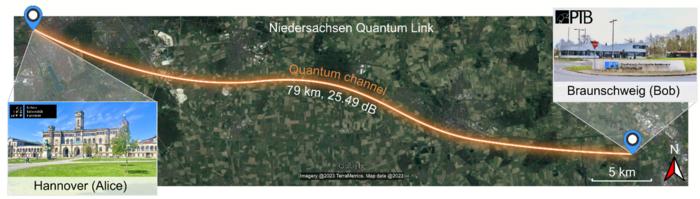
Professor Fei Ding explained “We work with quantum dots, which are tiny structures similar to atoms but tailored to our needs. For the first time, we used these ‘artificial atoms’ in a quantum communication experiment between two different cities. This setup, known as the ‘Niedersachsen Quantum Link,’ connects Hannover and Braunschweig via optical fibre”
The intercity experiment is performed in the German federal state of Niedersachsen, in which a deployed fibre of ∼79 km length connects the Leibniz University of Hannover (LUH) and Physikalisch-Technische Bundesanstalt (PTB) Braunschweig. Alice, located at the LUH, statically prepares single photons that are encrypted in polarisation. Bob, located at the PTB, contains a passive polarisation decoder to decrypt the polarisation states of the received single photons, coming through the fibre-based quantum channels. This is also the first quantum communication link in Lower Saxony of Germany.
As a result, the researchers have achieved stable and fast transmission of secret keys.
They first verified that positive secret key rates (SKRs) are determined achievable for distances up to 144 km corresponding to 28.11 dB loss in the laboratory. A high-rate secret key transmission with a low quantum bit error ratio (QBER) for 35 hours was ensured based on this deployed fibre link.
“Comparative analysis with existing QKD systems involving SPS reveals that the SKR achieved in this work goes beyond all current SPS based implementations. Even without further optimisation of the source and setup performance it approaches the levels attained by established decoy state QKD protocols based on weak coherent pulses.” The first author of the work, Dr. Jingzhong Yang remarked.
The researchers speculate that QDs also offer great prospect for the realisation of other quantum internet applications, such as quantum repeaters, distributed quantum sensing, as they allow for inherent storage of quantum information and can emit photonic cluster states. The outcome in this work underscores the viability of seamlessly integrating semiconductor single-photon sources into realistic, large-scale and high-capacity quantum communication networks.
The need for secure communication is as old as humanity itself. Quantum communication uses the quantum characteristics of light to ensure that messages cannot be intercepted. “Quantum dot devices emit single photons, which we control and send to Braunschweig for measurement. This process is fundamental to quantum key distribution,” Ding said. He expressed his excitement about the outcome of this collaborative effort: “Some years ago, we only dreamt of using quantum dots in real-world quantum communication scenarios. Today, we are thrilled to demonstrate their potential for many more fascinating experiments and applications in the future, moving towards a ‘quantum internet’.”
Journal
Light Science & Applications
Article Title
High-rate intercity quantum key distribution with a semiconductor single-photon source
Cite Scienmag News
Katie Riggs. (August 9, 2024). Quantum leap: breakthrough for secure communication with ‘artificial atoms’. Scienmag. https://scienmag.com/quantum-leap-breakthrough-for-secure-communication-with-artificial-atoms/
Katie Riggs. "Quantum leap: breakthrough for secure communication with ‘artificial atoms’." Scienmag, 9 August 2024, https://scienmag.com/quantum-leap-breakthrough-for-secure-communication-with-artificial-atoms/. Accessed 5 September 2026.
Katie Riggs. "Quantum leap: breakthrough for secure communication with ‘artificial atoms’." Scienmag. August 9, 2024. https://scienmag.com/quantum-leap-breakthrough-for-secure-communication-with-artificial-atoms/

