


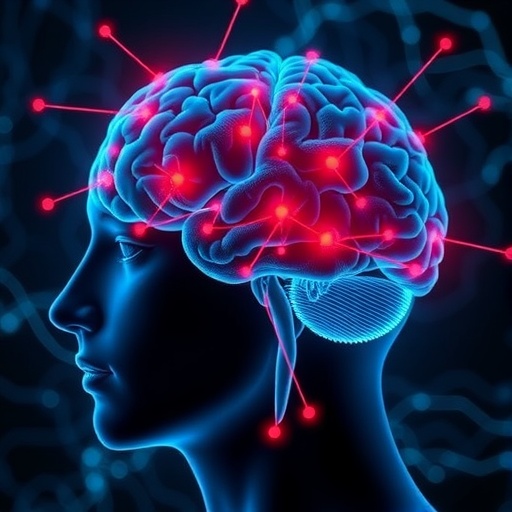
In an era where the boundaries of neuroscience are continually being pushed, recent groundbreaking research has unveiled novel complexities in brain function during pharmacologically induced states. A pioneering study, soon to be published in Translational Psychiatry in 2026, delves into the enigmatic neural dynamics orchestrated by ketamine administration, particularly in the context of treatment-resistant depression among the elderly. This research uncovers how high-order brain interactions serve as a functional marker for therapeutic response, marking a significant stride toward precision medicine in psychiatric care.
Ketamine, once primarily known as an anesthetic and recreational drug, has surged into the spotlight as a rapidly acting antidepressant. Its remarkable ability to alleviate depression symptoms within hours contrasts starkly with the delayed onset characteristic of traditional selective serotonin reuptake inhibitors (SSRIs). However, not all patients benefit equally, especially among late-life populations grappling with treatment-resistant depression (TRD). Understanding the neural underpinnings that differentiate responders from non-responders has, until now, remained elusive.
The research team led by Shah, Herzog, and Swann employed advanced neuroimaging techniques to investigate brain network dynamics under ketamine’s influence. Notably, they focused on “high-order brain interactions,” a sophisticated measure reflecting the complexity of communication across multiple brain regions simultaneously, beyond simple pairwise connections. These intricate interactions provide a window into the brain’s functional architecture during altered states induced by ketamine.
Central to their findings is the revelation that ketamine does not merely alter isolated regional activity but reconfigures the entire network topology of the brain. During induced state changes, high-order interactions become significantly modulated, suggesting that ketamine facilitates a global recalibration of neural circuitry. This reorganization appears closely tied to clinical improvements, particularly in elderly patients whose depression has proven refractory to conventional interventions.
The study leveraged cutting-edge computational models grounded in information theory and network neuroscience to quantify high-order interdependencies. Such models surpass traditional functional connectivity analyses by capturing multi-dimensional interplays among neural ensembles. Through these methodologies, the authors identified predictive markers within these high-order patterns that correlate strongly with individual treatment outcomes, thus offering a biomarker for responsiveness.
Elderly individuals with TRD present unique challenges due to age-related neurobiological changes and accumulated chronicity of illness. The variability in ketamine’s antidepressant efficacy within this demographic underscores the necessity for personalized approaches. This research bridges a critical gap by proposing that the nuanced understanding of brain state transitions—captured through high-order interactions—could guide tailored therapeutic strategies.
One striking feature of the study is its emphasis on dynamic brain states rather than static snapshots. Ketamine-induced alterations were tracked temporally, revealing that certain phases of neural network reconfiguration correspond to heightened responsiveness. This temporal profiling offers a richer, more granular perspective on how pharmacological agents modulate brain function and mood states dynamically.
Beyond its clinical implications, the study enriches fundamental neuroscience by illustrating how transient pharmacological perturbations can unmask latent network properties. The brain’s adaptability and resilience emerge vividly when probed via ketamine’s mechanisms, challenging existing paradigms about neuropsychiatric disorders as solely localized dysfunctions. It emphasizes the orchestration of complex, multi-regional interplay as a substrate for mental health and disease.
Furthermore, the investigation sheds light on ketamine’s role in modulating excitatory-inhibitory balance and synaptic plasticity, known mediators of its rapid antidepressant effects. By linking these molecular and cellular events to high-order network changes, the research integrates multiple layers of brain organization, from microcircuits to large-scale networks.
Importantly, the use of functional magnetic resonance imaging (fMRI) combined with sophisticated analytical frameworks allowed for non-invasive and replicable insights into the living brain’s functional architecture. This approach sets a precedent for future explorations into drug-induced brain state modifications and their relevance for psychiatric therapeutics.
The findings also open avenues for developing adjunctive treatments that can enhance or stabilize beneficial network configurations induced by ketamine. For example, neuromodulatory techniques such as transcranial magnetic stimulation (TMS) or targeted cognitive interventions might be synchronously deployed to sustain favorable high-order interaction patterns.
Given the burgeoning global burden of depression and the unique vulnerabilities of late-life populations, these insights carry profound public health implications. Identifying functional markers of treatment response paves the way for more efficient clinical decision-making, minimizing trial-and-error prescriptions and accelerating relief for those suffering with resistant depressive disorders.
While the excitement surrounding ketamine’s antidepressant properties continues to grow, this study advocates for careful consideration of individual brain network states when administering such treatments. It posits that beyond dosage and pharmacokinetics, the brain’s predisposed connectivity architecture critically shapes outcomes, mandating a neuroscience-informed clinical framework.
Moreover, this research underscores the value of interdisciplinary collaborations, integrating psychiatry, computational neuroscience, neuroimaging, and pharmacology to unravel complex psychiatric phenomena. Such integrative approaches herald a new frontier where mechanistic insights fuel innovative therapies and transform lives afflicted by severe mental illness.
In conclusion, the 2026 study by Shah and colleagues represents a watershed moment in understanding how ketamine-induced brain state changes fundamentally correspond to therapeutic response in late-life treatment-resistant depression. Its detailed interrogation of high-order brain interactions not only elucidates ketamine’s mode of action but also offers a tangible biomarker to predict and monitor treatment efficacy. As the scientific community continues to decode the brain’s intricate symphony, such contributions illuminate the path toward personalized, effective interventions for psychiatric disorders previously deemed intractable.
Cite Scienmag News
Glenn Wilkins. (July 4, 2026). Ketamine Alters Brain Interactions in Resistant Depression. Scienmag. https://scienmag.com/ketamine-alters-brain-interactions-in-resistant-depression/
Glenn Wilkins. "Ketamine Alters Brain Interactions in Resistant Depression." Scienmag, 4 July 2026, https://scienmag.com/ketamine-alters-brain-interactions-in-resistant-depression/. Accessed 4 September 2026.
Glenn Wilkins. "Ketamine Alters Brain Interactions in Resistant Depression." Scienmag. July 4, 2026. https://scienmag.com/ketamine-alters-brain-interactions-in-resistant-depression/


