


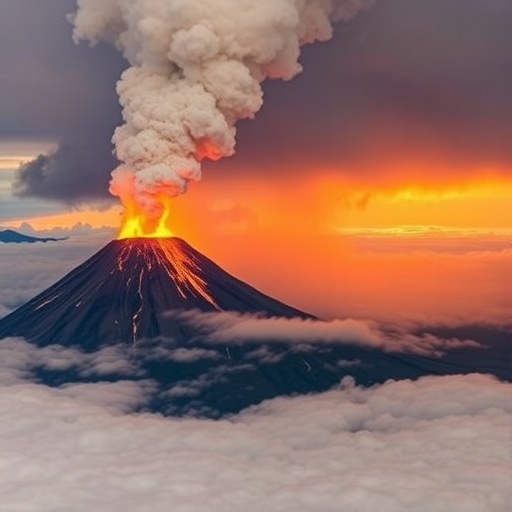
Stratospheric water vapor (SWV) plays a critical role in Earth’s climate system and stratospheric chemistry, yet the precise mechanisms governing its variability have remained elusive. New findings reveal that moderate volcanic eruptions and extreme wildfire events since 2005 have significantly increased stratospheric moisture levels, challenging previous assumptions about the pathways driving SWV fluctuations. This research, combining satellite observations with advanced climate model simulations, sheds light on the complex interplay between aerosol perturbations and stratospheric water vapor content, offering crucial insights into climate feedbacks and ozone chemistry.
The stratosphere, a key atmospheric layer extending from about 10 to 50 kilometers above Earth’s surface, contains water vapor concentrations that, though minuscule compared to the troposphere, profoundly impact radiative forcing and ozone photochemistry. Traditionally, stratospheric water vapor variations have been largely attributed to natural climate variability and temperature changes at the tropical tropopause, the boundary between the troposphere and the stratosphere. However, the discrete influence of episodic aerosol injections from volcanic activities and biomass burning, and their aerosol-induced tropopause warming impact, has lacked robust observational evidence until now.
Volcanic eruptions have long been hypothesized to enhance stratospheric humidity through the warming of the tropopause caused by aerosol scattering and absorption of solar radiation. This study confirms and quantifies this effect by analyzing data from multiple moderate-sized volcanic eruptions occurring since 2005. These events generate sulfate aerosols that increase the tropopause temperature, consequently facilitating the upward transport of water vapor into the stratosphere. Such warming reduces the cold trap efficiency at the tropopause, allowing more moist air to infiltrate the stratospheric layers.
In parallel, the role of extreme wildfires in modulating SWV has emerged as an important but previously underappreciated driver. The intense pyrocumulus convection associated with large wildfire events can penetrate the lower stratosphere, directly injecting water vapor along with smoke particles. This “self-lofting” mechanism propels moisture upward independently of tropopause temperature changes, representing a new pathway by which terrestrial processes can affect upper atmospheric humidity.
Quantitatively, the combined effect of these aerosol-related processes has increased SWV concentrations by approximately 0.1 parts per million by volume (ppmv) at roughly 83 hPa pressure level in the lower stratosphere, corresponding to an added 76–203 million tons of water vapor between 2005 and 2021. This augmentation accounts for around 36 ± 7% of the observed increase in stratospheric water vapor over this time span, which is comparable in magnitude to the enhancement driven by long-term global surface warming.
Importantly, these episodic enhancements in SWV partly offset a sharp 10% decline in stratospheric water vapor observed around the year 2000. That earlier reduction had been linked to changes in tropical tropopause temperatures and circulation patterns, underscoring the sensitivity of stratospheric hydrology to both steady climate trends and punctuated aerosol injections. The new findings elevate moderate volcanic eruptions and extreme wildfires from secondary to principal factors influencing stratospheric moisture content.
In addition to radiative impacts, elevated stratospheric water vapor influences the chemical composition of the stratosphere by participating in ozone-related chemical cycles. Increased water vapor can accelerate ozone depletion via enhanced HOx (hydroxyl radical) catalytic cycles, potentially delaying the recovery of the ozone layer. Thus, the aerosol-driven humidity changes documented here bear significant implications not only for climate but also for stratospheric photochemistry and UV radiation shielding.
The study integrates multi-decadal satellite retrievals, including limb-sounding humidity measurements, with high-resolution chemistry-climate model experiments that simulate aerosol-radiation interactions and convective injection processes. This comprehensive approach enables isolation of contributions from volcanic sulfate aerosol radiative forcing and wildfire-induced self-lofting events, providing a mechanistic understanding of their respective roles and relative importance.
As climate warming continues to exacerbate wildfire frequency and intensity, these findings signal an urgent need to incorporate aerosol-mediated stratospheric water vapor pathways into predictive models. Failure to do so risks underestimating future radiative forcing feedbacks, stratospheric temperature trends, and ozone recovery trajectories. Moreover, these insights highlight the interconnectedness of surface phenomena and upper atmospheric chemistry within a changing climate system.
Volcanic aerosols and wildfire smoke are transient yet potent perturbations that induce lasting stratospheric changes. Their influence extends beyond direct radiative impacts to modifying fundamental atmospheric moisture distributions. Recognizing these links advances our ability to interpret observed trends and improves projections of future climate behavior in a warming, fire-prone world.
This new paradigm underscores the necessity for sustained satellite monitoring of stratospheric water vapor alongside detailed characterization of aerosol optical properties and injection heights. Enhanced observational capabilities combined with evolving earth system models will be essential to refine estimates of stratospheric humidity variability and its climatic and chemical consequences.
In sum, the evidence that moderate volcanic eruptions and extreme wildfires systematically humidify the stratosphere represents a major advance in atmospheric science. These processes, once overlooked, now emerge as key modulators of stratospheric composition and climate forcing. Their effects compound existing human-induced changes and must be accounted for in holistic assessments of the stratosphere’s evolving state.
Looking forward, climate mitigation and adaptation strategies should consider the climate–wildfire feedback loops affecting upper atmospheric moisture. The amplification of extreme fires by global warming, alongside continuing volcanic activity, will likely ensure that aerosol-driven stratospheric water vapor perturbations remain an active factor in Earth’s future climate dynamics and atmospheric chemistry. This discovery thus frames new frontiers for interdisciplinary research spanning volcanology, wildfire science, atmospheric dynamics, and climate modeling.
Cite Scienmag News
Denise Maddox. (July 2, 2026). Volcanic Eruptions, Wildfires Moisturize Stratosphere. Scienmag. https://scienmag.com/volcanic-eruptions-wildfires-moisturize-stratosphere/
Denise Maddox. "Volcanic Eruptions, Wildfires Moisturize Stratosphere." Scienmag, 2 July 2026, https://scienmag.com/volcanic-eruptions-wildfires-moisturize-stratosphere/. Accessed 1 September 2026.
Denise Maddox. "Volcanic Eruptions, Wildfires Moisturize Stratosphere." Scienmag. July 2, 2026. https://scienmag.com/volcanic-eruptions-wildfires-moisturize-stratosphere/


