


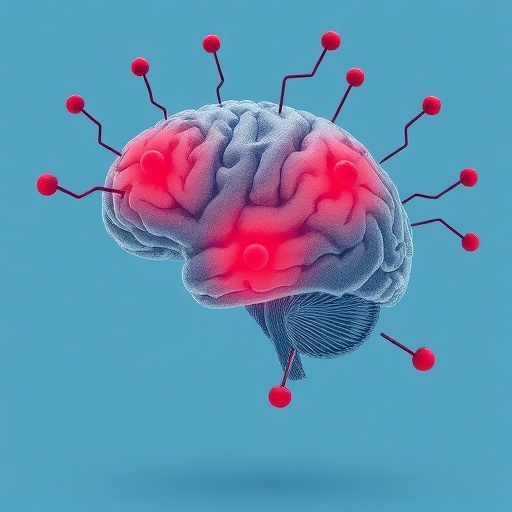
In the intricate orchestra of the brain, much emphasis has traditionally been placed on the engine’s power—the excitatory forces that drive thought, emotion, and behavior. Yet, an equally vital player often escapes the spotlight: the brake. Emerging from decades of scattered neuroscientific research, a comprehensive new review highlights somatostatin, a small but potent neuropeptide, as a crucial regulator that modulates stress responses across distinct brain circuits. This peptide, encoded in inhibitory neurons, functions less as a mere suppressor and more as an essential sculptor, fine-tuning the balance between excitation and inhibition to maintain mental equilibrium.
Somatostatin’s discovery itself was serendipitous, revealing the elegant intricacies of biological counterbalance. Initially identified in 1973 by Brazeau and colleagues, the peptide was found not as a stimulator but as an inhibitor of growth hormone release. Since this seminal moment, the molecule has been appreciated for its consistent “stop” signal across numerous physiological systems. However, it is within the central nervous system that somatostatin truly exhibits its complex neurochemical choreography, existing primarily in two isoforms—SST-14 and SST-28—and influencing neural signaling through a family of five distinct receptors. The extensive machinery dedicated to this inhibitory peptide underscores a principle fundamental to brain function: freedom of mind arises not from unchecked activation, but from the nuanced application of restraint.
Central to the brain’s inhibitory network, somatostatin neurons represent a subclass of interneurons that guard against runaway excitation. These neurons constitute approximately one-third of inhibitory interneurons within many cortical regions. Unlike their fast-firing counterparts, somatostatin neurons exhibit low-frequency, steady activity, releasing both GABA and somatostatin, effectively applying a dual-layered brake on cortical circuits. Their synaptic reach extends beyond local neighborhoods: these cells interact with other interneurons, exert influence over principal pyramidal neurons, and project to distant regions, thus integrating and modulating neural activity on multiple levels. Experimental manipulations reveal their behavioral significance—silencing these neurons can evoke heightened fear responses, behavioral freezing, or anhedonia, while their activation often restores emotional balance.
Perhaps most compelling is the nuanced relationship between somatostatin neurons and stress. Long considered a uniform disturbance, stress in fact carves and reshapes the inhibitory landscape in complex, region-specific ways. Acute stressors can induce rapid elevations of somatostatin levels in areas like the dentate gyrus within minutes, while prolonged mild stress results in a decline of somatostatin-positive neurons, particularly in the hippocampus, correlating with diminished reward seeking and motivational drive. Different stress modalities—predator odors, open field exposure, restraint, sleep deprivation, early maternal separation—each imprint unique signatures on somatostatin circuitries spanning the amygdala, prefrontal cortex, zona incerta, bed nucleus of the stria terminalis, and septum, highlighting the heterogeneity in neurobiological stress processing.
Dr. Hongling Guo, leading author of the review and researcher at Peking University Shenzhen Graduate School’s School of Chemical Biology and Biotechnology, emphasizes the selective vulnerability of these interneurons. “Somatostatin neurons are not passive bystanders in stress but are actively remodeled,” Guo states. Importantly, the affected circuits coincide with those governing mood and emotional regulation, placing these neurons squarely at the nexus of stress-related psychiatric disorders.
Neuroscience’s technological leap has been instrumental in untangling the connectivity of somatostatin neurons. Moving beyond simple cell counts, optogenetics and chemogenetics have revealed these cells as dynamic junctions within neural networks rather than isolated units. For example, in the central amygdala, somatostatin neurons modulate fear circuits by influencing downstream structures such as the zona incerta and periaqueductal gray. The zona incerta itself emerges as a critical relay station, mediating the interplay between the anterior cingulate cortex and the lateral habenula. Modulation of this circuit can shift an animal’s behavioral state dramatically—from despair to resilience—revealing a powerful point of intervention for mood disorders.
Chronic restraint stress, investigated in Guo’s lab, exemplifies how silencing somatostatin neurons in the zona incerta induces depressive-like behaviors, while reactivation produces rapid antidepressant-like effects. This convergence of findings across brain regions underscores a consistent motif: somatostatin neurons orchestrate emotional responses through their wiring, offering a unifying framework to understand mood dysregulation.
Underlying this circuitry are molecular and genetic facets of profound complexity, further complicated by sex differences. Single-cell transcriptomic analyses reveal that chronic stress engenders sex-specific gene expression patterns within somatostatin neurons. Genes implicated in GABA synthesis, intracellular cyclic signaling pathways, glutamate receptor subunits, cholinergic receptors, and growth hormone responsiveness all exhibit distinct regulation in males versus females. Dr. Shupeng Li of Tsinghua University emphasizes the therapeutic implications: “Treatments effective in one sex may be inert or even detrimental in the other, mandating a sex-informed approach in clinical interventions targeting these circuits.”
In human studies, postmortem analyses and cerebrospinal fluid measurements consistently report a somatostatin deficit in major depressive disorder, with greater reductions noted in females. This diminution extends beyond depression to schizophrenia, bipolar disorder, Alzheimer’s disease, Parkinson’s disease, and certain epilepsies, suggesting a pervasive role across brain pathologies. Intriguingly, post-traumatic stress disorder bucks this trend, with elevated somatostatin levels detected, underscoring the complex bidirectional effects of this neuropeptide contingent on disorder pathology. Whether somatostatin alterations represent causes, consequences, or epiphenomena remains an open question vital to unraveling mental illness etiology.
The translational potential of somatostatin-based therapies is tantalizing yet fraught with challenges. Existing somatostatin analogs—octreotide, lanreotide, and pasireotide—have found clinical use primarily in oncology and endocrinology due to their inhibitory effects on hormonal tumors, rather than brain disorders. The blood-brain barrier presents a formidable obstacle to delivering these peptides centrally. Fast-acting antidepressants like ketamine and scopolamine appear to engage interneuron networks that include somatostatin cells, hinting at indirect mechanisms to harness these circuits pharmaceutically. However, the direct application of somatostatin analogs for mood regulation remains unrealized, emphasizing the need for novel delivery strategies or small-molecule modulators capable of crossing brain barriers.
Fundamental questions remain elusive. How exactly does chronic stress remodel somatostatin neurons—morphologically, synaptically, and genetically—well before clinical symptoms manifest? What modes of communication exist between somatostatin neurons and glial or other non-neuronal brain cells during stress exposure? Can targeted gene therapies safely and selectively modulate these neurons in humans, moving beyond rodent models? The review pays homage to Dr. Seymour Reichlin, a pioneering figure in hypothalamic-pituitary axis research, reminding us that the journey to fully grasp somatostatin’s brain roles is ongoing, with the molecule continuing to redefine neuropsychiatric maps decades after its discovery.
This synthesis of fifty years of research reframes somatostatin not as a simple suppressor but as a dynamic neurochemical brake system integral to stress modulation and mental health. Its multifaceted roles across neural circuits, sexes, and disorders illuminate new frontiers in neuroscience and psychiatric medicine, inspiring innovative approaches to unraveling and alleviating the burdens of stress-linked disorders.
Cite Scienmag News
Cassandra Pierce. (June 30, 2026). How the Brain Uses Somatostatin to Curb Stress: Exploring Its Role in Fear, Mood, and Resilience. Scienmag. https://scienmag.com/how-the-brain-uses-somatostatin-to-curb-stress-exploring-its-role-in-fear-mood-and-resilience/
Cassandra Pierce. "How the Brain Uses Somatostatin to Curb Stress: Exploring Its Role in Fear, Mood, and Resilience." Scienmag, 30 June 2026, https://scienmag.com/how-the-brain-uses-somatostatin-to-curb-stress-exploring-its-role-in-fear-mood-and-resilience/. Accessed 1 September 2026.
Cassandra Pierce. "How the Brain Uses Somatostatin to Curb Stress: Exploring Its Role in Fear, Mood, and Resilience." Scienmag. June 30, 2026. https://scienmag.com/how-the-brain-uses-somatostatin-to-curb-stress-exploring-its-role-in-fear-mood-and-resilience/


