


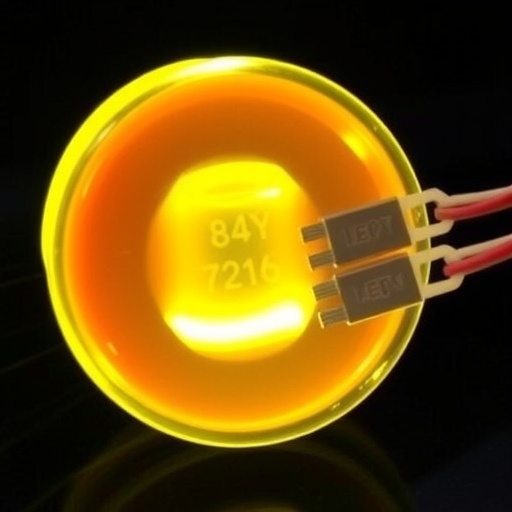
In a groundbreaking study poised to revolutionize the field of flexible electronics, researchers have unveiled the underlying impedance characteristics in iontronic tactile sensors that inherently separate temperature and pressure signals. This advancement, detailed by Hou, Mu, Zhang, and colleagues in the upcoming volume of npj Flexible Electronics, could usher in a new era of precision sensing technology, enabling devices to operate with unprecedented accuracy under varying environmental conditions.
Iontronic tactile sensors, a niche yet rapidly evolving class of sensory devices, function by transducing mechanical stimuli into electrical signals using ionic movements within soft, flexible materials. Unlike traditional electronic sensors that rely solely on electron flow, iontronic sensors leverage the unique properties of ions to achieve superior sensitivity and flexibility, making them ideal candidates for wearable technology, robotics, and interactive surfaces. However, a persistent challenge has been the entanglement of temperature and pressure effects within the sensor output, often complicating data interpretation and limiting practical applications.
The team’s work delves deeply into the sensor’s impedance – a measure of opposition to the alternating current that flows through the device when stimulated – revealing nuanced behaviors that vary distinctively with temperature and pressure. By mapping these impedance profiles, the researchers demonstrated an innovative method to intrinsically decouple the two parameters at a fundamental level, circumventing the need for external calibration or complex signal-processing algorithms which have traditionally been employed.
This intrinsic decoupling mechanism is rooted in the distinct dependence of ion transport and capacitance phenomena within the sensor’s architecture. Specifically, the researchers identified that pressure primarily influences the mechanical deformation of the sensor’s ionic interface, modulating the capacitance characteristics. Conversely, temperature predominantly affects the ionic conductivity and dielectric properties of the materials, altering the resistive components of impedance. Parsing these independent variations creates a reliable spectral window where each environmental variable can be measured independently with high fidelity.
The implications of such differentiation extend to numerous applications where precision tactile sensing under fluctuating thermal conditions is paramount. For instance, robotic hands designed for delicate manipulation often encounter temperature gradients that can distort tactile feedback, a limitation now addressable through this iontronic approach. Similarly, health-monitoring wearables could accurately track physiological pressures without interference from ambient temperature changes, significantly enhancing data reliability and user comfort.
Underlying this achievement is a sophisticated sensor design optimized through meticulous material selection and nano-scale engineering. The device incorporates layered ionic gels combined with conductive polymer electrodes, carefully engineered to respond predictably to mechanical stress and thermal variation. Advanced impedance spectroscopy provided a rich dataset to characterize sensor behavior across a spectrum of frequencies, revealing clear signatures attributable to pressure and temperature stimuli.
To validate their findings, the research team conducted extensive experiments encompassing controlled temperature and pressure environments. These experiments demonstrated that variations in impedance spectra could be consistently decomposed into components arising from mechanical deformation and thermal influences. Moreover, they confirmed that such signal decomposition remained robust over numerous cycles, indicating potential for durable, real-world deployment where environmental conditions fluctuate widely.
The methodology employed leverages sophisticated modeling that integrates electrochemical principles and solid mechanics. By combining experimental data with theoretical simulations, the researchers developed an analytical framework capable of predicting sensor responses to combined stimuli. This predictive capacity paves the way for next-generation sensor arrays, where embedded intelligence can autonomously interpret complex tactile data streams without human intervention.
This study not only elucidates fundamental science behind iontronic tactile sensors but also provides a practical pathway toward their commercial and industrial adaptation. The inherent temperature-pressure decoupling effectively removes a significant barrier to reliable sensor integration in environments characterized by thermal variability, such as outdoor robotics, industrial process monitoring, and medical diagnostics.
Furthermore, the approach champions sustainability by favoring soft, flexible materials that are more environmentally friendly and potentially easier to fabricate at scale compared to rigid, silicon-based counterparts. This aligns with broader trends in flexible electronics research aiming at creating adaptable, wearable tech that can seamlessly blend into daily life, expanding human-machine interfaces beyond traditional limits.
Looking ahead, the research opens several avenues for future exploration. One promising direction involves integrating these sensors with machine learning algorithms capable of interpreting complex impedance data in real time, further enhancing the sensor’s autonomy and application scope. Development efforts might also focus on miniaturization and integration with wireless communication modules to facilitate remote, real-time monitoring across diverse fields.
The robustness observed in impedance-based decoupling suggests compatibility with multi-modal sensing platforms, where tactile sensors can be combined with other environmental sensors (humidity, gas composition) to construct comprehensive environmental monitoring systems. Such synergy could yield smart skins for robots or intelligent prosthetics capable of nuanced sensing akin to human tactile perception.
This pioneering research reaffirms the burgeoning potential of iontronics in flexible sensoring technologies, where interdisciplinary approaches marry materials science, electrochemistry, and mechanical engineering. The ability to disentangle temperature effects from pressure responses represents a significant stride toward tactile sensors that truly mimic the human sense of touch, with all its adaptability and precision.
In summary, the elucidation of how impedance characteristics in iontronic tactile sensors enable intrinsic temperature-pressure decoupling promises to redefine sensor accuracy across many high-impact applications. By leveraging the distinctive electrochemical and mechanical responses governing ionic transport, the researchers have laid a solid foundation for advanced tactile devices that perform reliably regardless of thermal interference.
As technology increasingly demands sensors that can operate flawlessly in complex, variable environments, this work offers a vital technological leap. It empowers designers and engineers to create next-generation tactile systems that are not only sensitive and flexible but also smart enough to parse complex stimuli internally, delivering clean, actionable data streams essential for sophisticated real-world applications.
With the anticipated publication of this research in npj Flexible Electronics in 2026, the scientific community eagerly awaits further breakthroughs extending this paradigm, enabling a future where flexible, intelligent tactile sensors become ubiquitous tools enriching daily life and technological innovation alike.
Cite Scienmag News
Denise Maddox. (June 22, 2026). Impedance Enables Temperature-Pressure Decoupling in Iontronic Sensors. Scienmag. https://scienmag.com/impedance-enables-temperature-pressure-decoupling-in-iontronic-sensors/
Denise Maddox. "Impedance Enables Temperature-Pressure Decoupling in Iontronic Sensors." Scienmag, 22 June 2026, https://scienmag.com/impedance-enables-temperature-pressure-decoupling-in-iontronic-sensors/. Accessed 3 September 2026.
Denise Maddox. "Impedance Enables Temperature-Pressure Decoupling in Iontronic Sensors." Scienmag. June 22, 2026. https://scienmag.com/impedance-enables-temperature-pressure-decoupling-in-iontronic-sensors/


