


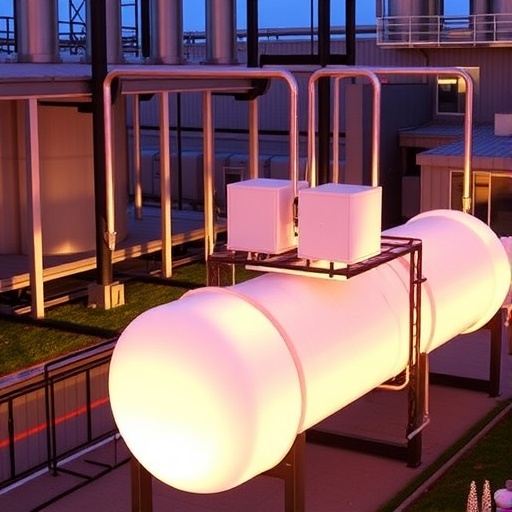
In a groundbreaking advancement for energy recovery at liquefied natural gas (LNG) terminals, researchers from The University of Western Australia have demonstrated a significant leap in harnessing LNG’s wasted cold energy. Their comprehensive study explores state-of-the-art two-stage Rankine cycle configurations that optimize the conversion of cryogenic LNG temperatures into usable electric power, a critical stride toward enhancing the sustainability of natural gas infrastructure.
LNG is transported globally at cryogenic temperatures near -162 °C, enabling efficient long-distance shipment and storage. However, the regasification process, which warms LNG back to piping and consumer-ready conditions, typically wastes much of this substantial cooling potential. Conventional terminal practices often vent this cold energy to ambient surroundings or seawater, resulting in a considerable loss of exergy—the maximum usable work obtainable from a system. This inefficiency presents an untapped opportunity for energy recovery, one that the new research systematically addresses through advanced thermodynamic cycle engineering.
Rankine cycles, long established in power generation, convert thermal gradients into mechanical work via phase changes of working fluids. The research team innovatively applied a two-stage variant of this cycle, wherein separate working fluids operate in tandem through upper and lower cycles bridged by an intermediate heat exchanger. This design effectively narrows the temperature difference between the cold LNG and warmer seawater, mitigating thermodynamic irreversibilities caused by temperature mismatches and boosting overall cycle efficiency.
Crucially, the selection of optimal working fluids is paramount to maximizing system performance. The researchers conducted a rigorous screening of 30 single fluids and 49 binary mixtures, leveraging a sophisticated optimization framework that couples genetic algorithms with Aspen HYSYS simulations. Parameters such as evaporation and condensation pressures, intermediate heat exchanger temperatures, and mixture compositions were meticulously tuned to identify fluid combinations that harmonize with the LNG temperature profiles.
The results reveal that hexafluoroethane (R116) excels as the upper cycle fluid due to its dry-fluid properties that promote superior heat rejection characteristics, while ethane (R170) and pentafluoroethane (R1150) emerged as leading candidates for the lower cycle. Notably, the pairing of R116 in the upper cycle with R170 in the lower cycle achieved a net power output of 7.5 MW with a thermal efficiency of 24.1%, underscoring the potential of single-fluid systems for LNG cold recovery with efficient heat transfer dynamics.
Further enhancement was realized through the use of binary mixtures, which exhibit temperature glide during phase transitions, better aligning the working fluid heat exchange processes with the non-isothermal warming curve of LNG. These mixtures demonstrated notable reductions in exergy losses by minimizing temperature mismatches throughout evaporation and condensation, offering more consistent thermal performance. While mixed fluids modestly outperformed single fluids—yielding up to 7.7 MW—the marginal gains emphasize the importance of fluid selection alongside system architecture.
The most remarkable advance, however, stems from the integration of reheating in the two-stage Rankine cycle. By incorporating reheating between turbine expansion stages, the system sustains higher upper-cycle pressures and retains exhaust temperatures favorable for driving the lower cycle. This configuration yielded a substantial power increase to 9.2 MW, marking a 22 percent improvement over the best single-fluid baseline. The reheating process simultaneously enhances work extraction and ensures optimal thermal synergies between cycle stages, establishing it as the preferred approach over regeneration or Kalina cycle variations that were also evaluated but found less effective.
Underpinning these findings is a robust simulation methodology designed to emulate realistic LNG terminal conditions, including a representative receiving capacity of 216 tonnes per hour. This holistic assessment enabled the evaluation of cycle thermodynamics, fluid properties, and optimization constraints, guiding the design toward configurations that can seamlessly integrate with existing regasification infrastructure while maximizing cold energy utilization.
The implications of this research stretch beyond theoretical thermodynamics; they offer practical pathways for LNG terminals worldwide to significantly reduce energy wastage and carbon footprints by converting previously squandered refrigeration potential into clean electricity. Capturing LNG’s cold energy through reheated two-stage Rankine cycles not only improves terminal efficiency but also supports broader energy transition goals by facilitating cleaner power generation from fossil fuel supply chains.
Moreover, the study underscores the transformative power of combining advanced working fluid science with innovative cycle architectures, demonstrating that the interplay between fluid thermophysical properties and system design profoundly influences overall energy recovery potential. This nuanced approach to thermodynamic matching paves the way for future exploration of mixed-fluid cycles and multi-stage power systems optimized via data-driven computational techniques.
Looking ahead, integrating such cycles at operational LNG terminals will require meticulous engineering to ensure economic feasibility, material compatibility under cryogenic and high-pressure conditions, and adherence to safety standards. However, the clearly demonstrated performance gains offer compelling motivation for industry adoption and further research into scalable, reliable LNG cold energy recovery technologies.
In summary, this pioneering work by Shing-hon Wong and colleagues from The University of Western Australia provides a vital technical breakthrough in LNG cold energy recovery. By systematically blending thermodynamic insights, advanced simulations, and optimized fluid pairings, they have charted a viable and impactful route toward capturing wasted cryogenic energy and converting it into valuable power. The reheated two-stage Rankine cycle, with its superior efficiency and net power output, stands out as a transformative innovation poised to reshape energy efficiency strategies at LNG terminals internationally.
News Publication Date: 11 May 2026
References:
DOI: 10.48130/een-0026-0007
Cite Scienmag News
Denise Maddox. (June 22, 2026). Reheating Enhances Energy Recovery from LNG Cold Source. Scienmag. https://scienmag.com/reheating-enhances-energy-recovery-from-lng-cold-source/
Denise Maddox. "Reheating Enhances Energy Recovery from LNG Cold Source." Scienmag, 22 June 2026, https://scienmag.com/reheating-enhances-energy-recovery-from-lng-cold-source/. Accessed 4 September 2026.
Denise Maddox. "Reheating Enhances Energy Recovery from LNG Cold Source." Scienmag. June 22, 2026. https://scienmag.com/reheating-enhances-energy-recovery-from-lng-cold-source/


