


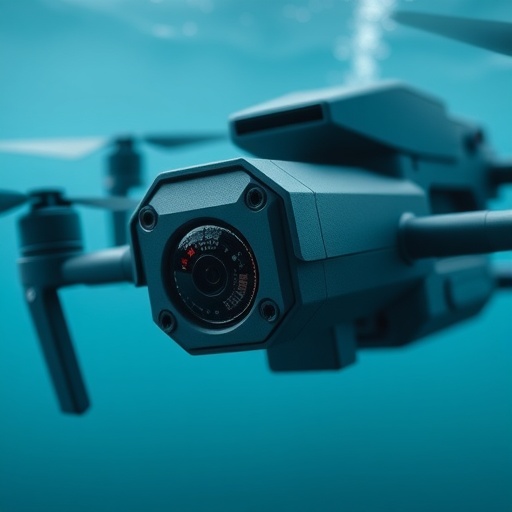
Beneath the crushing depths of the ocean, autonomous underwater vehicles (AUVs) are our eyes and ears, tirelessly exploring, mapping, and surveying the mysterious realm beneath the waves. Yet, despite their advanced capabilities, these drones face an age-old paradox: the very domes designed to protect their sensitive sonar systems simultaneously distort the sound waves essential for their operation. This distortion, caused by the curved, hydrodynamic enclosures, acts like a warped funhouse mirror that scatters and blurs sonar pulses, severely limiting the drones’ ability to detect distant objects and underwater features with precision. Until recently, addressing this longstanding challenge required complex solutions that were either power-hungry or computationally intense, hampering the mission duration and efficiency of these critical underwater explorers.
Profound innovation has emerged from the laboratories of Shanghai Jiao Tong University, where Prof. Yu Zhang and his research team have invented a groundbreaking solution: a soft, acoustic “contact lens” engineered to counteract the dome-induced aberrations before the sound waves even exit the AUV’s protective shell. This lens is not just a passive accessory but an active sculptor of acoustic waves, reshaping them to restore their integrity and focus. Published in the International Journal of Extreme Manufacturing, their work leverages physics principles rooted in time-reversal acoustics to design a lens that physically corrects the sound wavefront, bypassing the limitations of traditional electronic or algorithmic interventions.
The hydrodynamic domes encasing underwater vehicles are essential for minimizing drag and shielding delicate sonar electronics from relentless exposure to saltwater and pressure. However, these domes distort sonar pulses due to their curved shape, causing sound waves to bend unpredictably and scatter. The scattered returns weaken sonar resolution and increase background noise, transforming once-clear echoes into a confusing murmur. Attempts to solve this typically involve complex signal processing algorithms that aim to reconstruct the lost information or powerful electronic arrays that attempt to reshape the outgoing wavefronts. Yet, these methods either cannot recover lost acoustic energy or demand heavy power consumption, which is incompatible with the constraints of small, battery-operated underwater drones.
Prof. Zhang’s approach is fundamentally different. Instead of relying on electronics or computation after the fact, his team designed a physical lens that preemptively corrects acoustic wave distortions as they propagate through the dome. Utilizing the concept of time-reversal, the researchers measured how the dome distorts acoustic waves and inverted this knowledge to engineer a lens capable of compensating for those distortions. Their solution mixes tungsten particles — known for their high density — into flexible silicone rubber, producing a composite material with precisely tunable acoustic properties. Because sound velocity depends on both density and elastic moduli, adjusting the tungsten concentration allows the lens material to slow or speed up sound locally, much like prescription lenses manipulate light.
This acoustic gradient-index lens (GRIN) is molded into concentric rings, each engineered to delay or advance portions of the sonar pulse. As the sonar sound passes through these rings, its wavefront is transformed from a warped, distorted shape into a perfectly flat and focused beam just as it clears the hydrodynamic dome. This physical reshaping enables the sonar to transmit a tight, highly directive beam instead of a scattered flood, enhancing detection specificity and signal strength. The research team demonstrated that their lens concentrates a broad 65-degree sonar wave into a spotlight ranging between 16 to 30 degrees, significantly sharpening the sonar’s “vision” underwater.
Quantitatively, the acoustic lens boosts the main sonar signal by over 10 decibels across a wide frequency range of 20 to 45 kHz while simultaneously suppressing background reverberation by more than 10 decibels. These figures translate to clearer, sharper echoes that extend the effective detection range and improve resolution. Crucially, this leap in sonar performance comes without drawing any extra power or requiring complex onboard signal processing, preserving the drone’s battery life and reducing system complexity — a true game changer for long-term or remote underwater missions.
Beyond performance, the lens material exhibits remarkable durability in extreme underwater conditions. The silicone-tungsten composite withstands temperature fluctuations and prolonged exposure to saltwater without degradation. This robustness ensures that the acoustic lens can endure the harsh environments characteristic of deep-sea exploration, making it suitable for real-world deployment rather than laboratory proof-of-concept. Moreover, its soft, flexible nature allows it to be custom-molded to varying dome shapes, opening avenues for broad adoption across different AUV platforms.
This discovery signals a paradigm shift in underwater vehicle design. By integrating acoustic correction directly into the vehicle’s protective shell through a low-cost, easily manufactured material, the need for bulky, energy-intensive sonar systems diminishes. As a result, smaller, more affordable underwater drones can achieve sonar performance nearing that of larger, costlier submarines. The implications extend to diverse fields including marine biology, underwater archaeology, and subsea infrastructure inspection, where precise, long-range echo detection is vital.
Looking ahead, the next stage for Prof. Zhang’s team focuses on testing the lens’s performance in open ocean environments to assess its resistance to marine biofouling — the accumulation of microorganisms, plants, algae, or small animals on underwater surfaces — which can compromise acoustic properties over time. Additionally, they are advancing manufacturing techniques towards advanced 3D printing methods that will allow seamless gradient acoustic lenses to be produced with even greater precision, complexity, and scalability.
This technology’s potential impact surpasses marine exploration. The principles underlying this holographic gradient-index lens could revolutionize ultrasound imaging in medicine by refining ultrasonic wave propagation for clearer diagnostic images, or enhance non-destructive testing in industries like aerospace and civil infrastructure through improved ultrasonic signal control. As such, this innovation stands at the intersection of physics, materials science, and engineering, showcasing how fundamental scientific insight can spark transformative technological advances.
The story of the holographic GRIN lens exemplifies how embracing physical wave manipulation offers elegant, energy-efficient alternatives to purely electronic or algorithmic solutions. By rewiring the propagation path of acoustic waves with tailored materials, this breakthrough lays the foundation for smarter, sleeker underwater drones capable of revealing the ocean’s secrets with unprecedented clarity. Through meticulous design, material innovation, and acoustic expertise, Prof. Zhang’s lens turns the dome from an obstacle into an asset — finally granting underwater vehicles the sharp acoustic “vision” they need to navigate and explore the deep blue frontier.
News Publication Date: 8-Jun-2026
Web References:
- International Journal of Extreme Manufacturing: https://iopscience.iop.org/journal/2631-7990
- DOI link: http://dx.doi.org/10.1088/2631-7990/ae6b25
Keywords
Underwater acoustics, autonomous underwater vehicles, sonar enhancement, gradient-index (GRIN) lens, acoustic aberration correction, time-reversal acoustics, silicone-tungsten composite, broadband sonar, marine exploration technology, acoustic metamaterials, biofouling resistance, advanced manufacturing
Cite Scienmag News
Bethany Barker. (June 17, 2026). New Tungsten-Silicone Contact Lens Technology Restores Vision for Underwater Drone Operators. Scienmag. https://scienmag.com/new-tungsten-silicone-contact-lens-technology-restores-vision-for-underwater-drone-operators/
Bethany Barker. "New Tungsten-Silicone Contact Lens Technology Restores Vision for Underwater Drone Operators." Scienmag, 17 June 2026, https://scienmag.com/new-tungsten-silicone-contact-lens-technology-restores-vision-for-underwater-drone-operators/. Accessed 4 September 2026.
Bethany Barker. "New Tungsten-Silicone Contact Lens Technology Restores Vision for Underwater Drone Operators." Scienmag. June 17, 2026. https://scienmag.com/new-tungsten-silicone-contact-lens-technology-restores-vision-for-underwater-drone-operators/


