


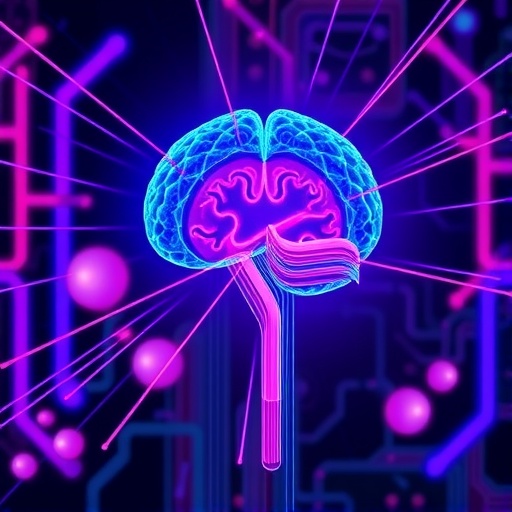
In a groundbreaking leap for quantum computing and biomedical research, scientists at Cleveland Clinic have introduced a transformative computing paradigm inspired by the human brain’s remarkable way of processing information. Spearheading this innovation, Dr. Fabio Cumbo, a Research Associate in the lab of Dr. Daniel Blankenberg at the Computational Life Sciences department, has pioneered what is being called quantum hyperdimensional computing (QHDC). Published recently in the prestigious journal npj Unconventional Computing, this novel framework promises to unlock the full potential of quantum hardware in solving complex computational problems that traditional methods find intractable.
The human brain’s method of encoding conceptual knowledge—such as recognizing a cat—is widely distributed and highly resilient. Instead of relying on a single neuron, it employs thousands or millions in a vast interconnected network, ensuring robustness against loss or damage of any individual neuron. Hyperdimensional computing (HDC) emulates this principle by employing long, multidimensional vectors to represent data; these vectors are capable of maintaining accuracy even when individual components fail. HDC’s architecture offers a drastic shift from conventional digital systems, which typically rely on precise binary structures prone to failures.
Applying hyperdimensional computing to quantum hardware is an intricate challenge due to the constraints of existing quantum systems. Current quantum computers struggle to host the massive, high-dimensional representations that classical HDC requires. QHDC bridges this divide by leveraging unique quantum mechanical phenomena such as quantum superposition, where qubits exist simultaneously in multiple states. This fundamental property allows quantum computers to encode and manipulate complex data spaces far more efficiently than classical counterparts, enabling the practical realization of hyperdimensional vectors on quantum platforms.
QHDC marries the neuroscience-inspired concept of distributed data encoding with quantum mechanics’ power, creating a natural synergy that sidesteps the bottlenecks experienced in directly mapping classical HDC to quantum devices. While hyperdimensional vectors are central to HDC, qubits and superposition form the bedrock of quantum computing’s power. This correspondence equips QHDC with the potential to tackle biomedical datasets characterized by high complexity and unpredictable outcomes, areas where classical computing often falters.
Significantly, Dr. Blankenberg, the senior author of the research paper, notes that as quantum computing technology undergoes rapid development, the scientific community is still in the early phases of establishing robust frameworks and algorithms that fully exploit the advantages offered by these machines. Existing quantum adaptations of artificial intelligence and neural networks often involve convoluted constructions that demand prolonged development and computational execution times, hindering their practical utility.
In contrast, Dr. Cumbo recognized the limitations inherent in simply porting classical computation strategies onto quantum devices. His insight was to explore computational models that inherently align with quantum processing capabilities rather than constraining them within traditional paradigms. His prior experience working with hyperdimensional computing provided the crucial foundation for conceptualizing and validating QHDC’s compatibility with quantum systems.
To evaluate the power of their novel framework, the research team conducted extensive experiments across three platforms: classical computers, highly idealized quantum simulators, and actual quantum hardware. These comparative analyses revealed not only the operational strengths of QHDC but also benchmarked its performance relative to conventional computational methods, providing evidence of its potential superiority.
Two distinct experiments were conducted to demonstrate the framework’s breadth. The first was a symbolic reasoning task, designed to assess QHDC’s ability to engage in abstract logical operations and symbolic manipulation, key components of high-level cognition. The second involved a machine learning challenge focused on image classification, testing the system’s capacity to learn patterns and generalize from data in a manner analogous to human perception.
Remarkably, across these rigorous assessments, QHDC achieved speeds up to 500 times faster than existing methods. This dramatic enhancement in computational efficiency underpins the promise of quantum-inspired algorithms in accelerating scientific discoveries, particularly in fields inundated with complex, multidimensional data such as genomics, proteomics, and clinical diagnostics.
This pioneering work lays the groundwork for a new generation of quantum algorithms emblematic of the emerging field of quantum neuromorphic computing. By symbiotically uniting neuroscientific principles with quantum mechanics, QHDC has opened avenues for devising customized computational architectures that may revolutionize biomedical research. Researchers anticipate their continued investigations will scale QHDC to larger and more intricate models while monitoring the preservation of its remarkable speed and precision.
As quantum computers incrementally progress from experimental devices to more reliable systems, the importance of developing algorithms that naturally exploit their unique strengths becomes imperative. Traditional methods, adapted from classical frameworks, risk underutilizing these nascent quantum platforms. Innovative approaches like QHDC exemplify how rethinking computation at its conceptual roots can unleash unprecedented scientific potential and accelerate the innovation cycle in medicine and beyond.
The implications of this research transcend the immediate biomedical sphere. The principles of distributed encoding and processing via quantum hyperdimensional vectors could inform next-generation artificial intelligence, cryptography, optimization, and data analysis. This intersection of neuroscience, quantum physics, and computational science heralds a multidisciplinary convergence with the power to reshape technology landscapes.
While QHDC is still in its formative stages, the compelling speed advantages and promising application prospects underscore its role as a transformative paradigm. Dr. Cumbo and his collaborators are poised to continue advancing this framework, with ambitions of integrating larger datasets and more complex computational problems, thereby laying a robust foundation for the future of quantum-powered biomedical innovation.
Cite Scienmag News
Cassandra Pierce. (June 16, 2026). Cleveland Clinic Scientists Pioneer Brain-Inspired Quantum Computing Paradigm. Scienmag. https://scienmag.com/cleveland-clinic-scientists-pioneer-brain-inspired-quantum-computing-paradigm/
Cassandra Pierce. "Cleveland Clinic Scientists Pioneer Brain-Inspired Quantum Computing Paradigm." Scienmag, 16 June 2026, https://scienmag.com/cleveland-clinic-scientists-pioneer-brain-inspired-quantum-computing-paradigm/. Accessed 5 September 2026.
Cassandra Pierce. "Cleveland Clinic Scientists Pioneer Brain-Inspired Quantum Computing Paradigm." Scienmag. June 16, 2026. https://scienmag.com/cleveland-clinic-scientists-pioneer-brain-inspired-quantum-computing-paradigm/


