


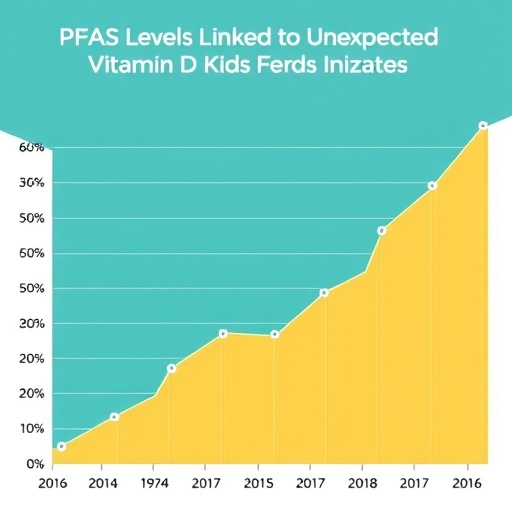
A groundbreaking study published in Pediatric Research on June 11, 2026, has unveiled a perplexing and paradoxical relationship between serum per- and polyfluoroalkyl substances (PFAS) concentrations and circulating vitamin D levels in prepubertal children across the United States. This investigation has profound implications for our understanding of environmental toxins and their unexpected influence on key micronutrients critical for child development. PFAS, a family of synthetic chemicals widely used in consumer products for their stain-, grease-, and water-resistant properties, have been under increasing scrutiny due to their persistence in the environment and potential adverse health impacts.
The research spearheaded by Soo, Barrett, Kengne, et al., rigorously examined serum levels of PFAS and vitamin D, revealing a paradox that challenges conventional toxicological assumptions. While PFAS are conventionally regarded as harmful environmental pollutants, the study’s data intriguingly suggest that higher PFAS serum concentrations correlate with elevated circulating vitamin D levels in a cohort of prepubertal children. This counterintuitive association demands a deeper dive into the mechanistic interplay between environmental contaminants and nutrient metabolism.
The study sample consisted of a demographically diverse group of U.S. children prior to the onset of puberty — an important window given the rapid physiological changes and increased vitamin D needs for bone growth and immune function. Employing advanced analytical techniques to quantify serum PFAS and 25-hydroxyvitamin D [25(OH)D], the researchers meticulously controlled for confounding variables such as age, sex, body mass index, and sunlight exposure, ensuring robustness of the findings. This rigorous methodology allowed unprecedented resolution of subtle biochemical relationships that might otherwise have been obscured.
PFAS are known for bioaccumulation and long biological half-lives, persisting in the human body for years after exposure. The study’s findings provoke urgent questions about how these chemicals might interfere with vitamin D metabolism. Vitamin D, a secosteroid hormone derived from skin synthesis and diet, requires hepatic and renal enzymatic modifications to become biologically active. It is hypothesized that PFAS might modulate these enzymatic pathways or affect vitamin D binding proteins, thereby altering circulating levels in ways not previously documented.
The paradoxical positive association between serum PFAS and vitamin D presents multiple hypotheses. One possibility is that PFAS exposure induces compensatory physiological responses leading to increased production or reduced degradation of vitamin D metabolites. Alternatively, PFAS may alter lipid metabolism or endocrine signaling cascades indirectly influencing vitamin D physiology. This paradox challenges prior research primarily focusing on PFAS as detrimental agents that depress nutrient levels, suggesting a nuanced interaction dependent on developmental stage and exposure context.
From a public health perspective, the implications of this paradox are profound. Vitamin D is crucial for skeletal mineralization, immune regulation, and even neurodevelopment in children. Traditionally, PFAS exposure was linked to adverse outcomes such as immunosuppression or endocrine disruption, yet here a seemingly beneficial association with vitamin D status emerges. This underscores a critical need to revisit environmental health risk assessments that typically consider chemical exposures solely as negative factors without accounting for potential biochemical compensations or complex endocrine interactions.
Moreover, this study opens new avenues for research into environmental chemical mixtures and their multifaceted effects on nutrient homeostasis. Given that children are particularly vulnerable due to developmental plasticity, understanding the full spectrum of PFAS impacts on vitamin D metabolism is essential for crafting nuanced guidelines addressing exposure limits and nutritional interventions. It may also stimulate renewed interest in exploring how endocrine disruptors influence hormonal micronutrient pathways beyond traditional toxicology paradigms.
The authors rightfully emphasize that while enhanced vitamin D status might superficially appear beneficial, the presence of high PFAS levels still represents a significant health concern due to their established toxicities, including hepatic, renal, and immunological effects. The paradox does not imply PFAS are harmless but rather reveals an unexpected biochemical complexity that warrants a careful reevaluation of how we assess chemical-nutrient interactions.
Future research directions suggested by this study include longitudinal tracking of vitamin D and PFAS dynamics through puberty, mechanistic studies investigating enzymatic modulation by PFAS compounds, and exploring genetic factors that may mediate individual variability in response. Additionally, integration of metabolomics and proteomics could elucidate downstream signaling changes triggered by PFAS exposure that alter vitamin D pathways.
The societal implications are equally significant. Public health messaging on PFAS contamination commonly urges avoidance due to toxicity risks, while nutritional campaigns emphasize vitamin D sufficiency for healthy child development. This study complicates these narratives by revealing that exposure and nutritional status may be intertwined in unexpected ways. Policymakers might need to consider integrated strategies that address contaminant exposure and nutrient sufficiency simultaneously rather than in isolation.
In conclusion, the pioneering work by Soo and colleagues has unearthed a paradox in pediatric environmental health research: higher PFAS serum concentrations coincide with increased circulating vitamin D in prepubertal children, challenging traditional toxicology assumptions. This novel insight compels a paradigm shift towards recognizing complex biochemical crosstalk between contaminants and micronutrients. It is a clarion call for multidisciplinary investigations uniting environmental science, endocrinology, and pediatric nutrition to safeguard child health in an increasingly industrialized world.
As we forge ahead, it becomes clear that environmental pollutants like PFAS do not simply operate as linear disruptors but rather integrate into biological systems reshaping metabolic landscapes in nuanced ways. This study exemplifies the necessity of holistic, mechanistic exploration of pollutant-nutrient interactions to truly comprehend and mitigate their public health impacts. The “PFAS-vitamin D paradox” will undoubtedly catalyze intense scientific debate and inspire innovative research paradigms focused on unraveling hidden biochemical dialogues in the human body.
This emerging narrative is of urgent interest not only to pediatricians and toxicologists but also to environmental regulators, nutritionists, and the general public concerned with the long-term consequences of chemical exposures during critical developmental windows. Groundbreaking revelations such as these remind us of the intricately woven fabric connecting our environment, chemical exposures, and essential nutrient homeostasis—an intricate balance that defines health from childhood onwards.
The publication of this research marks a pivotal milestone in environmental pediatric research with far-reaching significance, promising to transform how we evaluate chemical exposure risks and develop public health recommendations for children’s nutritional and environmental wellbeing worldwide.
Cite Scienmag News
Daisy Hatcher. (June 11, 2026). PFAS Levels Linked to Unexpected Vitamin D Trends in Kids. Scienmag. https://scienmag.com/pfas-levels-linked-to-unexpected-vitamin-d-trends-in-kids/
Daisy Hatcher. "PFAS Levels Linked to Unexpected Vitamin D Trends in Kids." Scienmag, 11 June 2026, https://scienmag.com/pfas-levels-linked-to-unexpected-vitamin-d-trends-in-kids/. Accessed 4 September 2026.
Daisy Hatcher. "PFAS Levels Linked to Unexpected Vitamin D Trends in Kids." Scienmag. June 11, 2026. https://scienmag.com/pfas-levels-linked-to-unexpected-vitamin-d-trends-in-kids/


