


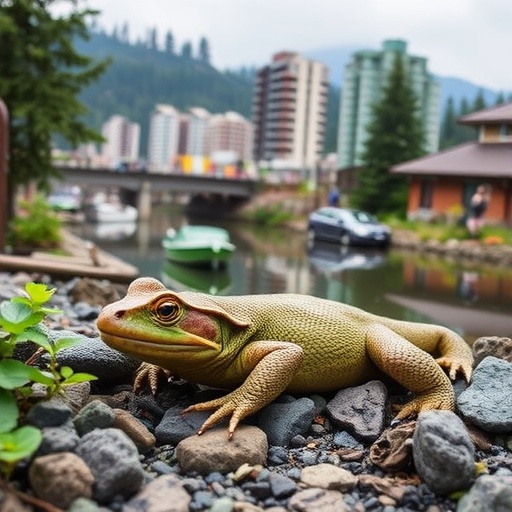
In a groundbreaking study that sheds light on an overlooked ecological issue, researchers at the University of British Columbia have uncovered the immense scale at which amphibians and reptiles are being relocated due to development projects throughout British Columbia. Their findings reveal that over a span of just four years, more than five million herpetofauna—primarily amphibians—were displaced. This revelation marks the first comprehensive attempt to chart the extensive practice of herpetofauna translocation within the province, spotlighting critical gaps in wildlife management policies.
This large-scale translocation effort, uncovered through the meticulous analysis of 629 provincial permits issued between 2019 and 2022, highlights a paradox in conservation strategy. While translocation aims to mitigate the immediate impact of human infrastructure on sensitive species, there exists a startling absence of mandatory post-relocation monitoring to assess the survival or long-term viability of these displaced populations.
Amphibians, which accounted for a staggering 99% of the relocations recorded, stand out as the predominant beneficiaries—or victims—of these efforts. Foremost among these is the western toad (Anaxyrus boreas), the most frequently moved species. This is especially significant given amphibians globally are among the most threatened vertebrates, often serving as critical indicators of ecosystem health due to their permeable skin and biphasic life cycles.
Lead author Megan Winand, a recent Master’s graduate from UBC’s Department of Forest and Environmental Stewardship, emphasizes the pressing question that her study raises: “What happens next?” This query underscores the troubling reality that while millions of animals are shifted to accommodate development, their post-relocation fate remains a mystery, largely because legal frameworks impose no requirement for survival tracking or population monitoring.
The researchers note that in British Columbia, translocation has effectively become a routine mitigation practice, employed almost reflexively in the face of escalating development pressures such as pipelines, railways, bridges, and water infrastructure projects. These large-scale endeavors disrupt natural habitats, leading to the frequent need to move wildlife out of harm’s way. However, such interventions come with a high degree of uncertainty about their long-term ecological efficacy.
This unregulated practice of herpetofauna relocation presents a stark contrast to other Canadian provinces. Alberta and Ontario, for instance, have policies that restrict the translocation of at-risk herpetofaunal species, emphasizing habitat avoidance and preservation instead. In the Maritime provinces, translocation of these species is comparatively rare, further highlighting British Columbia’s unique reliance on this method.
The absence of post-relocation monitoring represents a significant blind spot. Without systematic data on surviving animals or the stability of populations after relocation, it remains impossible for conservationists or policymakers to evaluate if these interventions merely delay inevitable declines or genuinely support species persistence. This knowledge gap imperils the ability to optimize mitigation strategies and to justify future development-related relocations.
Dr. Tara Martin, senior author and professor in UBC’s Forest and Conservation Sciences Department, voices deep concern over the lack of evidence supporting current translocation practices. “We are making consequential decisions affecting millions of amphibians with no guarantee of positive outcomes,” she states. Her remarks highlight the urgent need for evidence-based policies that both protect biodiversity and inform sustainable development practices.
A central recommendation from the researchers calls for a shift toward habitat avoidance: prioritizing early-stage infrastructure planning to sidestep sensitive areas altogether. This strategy entails rerouting projects and redesigning roadways or crossings to minimize environmental disturbance. When impacts cannot be avoided, the authors advocate for increased investment not just in moving animals, but in restoring and creating suitable habitats that these species depend upon.
Winand points out a critical misconception that simple relocation solves the underlying threat. “Moving animals without addressing habitat loss is insufficient,” she insists. Habitat degradation continues unabated, and translocation alone cannot replace the complex ecological functions and environmental features lost to development.
The study also pushes for legislative reform, urging the establishment of mandatory reporting and systematic, legally mandated post-relocation monitoring protocols. This crucial step would enable wildlife managers to collect data necessary for adaptive management, refining relocation techniques over time and ensuring better conservation outcomes.
In the broader context of global amphibian declines — driven by habitat destruction, climate change, disease, and pollution — the findings from British Columbia serve as a microcosm of challenges faced worldwide. The study calls on conservationists, developers, and policymakers to reconsider translocation as a default solution and instead promotes integrative approaches that prioritize long-term ecosystem integrity.
Through meticulous research grounded in observational data, this study brings to the forefront the hidden ecological cost of infrastructure expansion, urging a paradigm shift that balances human development needs with robust, science-informed wildlife conservation strategies. British Columbia’s experience offers valuable lessons, emphasizing that large-scale wildlife translocations are not without risk and must be subjected to rigorous scientific scrutiny.
As infrastructure projects continue to burgeon worldwide, this research ignites critical conversations about responsible mitigation and conservation methods. It challenges stakeholders to move beyond surface-level solutions and invest in protecting the habitats that sustain biodiversity, ensuring that displaced populations of amphibians and reptiles do not become casualties of development hidden in plain sight.
News Publication Date: 14-Apr-2026
Web References:
Journal of Wildlife Management DOI 10.1002/jwmg.70172
Keywords
Wildlife management, amphibian translocation, reptile relocation, habitat conservation, ecological mitigation, herpetofauna, British Columbia biodiversity, habitat avoidance, conservation policy, infrastructure development impact, species survival monitoring, ecological sustainability
Cite Scienmag News
Margaret Porter. (June 9, 2026). UBC Study Reveals 5 Million Amphibians and Reptiles Displaced by B.C. Construction Without Survival Monitoring. Scienmag. https://scienmag.com/ubc-study-reveals-5-million-amphibians-and-reptiles-displaced-by-b-c-construction-without-survival-monitoring/
Margaret Porter. "UBC Study Reveals 5 Million Amphibians and Reptiles Displaced by B.C. Construction Without Survival Monitoring." Scienmag, 9 June 2026, https://scienmag.com/ubc-study-reveals-5-million-amphibians-and-reptiles-displaced-by-b-c-construction-without-survival-monitoring/. Accessed 4 September 2026.
Margaret Porter. "UBC Study Reveals 5 Million Amphibians and Reptiles Displaced by B.C. Construction Without Survival Monitoring." Scienmag. June 9, 2026. https://scienmag.com/ubc-study-reveals-5-million-amphibians-and-reptiles-displaced-by-b-c-construction-without-survival-monitoring/


