


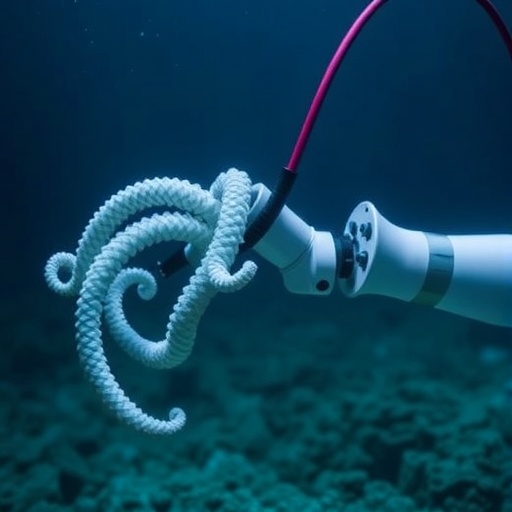
In a thrilling breakthrough at the intersection of biology and robotics, researchers at the Italian Institute of Technology (IIT) have unveiled an octopus-inspired soft robotic arm capable of autonomous underwater grasping. This pioneering achievement, led by Barbara Mazzolai, Associate Director for Robotics at IIT and head of the Bioinspired Soft Robotics research unit, signifies a major leap in soft robotics, embedding tactile sensing within artificial suction cups to allow the robot to perceive and interact with its environment with unprecedented dexterity and subtlety. The study, recently published in Nature Machine Intelligence, underscores a transformative approach to robotic manipulation by mimicking the complex biological mechanisms of the octopus.
Soft robotics, the field this development inhabits, distinguishes itself through the use of compliant, flexible materials as opposed to the rigid structures common in traditional robots. This softness enhances the robot’s ability to interact naturally with dynamic or delicate surroundings, making it especially viable for underwater operations where adaptability and gentle touch are paramount. The octopus, with its eight muscular and highly flexible arms, has long fascinated biologists and engineers alike due to its sophisticated ability to grasp, explore, and manipulate objects underwater—capabilities that are difficult to reproduce with conventional robotic systems.
Central to this innovation are the robotic arm’s specially designed artificial suction cups, made from silicone and equipped with miniaturized optical tactile sensors. These sensors operate by detecting changes in reflected light when the suction cups deform upon contact with objects. Internal LEDs emit light within each suction cup, and the deformation caused by touch modifies how this light reflects, enabling the system to estimate not only the force’s intensity but also its direction. This sensory data is then processed locally by an embedded control system, allowing each suction cup and the arm as a whole to respond rapidly and adaptively without reliance on a centralized control center.
This distributed sensing and peripheral control model draws directly on the octopus’s decentralized nervous system, where much of the sensory processing and motor coordination occurs within the arms themselves rather than in the brain. By replicating this biological strategy, the robotic arm attains remarkable autonomy and resilience; it effortlessly adjusts its grip in real time, even in challenging underwater environments. The robot’s ability to detect extremely subtle stimuli extends its potential usefulness across delicate operations, where conventional robotic manipulators might fail or cause damage.
The development is also forward-thinking in its modularity. Researchers have designed the arm so that the number and positioning of suction cups can be altered to suit various tasks, optimizing both sensory input and mechanical capability. This adaptability is a significant advantage in fields ranging from marine biology research, where handling fragile specimens requires tact, to industrial subsea maintenance tasks that demand reliable and dexterous manipulation in unpredictable conditions.
Underpinning the octopus-inspired arm are years of progressive research by the IIT team. Previous works include computational modeling to optimize the tendon-cable arrangements within soft robotic arms to mimic natural octopus movements while minimizing the number of actuators required — an approach that simplifies control architectures and enhances efficiency. Coupled with recent advances in 3D-printed soft endoskeletons, which enable the construction of intricate three-dimensional internal pathways necessary for complex motion with material softness and ease of manufacture, the current sensory-integrated soft arm represents a culmination of these multidisciplinary innovations.
The implications of this research extend beyond robotics itself. Autonomous underwater vehicles and robotic manipulators augmented with biologically inspired sensors offer new horizons for marine exploration, environmental monitoring, and even sustainable aquatic farming. The ability to operate with precision and care in delicate or hazardous underwater ecosystems makes these technologies invaluable for scientific investigation and conservation efforts alike.
Another remarkable feature of the new robotic arm is how it integrates perception and action seamlessly within its structure, mimicking the octopus’s biological integration of sensing and motor function. This cohesive design allows the robot to process tactile inputs locally and execute immediate motor responses, creating a fluid and adaptive manipulation strategy that is robust against environmental uncertainties and communication delays common in underwater operation setups.
Emanuela Del Dottore, the study’s lead author, emphasizes the significance of integrating sensors and signal processing directly into the robot’s interface with the environment. This advanced level of embodiment, where the “skin” of the robot itself senses and reacts, heralds a paradigm shift in the design of autonomous systems. The system’s scalability suggests that future iterations could be expanded into multi-limbed robotic platforms, all equipped with distributed sensory feedback for finely tuned, real-time, environment-responsive behavior.
Looking forward, the IIT team plans to explore enhancements to improve the arm’s payload capacity, its grasping versatility across a wider variety of underwater objects, and even its potential utility in harsher or more complex natural and industrial environments. This ongoing expansion aims to realize fully autonomous, soft robotic platforms capable of performing intricate tasks once confined to biological organisms, broadening the frontier of robotic manipulation.
This milestone is part of a broader initiative supported by RAISE (Robotics and AI for Socio-economic Empowerment), funded by Italy’s Ministry of University and Research under the National Recovery and Resilience Plan. By uniting bioinspiration, materials science, optical sensing, and advanced control algorithms, this research demonstrates the profound potential of interdisciplinary collaboration and biomimetic design to advance robotics technology in meaningful, impactful ways.
The advent of this octopus-inspired soft robotic arm not only pushes the technical boundaries of tactile sensing in robotics but also reimagines how intelligent, autonomous manipulation can be achieved in environments previously regarded as too complex or sensitive. By turning to the ocean’s most versatile manipulator as a blueprint, the IIT researchers have crafted a technological marvel that holds promise for revolutionizing underwater exploration and interaction.
News Publication Date: 8 June 2026
Web References:
https://doi.org/10.1038/s42256-026-01230-y
References:
Del Dottore, E., et al. (2026). Peripheral control enabled by distributed sensing in an octopus-inspired soft robotic arm for autonomous underwater grasping. Nature Machine Intelligence.
Keywords
Soft robotics, Robotics, Biomimetics, Animal robots, Sensors, Sustainability, Engineering
Cite Scienmag News
Denise Maddox. (June 8, 2026). From the Ocean Depths: Octopus-Inspired Robotic Arm Revolutionizes Technology. Scienmag. https://scienmag.com/from-the-ocean-depths-octopus-inspired-robotic-arm-revolutionizes-technology/
Denise Maddox. "From the Ocean Depths: Octopus-Inspired Robotic Arm Revolutionizes Technology." Scienmag, 8 June 2026, https://scienmag.com/from-the-ocean-depths-octopus-inspired-robotic-arm-revolutionizes-technology/. Accessed 3 September 2026.
Denise Maddox. "From the Ocean Depths: Octopus-Inspired Robotic Arm Revolutionizes Technology." Scienmag. June 8, 2026. https://scienmag.com/from-the-ocean-depths-octopus-inspired-robotic-arm-revolutionizes-technology/


