


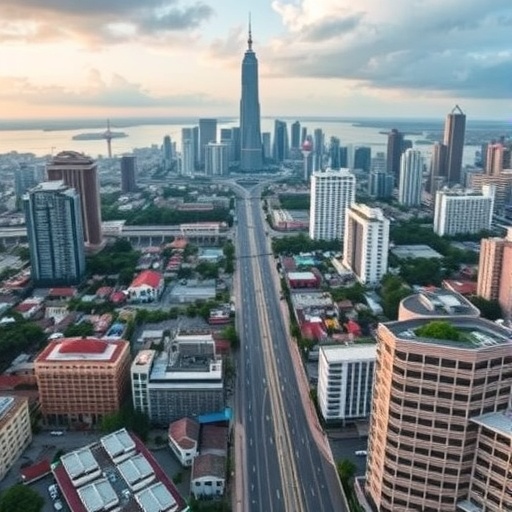
In recent years, Southeast Asia has witnessed an extraordinary transformation in its urban landscapes, driven by the influx of external investment that transcends traditional models of urban sprawl. As cities in this region evolve beyond mere expansion, the nature, scale, and impact of foreign capital have become pivotal in redefining urban form, economic dynamics, and social fabric. A groundbreaking study by Zhang, Ren, An, and colleagues, published in npj Urban Sustainability, delves deep into the mechanisms through which external investment reconfigures Southeast Asian cities, offering nuanced insights into the complex interplay between global capital flows and local urban development.
The legacy of rapid urban sprawl in Southeast Asia has long been a double-edged sword. While it has accommodated booming populations and economic growth, this unchecked expansion has frequently resulted in significant environmental degradation, infrastructure strain, and social inequities. Historically, urban growth followed a predominantly horizontal trajectory, characterized by suburbanization and informality. However, Zhang and collaborators reveal that the recent wave of external investment catalyzes a paradigm shift, promoting densification, vertical growth, and mixed-use developments that challenge conventional sprawl paradigms.
One of the critical contributions of the study is its focus on the spatial reconfiguration induced by foreign capital. Instead of perpetuating sprawling metropolitan footprints, investment flows increasingly target strategic corridors, central business districts, and transit-oriented developments. This investment pattern fosters urban cores that integrate residential, commercial, and recreational spaces while prioritizing connectivity and accessibility. Such a mixed-use approach not only enhances economic productivity but also mitigates environmental pressures by encouraging public transit use and reducing dependence on private vehicles.
Technologically, these external funds often come hand-in-hand with avant-garde urban infrastructure, leveraging innovations in green building materials, smart energy systems, and digital connectivity. The researchers highlight how international investors, in collaboration with local governments and developers, promote “smart city” initiatives tailored to Southeast Asia’s unique socio-economic contexts. These initiatives use Internet of Things (IoT) technologies, advanced data analytics, and sustainable construction practices to optimize resource use and improve urban resilience against climate extremes, a growing threat in the tropical region.
A salient feature discussed in the publication is the role of geopolitics and transnational capital networks in shaping investment flows. The study underscores that external investment is not monolithic; rather, it is influenced by a complex nexus of economic diplomacy, bilateral cooperation agreements, and regional development strategies such as the Belt and Road Initiative. These geopolitical dimensions direct where and how resources are allocated, often privileging mega-projects like ports, high-speed rail links, and economic zones that inject capital and generate employment but also recalibrate urban hierarchies and power relations.
The social ramifications of these financial injections are substantial and multifaceted. While new developments promote modernization and can uplift living standards through enhanced amenities, they also risk exacerbating urban inequality. The authors caution that gentrification processes may displace vulnerable communities, especially in informal settlements situated near newly valorized neighborhoods. They emphasize the necessity for inclusive urban policies ensuring affordable housing, equitable access to services, and community engagement in planning to prevent socio-spatial polarization.
Importantly, Zhang et al. propose a conceptual framework that integrates external investment patterns with local governance capacity as determinants of urban outcomes. This framework highlights how effective urban management, transparent regulatory institutions, and participatory decision-making modulate the benefits and downsides of foreign capital deployment. Cities with robust governance structures are better positioned to harness investment for sustainable growth, balancing economic, social, and environmental goals.
Environmental sustainability is another cornerstone of the analysis. The study scrutinizes how investor priorities align with climate change mitigation and adaptation objectives. Some projects incorporate green infrastructure, renewable energy installations, and comprehensive waste management systems, reflecting a growing awareness of environmental stewardship. Nevertheless, the authors find that environmental standards are unevenly enforced across cities and developments, necessitating stronger regulatory oversight, incentives for low-impact design, and enhanced civil society monitoring.
The research employs a comparative methodology, examining multiple Southeast Asian urban centers to identify divergent trajectories driven by varying external investment profiles. By combining satellite imagery analysis, investment flow data, and on-the-ground surveys, the team generates a granular understanding of urban morphologies and functional attributes influenced by global capital. This mixed-methods approach produces rich spatial-temporal narratives illustrating how cities negotiate modernity, economic integration, and sustainability imperatives.
Economic restructuring linked to external investment flows also emerges as a transformative force. Beyond physical infrastructure, capital injections stimulate new industrial clusters, high-value services, and creative economies that rebrand cities as global or regional hubs. This dynamic reshapes labor markets, occupational structures, and urban socio-economic composition, creating opportunities but also requiring adaptive workforce policies to mitigate displacement and skill mismatches.
The publication draws attention to the challenges of balancing growth and cultural heritage preservation amidst intensified external investments. Rapid urban redevelopment often threatens historical districts and intangible cultural assets, provoking tensions between modernization and identity maintenance. Zhang and colleagues advocate for integrative planning frameworks that embed cultural conservation within broader urban regeneration schemes, ensuring that modernization does not result in cultural erasure.
From a financing perspective, the study details how external investment is often structured through public-private partnerships, sovereign wealth funds, and international development finance institutions. These complex financial instruments bring capital into urban projects but demand new accountability mechanisms, risk assessments, and transparent reporting practices to safeguard public interest and ensure long-term project viability.
A notable technological insight involves the use of big data and geospatial analytics to monitor urban change and assess the impact of investments in near real-time. This capability enhances adaptive urban management, enabling policymakers to fine-tune strategies, anticipate unintended consequences, and optimize resource allocation. Such digital transformation underpinned by foreign capital influx represents a frontier in Southeast Asian urbanism.
Looking ahead, the authors articulate a call to action for multi-stakeholder collaboration involving governments, investors, civil society, and the urban populace to co-create sustainable urban futures. They stress that harnessing external investment for genuinely inclusive and resilient urban development demands transparency, accountability, and a shared vision that transcends short-term profits.
In summary, Zhang et al.’s study innovatively reframes the narrative on Southeast Asian urban sprawl by spotlighting the complex and dynamic role of external investment in driving urban transformation. Their work not only expands academic understanding but also provides practical guidance for policymakers and urban planners aiming to orchestrate equitable, sustainable, and technologically advanced urban futures in an era of pervasive globalization and environmental uncertainty.
Zhang, T., Ren, J., An, N. et al. Beyond sprawl: how does external investment reshape Southeast Asian cities. npj Urban Sustain (2026). https://doi.org/10.1038/s42949-026-00413-1
Cite Scienmag News
Courtney Benton. (June 4, 2026). Beyond Sprawl: Investment Reshapes Southeast Asian Cities. Scienmag. https://scienmag.com/beyond-sprawl-investment-reshapes-southeast-asian-cities/
Courtney Benton. "Beyond Sprawl: Investment Reshapes Southeast Asian Cities." Scienmag, 4 June 2026, https://scienmag.com/beyond-sprawl-investment-reshapes-southeast-asian-cities/. Accessed 3 September 2026.
Courtney Benton. "Beyond Sprawl: Investment Reshapes Southeast Asian Cities." Scienmag. June 4, 2026. https://scienmag.com/beyond-sprawl-investment-reshapes-southeast-asian-cities/


