


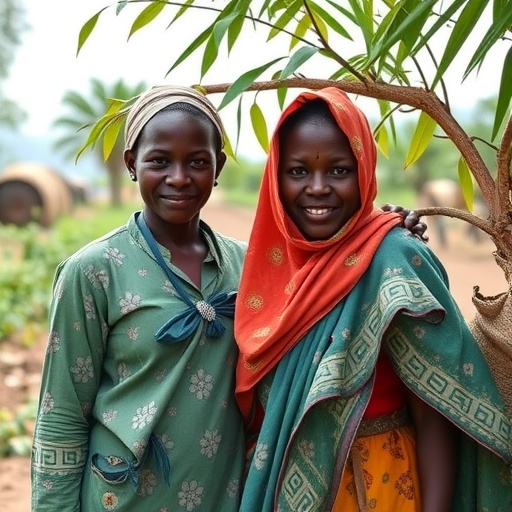
In the sprawling megacity of Lagos, a remarkable yet largely overlooked narrative unfolds along its dynamic coastal margins. Informal settlements, often dismissed and imperiled, reveal an extraordinary capacity for climate adaptation that challenges conventional frameworks of urban resilience and sustainability. Recent research spearheaded by Brianna Castro, assistant professor of urban sustainability at the Yale School of the Environment, uncovers how these marginalized communities deploy sophisticated, multi-scale adaptive strategies to withstand escalating climate pressures, notably flooding, while simultaneously forging vital economic livelihoods rooted in climate action.
Lagos, a megacity characterized by its dense population and extensive water coverage—approximately 40% of its acreage comprises bodies of water—faces acute vulnerabilities due to its low-lying coastal plains. These regions experience persistent flooding threats exacerbated by climate change-induced sea level rise and extreme weather events. Despite these perils, many inhabitants opt to settle near the coast, attracted by resource availability and the relatively faster drainage properties of sandy soils compared to the city’s interior. This spatial preference presents a paradox where risk is concentrated in areas offering the critical ecosystem services that sustain urban life.
Amid these challenges, informal coastal communities exhibit remarkable ingenuity. Residents have engineered makeshift yet effective drainage infrastructures, harnessing local materials and knowledge systems to mitigate flood impacts. Examples include the stabilization of land via sand infilling, the erection of pedestrian bridges to navigate floodwaters, and the establishment of communal shelters designed to provide resilience during extreme weather events. These grassroots modifications form a resilient spatial logic, enhancing the habitability of precarious zones without reliance on formal urban planning mechanisms.
One particularly innovative adaptation involves the interior elevation of homes through the melting and compacting of plastic waste. This novel approach raises floor levels above anticipated flood heights, enabling residents to maintain continuity in daily life despite inundation. Such practices demonstrate not only technical resourcefulness but also an adaptive reuse of materials that would otherwise contribute to environmental degradation. The plastic elevation method represents a fusion of environmental remediation and flood mitigation that is locally inventive and pragmatically effective.
Economic activities within these informal settlements have increasingly oriented around climate adaptation measures. Residents derive income from procuring sand for land stabilization, collecting and redistributing plastic debris to elevate floors, and digging freshwater wells to supply potable water during flood events. These entrepreneurial endeavors do not solely benefit the immediate community; they ripple outward, delivering essential climate adaptation services to wealthier districts across Lagos. This interconnectedness highlights a critical yet underappreciated dimension of informal economies as integral components of urban resilience.
Despite these adaptive successes, state policies present formidable barriers. The Nigerian government, pursuing aggressive development agendas framed under climate mitigation and protection rhetoric, frequently targets informal settlements for demolition. Such interventions proceed under the justification of environmental safeguarding but often result in the displacement and dispossession of vulnerable populations who reside in these areas. The official perspective tends to regard these spaces as devalued and disposable, undermining community agency and disregarding the adaptive capacities residents have cultivated over years.
Castro’s research critically interrogates such governmental approaches, urging a shift in perspective to recognize and amplify the strategies employed by communities enduring the harshest conditions. She highlights the loss inherent in eviction processes, where locally developed infrastructural knowledge and social networks are dismantled rather than leveraged for broader urban resilience. The study invites policymakers and urban planners to engage more deeply with informal adaptation infrastructures as potentially scalable solutions that could inform sustainable climate responses in other contexts.
Furthermore, the research underscores the imperative to reframe informal settlements not only as sites of vulnerability but as active agents in climate adaptation innovation. These communities operate within a complex socio-ecological system, navigating environmental hazards, limited resources, and socio-political marginalization with ingenuity and resilience. Their lived experiences and material practices challenge dominant narratives that equate formality with viability and illegitimacy with vulnerability.
Lagos serves as a microcosm illustrating the broader tensions between rapid urbanization, climate change, and socio-economic inequalities in coastal megacities worldwide. It compels urban scholars and practitioners to reconsider how resilience is conceptualized and operationalized, especially in contexts where formal infrastructure provision is inadequate and governance frameworks are insufficiently inclusive. Understanding informal adaptation infrastructures can yield transformative insights into sustainable urban futures.
The study’s findings also highlight critical intersections between environmental policy and social justice. As climate adaptation strategies are integrated into urban governance, attention must be given to the rights and knowledge of informal communities. The demolition of adaptive spaces risks exacerbating social inequities, undermining livelihoods, and eroding community cohesion. Inclusive policies that recognize and support grassroots adaptation are necessary to foster equitable resilience.
Moreover, the technical innovations emerging from these communities—from sand infilling to plastic waste elevation—offer valuable lessons for climate adaptation science and engineering. These low-cost, locally sourced interventions demonstrate the potential of community-driven solutions to enhance urban flood management. Embracing these approaches can challenge conventional top-down adaptation models that often overlook the social and material realities of marginalized populations.
Castro’s work serves as a clarion call for integrating social science perspectives with climate adaptation research. It stresses the necessity of multi-disciplinary approaches that accommodate the experiential knowledge of informal inhabitants and the complex dynamics shaping urban environmental change. Ultimately, fostering dialogue between academia, policymaking, and local communities can pave the way for more just and effective climate resilience strategies in megacities confronting mounting climate threats.
In sum, Lagos’ informal coastal settlements epitomize resilience born from adversity. Their adaptive infrastructures, borne of necessity and ingenuity, not only mitigate climate risks but also generate vital economic opportunities. Acknowledging and investing in these grassroots systems is critical for sustainable urban futures in Lagos and beyond. As climate change intensifies, the lessons embedded in these margins offer indispensable guidance for building cities that are not only resistant but regenerative.
News Publication Date: 3-Jun-2026
Web References:
https://www.tandfonline.com/doi/full/10.1080/17565529.2026.2679005
Cite Scienmag News
Gavin Prescott. (June 4, 2026). Nigerian Communities Develop Innovative Adaptation Systems to Combat Climate Vulnerability. Scienmag. https://scienmag.com/nigerian-communities-develop-innovative-adaptation-systems-to-combat-climate-vulnerability/
Gavin Prescott. "Nigerian Communities Develop Innovative Adaptation Systems to Combat Climate Vulnerability." Scienmag, 4 June 2026, https://scienmag.com/nigerian-communities-develop-innovative-adaptation-systems-to-combat-climate-vulnerability/. Accessed 4 September 2026.
Gavin Prescott. "Nigerian Communities Develop Innovative Adaptation Systems to Combat Climate Vulnerability." Scienmag. June 4, 2026. https://scienmag.com/nigerian-communities-develop-innovative-adaptation-systems-to-combat-climate-vulnerability/


