


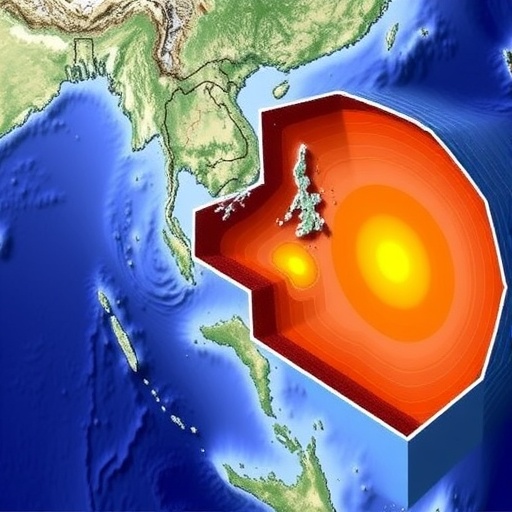
In a groundbreaking new study poised to reshape our understanding of complex tectonic processes, researchers have unveiled compelling evidence pointing to the profound influence of convergent mantle flow combined with intricate plate kinematics on the rifting mechanisms of the South China Sea. This comprehensive investigation, published by Li, Suo, Liu, and colleagues in Nature Communications in 2026, offers an unprecedented view into the dynamic interplay between deep Earth processes and surface deformation that gives rise to major oceanic basin formations.
The South China Sea has long been recognized as a critical natural laboratory for studying rifting phenomena due to its unique geodynamic setting at the junction of multiple tectonic plates. Historically, investigations into its rifting have focused heavily on plate boundary forces and surface tectonic motions. However, this fresh research emphasizes the active role played by mantle flow patterns beneath the lithosphere, revealing that sub-lithospheric processes are not merely passive players but dynamic agents facilitating lithospheric stretching and eventual breakup.
The central thesis of the study revolves around the convergence of mantle flow beneath the South China Sea region. Utilizing advanced geophysical imaging techniques alongside state-of-the-art numerical modeling, the research team documented a focused mantle convergence zone that induces shear and stress concentrations within the overlying crust. This convergent flow, distinct from the usual divergent mantle upwelling associated with rift initiation, acts synergistically with plate kinematic forces to accentuate extensional stresses, ultimately promoting rift development and propagation.
What differentiates this research is the integration of multidisciplinary datasets including seismic tomography, geodetic measurements, and geodynamic simulations. The seismic tomography maps provide a high-resolution snapshot of mantle flow patterns, revealing deep mantle anomalies beneath the region that correspond precisely with areas of intense seismicity and surface deformation. These anomalies are interpreted as powerful drivers of localized mantle flow convergence, a process previously underestimated in its contribution to rifting.
Plate kinematics, often studied through GPS arrays and satellite geodesy, confirm that the South China Sea region experiences complex motions characterized by oblique extension and strike-slip faulting. The researchers highlight that these kinematic patterns are not random but are intimately linked to the underlying mantle flow regime. The coupling between mantle convection patterns and surface plate motions creates a feedback system where stress and strain are redistributed in ways that facilitate continuous lithospheric thinning and fault formation.
A standout feature of the study is its innovative use of numerical geodynamic models that incorporate realistic rheological properties of the lithosphere and mantle. These models simulate how mantle flow convergence generates differential stresses that weaken the lithosphere heterogeneously. This weakening is particularly pronounced along pre-existing structural weaknesses, which it exploits to nucleate rift basins. The South China Sea, with its complex tectonic inheritance, presents an ideal case for this novel mechanism.
Moreover, the research challenges the traditional view of mantle convection solely as a deep-seated, homogenized process by proving that spatial heterogeneity and directional flow convergence at relatively shallow mantle depths are crucial in shaping continental breakup processes. This insight reframes tectonic theory by emphasizing the importance of multidirectional mantle flow in controlling the temporal and spatial evolution of rift systems.
The implications of this study reach far beyond the South China Sea. Convergent mantle flow may be a fundamental, yet overlooked driver in the formation of many other marginal basins worldwide, especially in tectonically complex settings where multiple plates interact. It suggests a need for reevaluation of basin development models that have predominantly relied on simplistic divergent flow assumptions.
Furthermore, the study addresses the question of how mantle dynamics influence seismic hazard potential in rift zones. By linking mantle flow convergence zones with regions of intense seismicity and crustal deformation, the authors provide a mechanistic explanation for spatial clustering of earthquakes in rift environments. This improves predictive models for seismic hazard assessment and could aid in disaster preparedness in vulnerable regions around the South China Sea.
The findings also integrate with advances in understanding mantle plume interactions and lithospheric delamination processes. The convergent mantle flow observed might be indicative of a broader mantle circulation pattern involving deep-sourced upwellings and downwellings that collectively sculpt lithospheric architecture. This integrated mantle-plate system perspective could reconcile previously conflicting data about the timing and style of South China Sea rifting.
Another important aspect detailed in the paper is the geological record’s support for the mantle flow convergence model. Sedimentary sequences and structural analyses from drilling data exhibit deformation patterns consistent with episodic lithospheric weakening and extension tied to mantle-induced stress fields. This geologic corroboration adds a temporal dimension that aligns with the proposed mantle flow dynamics through geological time.
In terms of future research trajectories, the authors identify critical gaps, emphasizing the necessity for higher-resolution seismic studies and expanded geodynamic simulations that incorporate transient rheological changes. They advocate for an integrated approach combining field geology, geophysics, and computational modeling to further elucidate the nuances of mantle-plate interactions, not just in the South China Sea but globally.
This work marks a critical milestone in geosciences by advancing the paradigm of Earth’s interior processes. It eloquently demonstrates that the path to ocean basin formation is not governed solely by brittle plate tectonics but also by the complex, convergent movements of the mantle beneath. The convergence of mantle flow and its feedback with plate kinematics provides a powerful new lens to view rifting and continental breakup.
By meticulously quantifying these interactions, Li and colleagues open new frontiers in understanding lithospheric dynamics. Their study compels researchers and policymakers alike to reconsider how tectonic hazards are conceptualized and managed in active rift zones, offering hope for more accurate forecasting of geological events that influence millions of lives.
In conclusion, this seminal research redefines the South China Sea as a model region for studying how convergent mantle flow shapes tectonic processes and rifting dynamics. It promises to inspire a wave of similar investigations worldwide, potentially transforming geodynamic science into a more integrative discipline where mantle and plate processes are inseparably linked in governing Earth’s constantly evolving surface.
Cite Scienmag News
Violet Maxwell. (June 2, 2026). Convergent Mantle Flow Drives South China Sea Rifting. Scienmag. https://scienmag.com/convergent-mantle-flow-drives-south-china-sea-rifting/
Violet Maxwell. "Convergent Mantle Flow Drives South China Sea Rifting." Scienmag, 2 June 2026, https://scienmag.com/convergent-mantle-flow-drives-south-china-sea-rifting/. Accessed 4 September 2026.
Violet Maxwell. "Convergent Mantle Flow Drives South China Sea Rifting." Scienmag. June 2, 2026. https://scienmag.com/convergent-mantle-flow-drives-south-china-sea-rifting/


