


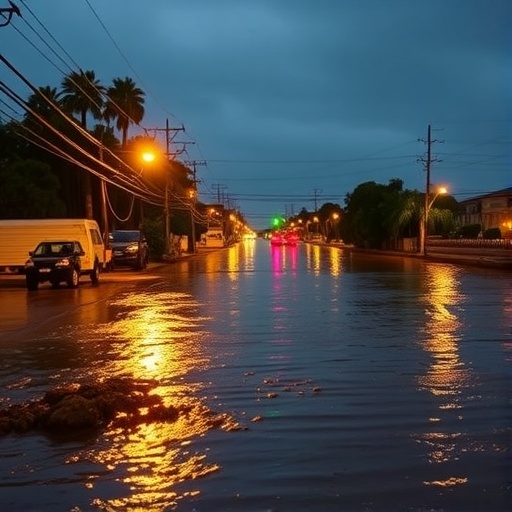
In a groundbreaking study set to redefine our understanding of climate-driven hydrological shifts, scientists have unveiled compelling evidence that anthropogenic climate change is not only intensifying global flood events but also accelerating their onset worldwide. Published in Nature Communications, the research meticulously analyzes decades-long hydrological data spanning continents and climate zones, demonstrating a clear trend: floods are arriving earlier in the year, disrupting traditional seasonal patterns and posing unprecedented risks to ecosystems, infrastructure, and human societies.
The team, led by Qi, Liu, Jiang, and colleagues, employed a sophisticated blend of observational data and state-of-the-art climate modeling frameworks to differentiate natural variability from human-induced climate effects. Their analysis reveals that rising global temperatures have perturbed large-scale atmospheric circulation patterns, influencing precipitation regimes in ways that precipitate more frequent heavy rainfall events earlier in typical flood seasons.
This shift in flood timing carries profound implications for flood prediction models and disaster preparedness strategies worldwide. Historically, communities have relied on predictable monsoon or snowmelt schedules to anticipate flood risks. However, with floods arriving prematurely, traditional early warning systems may become obsolete, thereby increasing vulnerability in flood-prone regions. For agricultural sectors, this could translate into disrupted planting cycles and compromised harvests, imperiling food security on a global scale.
Technically, the researchers integrated remote sensing data with hydrological modeling to capture subtle changes in river discharge timings. High-resolution satellite imagery helped track catchment responses to shifting precipitation patterns, while river gauge networks provided ground truth verification. The study’s temporal scope spanned the late 20th century to projections extending to mid-21st century climate scenarios, facilitating robust trend detection and future forecasting.
Fundamentally, the mechanism behind earlier flood onset lies in the accelerated hydrological cycle driven by a warmer atmosphere, which holds increased moisture content. This phenomenon intensifies the frequency and intensity of extreme rainfall episodes, especially in temperate and high-latitude zones where snowpack dynamics historically regulated flood timing through delayed meltwater pulses. With diminished snow accumulation and earlier melting seasons, rivers are swelling sooner than populations have experienced historically.
The interdisciplinary approach combining climatology, hydrology, and remote sensing underscores that human activities—chiefly fossil fuel combustion and land-use changes—have disrupted the delicate interplay between temperature, precipitation, and hydrological processes. The scientific team warns that without urgent mitigation efforts to curb greenhouse gas emissions, these temporal shifts in hydrological extremes will compound risks, exacerbating flood hazards in vulnerable regions.
Crucially, the findings challenge the existing paradigm of static flood seasonality, urging policymakers to incorporate dynamic risk assessments that reflect the nonstationarity of hydroclimatic phenomena. Emergency management agencies must recalibrate response plans to accommodate more erratic flood timings, while infrastructure designs need to factor in earlier and potentially more severe flooding events.
Further analysis revealed regional disparities in the acceleration of flood onset. While mid- to high-latitude basins exhibited pronounced shifts linked to snowmelt timing alterations, tropical basins showed variable responses associated with changes in the intensity and timing of convective storm systems. These nuances highlight the complexity of global hydrological responses to climate perturbations and the necessity for tailored adaptation strategies.
From a technological perspective, advancements in artificial intelligence and machine learning were instrumental in sifting through enormous datasets to detect subtle temporal trends otherwise masked by natural variability. The integration of AI-based predictive analytics with traditional hydrological models marks a pivotal advancement in climate impact studies, enabling near-real-time monitoring and forecasting improvements.
The research also calls attention to cascading effects on ecosystems. Early flooding disrupts breeding cycles of aquatic species accustomed to stable seasonal flows. Altered floodplain inundation patterns affect nutrient cycling and habitat connectivity, potentially leading to biodiversity losses. These ecological consequences feed back into human societies, which rely on ecosystem services such as fisheries and water purification.
Socioeconomic vulnerabilities are heightened, as early floods strike before disaster preparedness efforts traditionally ramp up. Communities with limited adaptive capacities—often in developing countries—face disproportionate risks, amplifying inequities. The study emphasizes integrating climate justice considerations into flood management, ensuring resilient systems that protect marginalized populations.
Importantly, the research pioneers a novel methodological framework combining extensive observational datasets with predictive scenarios tailored to regional hydroclimatic characteristics. By capturing the interactive effects of temperature, precipitation, snowpack dynamics, and land-use changes, this framework sets a new standard for understanding and anticipating climate-induced hydrological shifts.
Looking forward, the authors advocate for sustained global monitoring networks and improved data sharing mechanisms to track evolving flood behaviors. They also stress the critical need for interdisciplinary collaborations bridging climatology, hydrology, ecology, and social sciences to craft comprehensive adaptation pathways responsive to the accelerating pace of climate impacts.
In sum, this seminal study delivers a sobering revelation: anthropogenic climate change is forcing a fundamental reordering of flood seasonality worldwide, advancing the onset of destructive flood events and escalating risks that demand urgent attention. As floodwaters creep ever earlier and with greater ferocity, the global community must urgently recalibrate its strategies to safeguard lives, ecosystems, and economies amid an increasingly volatile hydrological future.
Qi, W., Liu, Y., Jiang, X. et al. Anthropogenic climate change accelerates the onset of global flood timing.
Nat Commun (2026). https://doi.org/10.1038/s41467-026-73839-x
Cite Scienmag News
Violet Maxwell. (May 29, 2026). Human Activity Speeds Up Global Flood Timing. Scienmag. https://scienmag.com/human-activity-speeds-up-global-flood-timing/
Violet Maxwell. "Human Activity Speeds Up Global Flood Timing." Scienmag, 29 May 2026, https://scienmag.com/human-activity-speeds-up-global-flood-timing/. Accessed 5 September 2026.
Violet Maxwell. "Human Activity Speeds Up Global Flood Timing." Scienmag. May 29, 2026. https://scienmag.com/human-activity-speeds-up-global-flood-timing/


