


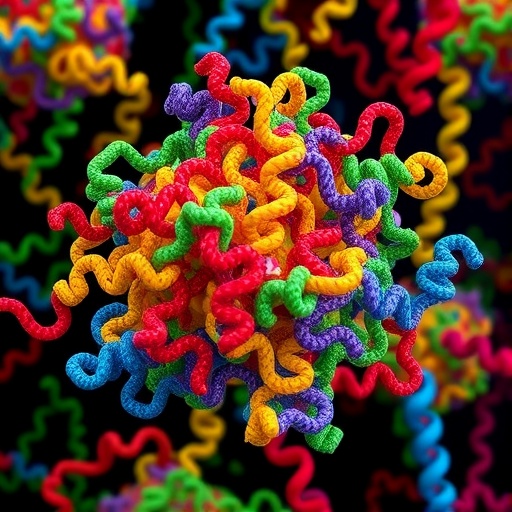
In the relentless pursuit to decode the complex orchestration of protein interactions within living cells, a groundbreaking innovation has emerged, poised to transform the landscape of molecular biology and proteomics. Conventionally, proximity labeling (PL) techniques, epitomized by the enzyme ascorbate peroxidase APEX2, have enabled scientists to capture the fleeting assemblies of protein complexes with remarkable spatiotemporal precision. However, the Achilles’ heel of these powerful tools has always been their dependency on hydrogen peroxide (H2O2), a chemical that introduces oxidative stress and toxicity, especially in delicate biological systems. Today, a new paradigm shatters this limitation, delivering a rapid, sensitive, and non-invasive method that circumvents the need for H2O2 entirely.
This revolutionary technique, coined ROProx, harnesses the power of radical and oxygen-driven photoreactive chemistry to achieve proximity labeling with unprecedented control and minimal perturbation to living systems. The innovation pivots around a chemically refined biotin-naphthylamine probe, termed BN2, engineered to exhibit a strong binding affinity for the APEX2 enzyme. Intriguingly, this method exploits naturally occurring tyrosyl radicals within APEX2, previously unrecognized players in labeling strategies, to initiate a labeling cascade upon mild blue light illumination.
By activating ROProx with gentle blue light rather than harsh chemicals, researchers can now label dynamic protein complexes in living cells within mere seconds, achieving spatial resolution on the order of 10 nanometers. This spatial precision ensures that only proteins in immediate proximity to APEX2 are marked, offering a clear snapshot of protein interactions as they unfold in real time. The reliance on light, a clean and adjustable trigger, affords unparalleled temporal control, allowing scientists to dissect molecular events with previously unattainable accuracy.
The elimination of hydrogen peroxide from the process is not merely a technical feat—it radically expands the scope of proximity labeling into previously inaccessible biological contexts. Sensitive living systems, such as primary cells, delicate tissues, and even whole organisms, can now be probed without the confounding effects of oxidative damage. This advancement stands to revolutionize in vivo studies, bridging a critical gap in proteomics research where mimicking natural physiological conditions has long been a barrier.
Taking their innovation beyond the confines of cell culture, the creators of ROProx have successfully demonstrated its power in living mice. By simply administering the BN2 probe for a brief five-minute window, they explored the phosphotyrosine-dependent interactome of GRB2, a key signaling adaptor protein. This remarkable achievement underscores the versatility of ROProx, proving its potential as a robust tool for in vivo proteomics and expanding the horizons of biological research in real-time animal models.
At the heart of this breakthrough is the chemically evolved probe BN2. Unlike previous biotinylation reagents, BN2 is optimized for both high-affinity binding and reactivity in the presence of tyrosyl radicals—a unique class of reactive species generated by APEX2 upon light exposure. This synergy between BN2 and APEX2’s intrinsic radical chemistry results in a labeling mechanism that is efficient, rapid, and free from exogenous toxic agents, setting a new standard in proximity proteomics.
The conceptual leap of exploiting tyrosyl radicals within APEX2 for labeling extends the toolkit of chemical biology. Tyrosyl radicals, often transient and elusive, are here used as a precise molecular switch, converting light into selective labeling events. This represents a novel photochemical mechanism distinct from traditional peroxidase-driven reactions, opening avenues for further chemical evolution of labeling probes and methodologies.
Temporal control is a cornerstone of dynamic proteomics. The capability of ROProx to initiate labeling with seconds of blue light pulses means researchers can capture snapshots of transient protein interactions that underpin cellular signaling, metabolic fluxes, and structural rearrangements. This temporal finesse can illuminate protein dynamics governing processes like immune responses, neuronal activity, and cell division with unparalleled clarity.
Spatially, the labeling radius of approximately 10 nanometers achieved by ROProx matches the scale of direct protein-protein interactions and small multiprotein complexes. Such fine resolution allows for discrimination between genuine interactors and more distal neighbors, refining the accuracy of interactome mapping. This precision is critical for interpreting complex biological networks and identifying potential therapeutic targets.
Beyond methodological excellence, the compatibility of ROProx with living systems ensures minimal biological disruption during experiments. Since redox perturbations are avoided, cellular physiology remains largely unaltered, preserving the authenticity of the interactomes captured. This fidelity is vital for translational research where reproducing physiological states is paramount for drug discovery and understanding disease mechanisms.
The adoption of light as a triggering modality is not only gentle but scalable and versatile. Blue light sources are widely available and can be finely modulated in intensity and duration. This opens potential for combinatorial studies, spatially restricted labeling within tissues, and integration with other optogenetic and imaging technologies for multi-modal investigation of cellular environments.
ROProx’s application in animal models signals a new era in proteomics where researchers can investigate protein networks in their native context, observing interactions in response to stimuli, developmental cues, or pathological states in vivo. Such studies promise insights into complex diseases like cancer, neurodegeneration, and immune disorders, where protein interactions often shift dynamically and spatially.
As dynamic protein complex assembly underpins virtually all cellular functions, the advent of a tool like ROProx will catalyze a surge in discoveries—from decoding signaling cascades to charting uncharted territories of protein cooperation and competition. This chemical evolution of proximity labeling technology is poised to become an indispensable method for biologists seeking to capture molecular events with exquisite fidelity inside living organisms.
In summary, ROProx represents a paradigm shift, surmounting the long-standing challenges posed by peroxide-dependent labeling technologies. Its introduction heralds a future where scientists can probe protein interactions rapidly, precisely, and non-invasively across diverse biological systems. Such capability will undoubtably accelerate our molecular exploration of life, facilitating breakthroughs in fundamental biology and translational medicine.
The study detailing this innovative technology was recently published in Nature Chemical Biology, marking a significant milestone in proximity proteomics and chemical biology at large. The molecular artistry of combining chemical probe design with enzyme radical chemistry and photoreactive control exemplifies the creative convergence driving modern bioscience innovation.
As further refinements and adaptations emerge, including probe diversification and multiplexed labeling, ROProx’s foundational principles are likely to spawn an entire new class of labeling strategies. Its impact stretches beyond proteomics, potentially influencing fields like metabolomics, interactomics, and cell signaling with light-driven precision.
Ultimately, ROProx typifies how chemical ingenuity married with biological insight can unlock mysteries of the proteome, charting the dynamic web of protein interactions that animate all living cells. The future of proximity labeling now shines brighter, driven by light and chemistry, illuminating the shadows of cellular complexity with newfound clarity.
Cite Scienmag News
Kenneth Gardner. (May 28, 2026). H2O2-Free Proteomics Reveals Dynamic Protein Complexes. Scienmag. https://scienmag.com/h2o2-free-proteomics-reveals-dynamic-protein-complexes/
Kenneth Gardner. "H2O2-Free Proteomics Reveals Dynamic Protein Complexes." Scienmag, 28 May 2026, https://scienmag.com/h2o2-free-proteomics-reveals-dynamic-protein-complexes/. Accessed 4 September 2026.
Kenneth Gardner. "H2O2-Free Proteomics Reveals Dynamic Protein Complexes." Scienmag. May 28, 2026. https://scienmag.com/h2o2-free-proteomics-reveals-dynamic-protein-complexes/


