


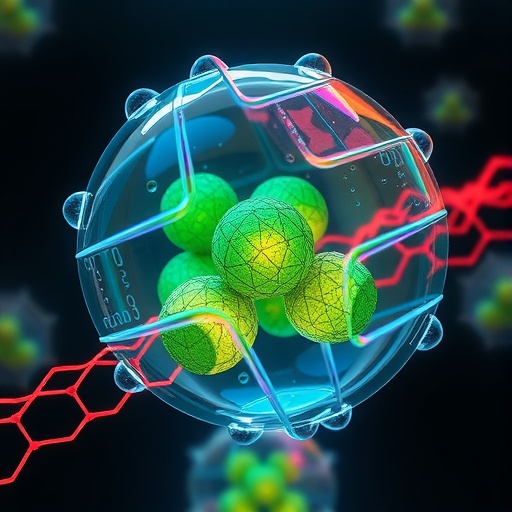
In a groundbreaking advancement that unravels the complex molecular strategies cells deploy to sense their water environment, a recent study published in Nature illuminates the enigmatic process of cellular water-potential sensing through biomolecular condensation. This discovery, focused on the hydration properties of a specific peptide domain known as SAM8, could redefine our understanding of how cells interpret and respond to their hydration status, a fundamental biological challenge critical to cell survival and function.
Water potential, the thermodynamic potential that dictates water movement, is a crucial parameter that cells must continuously monitor to maintain homeostasis. Despite its importance, the molecular mechanisms underpinning water-potential sensing remained largely elusive until now. Researchers have turned their attention to SAM8, a segment derived from the Sterile Alpha Motif (SAM) domain family, which appears to play a pivotal role in this sensory system through its unique physical interactions with its aqueous environment.
By employing sophisticated biophysical techniques, including dynamic light scattering (DLS) and multi-angle light scattering (MALS), the research team measured two distinct parameters related to the size of SAM8: the hydration radius (Rh) and the radius of gyration (Rg). The hydration radius offers insights into the extent of the domain’s interaction with surrounding water molecules, whereas the radius of gyration reflects the intrinsic physical size of the peptide in solution. Intriguingly, their findings reveal that the Rh of SAM8 is significantly larger than its Rg, suggesting an unusually extensive hydration shell or possibly an unfolded, expanded molecular conformation that maximizes water interactions.
To establish a comparative baseline, the study also examined other SAM domain-containing proteins such as SOSEKI1 and SAM7, which possess polymerization domains but do not exhibit such disparity between Rh and Rg. This critical control confirms the exceptional hydration behavior of SAM8, spotlighting it as a unique molecular architect within the water-potential sensory framework.
The interplay between SAM8’s hydration shell and water potential was further explored by introducing polyethylene glycol (PEG), a known modulator of hydration due to its competition for water molecules. PEG addition led to a measurable decrease in the hydration radius of SAM8, reinforcing the notion that SAM8’s hydration shell is sensitive and responsive to changes in the local water milieu. This modulation underscores the delicate balance SAM8 maintains between its molecular state and environmental hydration.
Temperature also emerged as a determining factor influencing SAM8’s behavior. Experiments showed that at physiological body temperature (37°C), SAM8 formed significantly smaller droplets in the presence of PEG compared to room temperature (25°C), affirming that temperature modulates the water potential landscape and consequently affects biomolecular condensation. Contrastingly, droplets formed by IDR1^SEU, an intrinsically disordered region studied in parallel, displayed negligible size variation across the same temperature range, hinting at distinct mechanisms governing phase separation among different protein domains.
Together, these observations paint a comprehensive picture wherein SAM8 exists in solution as an extensively hydrated molecule harboring a robust hydration shell. The thick hydration layer offers a sensitive interface capable of detecting reductions in water potential, thereby triggering phase separation—a phenomenon where molecules condense into distinct liquid-like droplets. This phase behavior is critical for cellular compartmentalization, influencing biochemical reactions without the need for membrane-bound organelles.
Biomolecular condensation, a concept gaining traction since the last decade, is now implicated in a diverse array of cellular processes. This study uniquely links it to water-potential sensing, extending the functional repertoire of phase separation beyond its traditional roles. It proposes a model where changes in the cellular water environment directly impact the hydration shell of specific sensor domains like SAM8, initiating a condensation response that informs subsequent cellular adjustments.
The implications of this research are multifaceted. Understanding the molecular basis for water-potential sensing enhances our grasp of cellular resilience during dehydration stress, a common challenge in both plant and animal cells. This mechanistic insight could inform innovative strategies for managing water balance in crops or addressing pathological conditions arising from cellular water imbalance in humans.
Moreover, the precise modulation of hydration and phase behavior by temperature and molecular crowding agents like PEG hints at potential therapeutic avenues. For instance, manipulating such interactions could fine-tune phase separation processes implicated in neurodegenerative diseases where aberrant condensate formation often occurs.
Future investigations will undoubtedly seek to explore the in vivo relevance of these findings, determining how SAM8 and similar sensor domains function within the complex milieu of living cells. The translation of in vitro biophysical parameters to physiological contexts remains a vigilant frontier, promising to unveil the nuanced controls governing cellular hydration homeostasis.
In summary, this study deftly combines cutting-edge biophysical measurements with molecular biology to decode the water-potential sensing mechanism mediated by SAM8. By characterizing its expansive hydration shell and the triggered phase separation upon water potential reduction, it highlights an elegant, previously unrecognized pathway by which cells tune their internal environment in response to hydration fluctuations. This represents a significant leap in cell biology, carrying wide-reaching consequences for our understanding of cellular adaptation, structure, and function.
With these compelling insights, the scientific community is poised to embrace a new paradigm wherein hydration shells and phase behavior constitute a fundamental sensory axis for cellular environmental interaction. The meticulous characterization of SAM8 paves the way for broader explorations into cellular hydration networks and their impact on health and disease.
Cite Scienmag News
Denise Maddox. (May 27, 2026). Cellular Water-Potential Sensing via Biomolecular Condensation. Scienmag. https://scienmag.com/cellular-water-potential-sensing-via-biomolecular-condensation/
Denise Maddox. "Cellular Water-Potential Sensing via Biomolecular Condensation." Scienmag, 27 May 2026, https://scienmag.com/cellular-water-potential-sensing-via-biomolecular-condensation/. Accessed 4 September 2026.
Denise Maddox. "Cellular Water-Potential Sensing via Biomolecular Condensation." Scienmag. May 27, 2026. https://scienmag.com/cellular-water-potential-sensing-via-biomolecular-condensation/


