


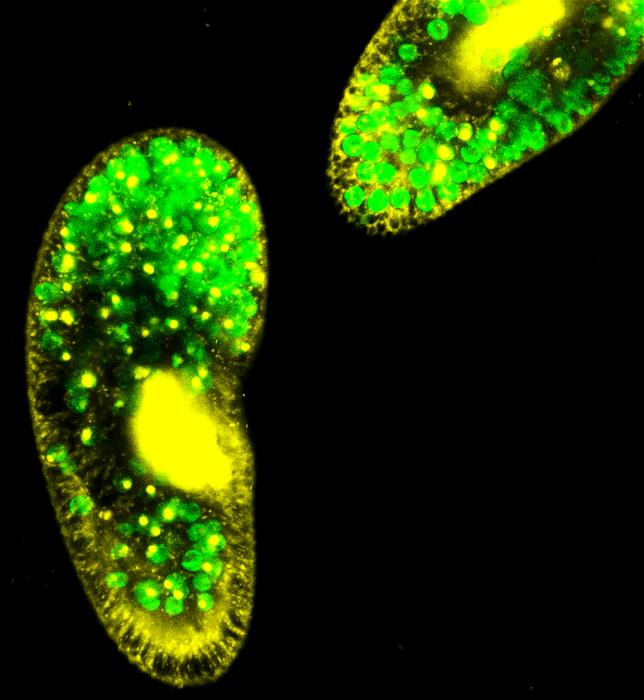
Hotter conditions prevent two tiny organisms working together for mutual benefit, new research shows.

Credit: Dr Ben Makin
Hotter conditions prevent two tiny organisms working together for mutual benefit, new research shows.
University of Exeter scientists studied a single-celled organism (Paramecium bursaria) which can absorb and host algae (Chlorella spp).
This pairing is common in freshwater worldwide, and their symbiotic relationship provides benefits including trading of nutrients and protection for the algae.
But when scientists made the water 5°C warmer, the partnership stopped working – and the results suggest the algae may even become parasitic.
The breakdown of such relationships could have a major impact on ecosystems.
“This kind of relationship – called photosymbiosis – is an important part of freshwater and ocean ecosystems,” said Dr Ben Makin, of the Environment and Sustainability Institute on Exeter’s Penryn Campus in Cornwall.
“To illustrate their importance, these relationships provide around half of all marine photosynthesis.
“A well-known example is found in coral reefs – where the reef-building corals host resident photosynthetic partners. In recent years, we have seen many high-profile ‘bleaching’ events – when corals expel these partners, often due to high temperatures, leaving them at risk of stress and mortality.
“That is a short-term, ‘immediate’ reaction to changing conditions, but in this study we wanted to find out the possible evolutionary effects of high temperatures – occurring over multiple generations. Such effects remain virtually unknown, as they are difficult to study in slow-growing organisms.
“The single-celled organisms we chose in our study have short lifespans, so by testing them in sustained high temperatures we were able to examine how they respond over many generations.”
The Paramecium bursaria and Chlorella spp. in the study had been kept in lab conditions at 25°C – a realistic temperature for these species in the environment.
The researchers kept some at 25°C as a control group, while others were exposed to cooling (20°C) or warming (30°C) for 295 days.
“With 5°C of warming – consistent with worst-case climate scenarios by the end of this century – the relationship between these species appears to be fundamentally changed,” Dr Makin said.
“While some algae stayed within host cells, the relationship was strongly degraded in warmer conditions.
“Net photosynthesis and carbon-use efficiency – in effect the amount of energy produced by the algae for its host and the capacity for the association to use that energy to grow – both strongly declined to zero.
“The complete loss of net photosynthesis was a striking result. Alarmingly, this implies the photosynthesis rates provided globally by these associations could be at risk over evolutionary timescales under warming.
“It also means the algae no longer provide the key photosynthetic benefit to their hosts, with the association showing signs of becoming parasitic.”
This is an ‘inversion’ of the mutualistic association these photosymbioses typically form – which means the species no longer receive benefits from one another, and instead partners can exploit or harm the other.
It is hoped that evolution can “rescue” some species, allowing them to adapt quickly enough to rapid environmental changes being caused by humans.
While these species did manage to raise their “growth rate thermal optimum” (their ideal temperature for reproduction), they did not evolve to save their symbiotic relationship.
This type of algae usually relies on organic nitrogen sourced from its host, but in the study more and more of the algae became free living – existing outside the host and now relying on inorganic nitrogen found in the water.
Dr Makin concluded: “Warming has the power to erode these relationships over evolutionary timescales – with serious implications for global, highly productive photosymbiotic associations, like those found in coral reefs.”
The paper, published in the journal Aquatic Biology, is entitled: “One year of warming leads to the total loss of productivity in a widespread photosymbiosis.”
Journal
Aquatic Biology
DOI
Article Title
One year of warming leads to the total loss of productivity in a widespread photosymbiosis
Article Publication Date
1-Aug-2024
Cite Scienmag News
Violet Maxwell. (August 1, 2024). Warming stops tiny organisms working together. Scienmag. https://scienmag.com/warming-stops-tiny-organisms-working-together/
Violet Maxwell. "Warming stops tiny organisms working together." Scienmag, 1 August 2024, https://scienmag.com/warming-stops-tiny-organisms-working-together/. Accessed 6 September 2026.
Violet Maxwell. "Warming stops tiny organisms working together." Scienmag. August 1, 2024. https://scienmag.com/warming-stops-tiny-organisms-working-together/

