


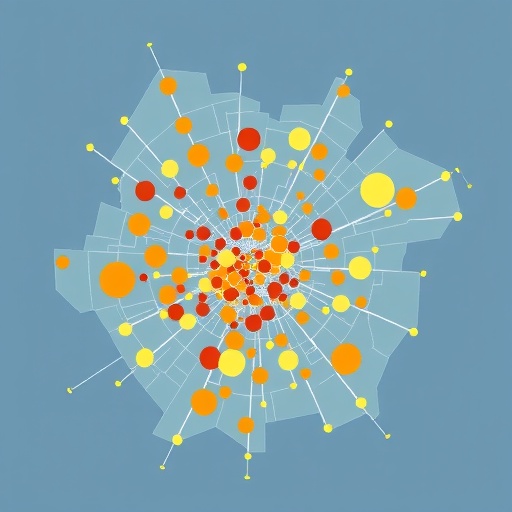
The digital revolution has irrevocably transformed healthcare delivery worldwide, with telemedicine emerging as a vital tool in bridging disparities in medical access. A groundbreaking study analyzing large-scale consultation data from China’s online healthcare platforms reveals an intricate, multifaceted landscape characterizing the nation’s intercity telemedicine system (ITS). This exploration into the spatial patterns and city-specific roles unearths profound implications for healthcare equity and system efficiency—offering a nuanced understanding of how digital platforms reshape patient flows and resource distribution across urban networks.
At its core, the study uncovers the ITS as a densely interconnected network, where telemedicine consultations flow fluidly between cities. This network’s highly integrated nature improves systemic efficiency, enabling patients to circumvent traditional barriers such as geographical distance and limited local expertise. However, beneath this veneer of connectivity lies a complex dynamic where top-tier hubs dominate the system. These hubs, often situated in major metropolitan centers, centralize an overwhelming share of medical consultations, effectively consolidating critical resources and exacerbating healthcare inequalities by marginalizing smaller cities with fewer medical assets.
A particularly striking insight reveals the divergence of telemedicine from conventional healthcare-seeking behaviors. Traditionally, patients tend to travel to their nearest large administrative city to receive care, reflecting a hierarchical, proximity-driven pattern rooted in face-to-face interactions. Contrastingly, the ITS defies this convention, as patients increasingly prioritize specialized medical expertise tailored to their individual needs, regardless of geographic proximity. Telemedicine thus introduces a selection criterion governed less by spatial convenience and more by clinical specialization and perceived quality, signaling a paradigm shift in how healthcare demand navigates urban networks.
This realignment of patient flows also underscores the twin-edged nature of telemedicine’s impact on healthcare access. While telemedicine platforms exacerbate resource concentration in dominant cities, they simultaneously enhance service availability in smaller, resource-poor cities. These platforms enable the extension of expert medical services into territories traditionally underserved by brick-and-mortar medical facilities, thereby expanding the reach of healthcare into remote or marginalized regions. The net effect is a nuanced ecosystem where digital conduits both centralize and diffuse healthcare capacities, reflecting complex systemic trade-offs.
Further dissecting city roles reveals pronounced structural differentiation within the ITS framework. A handful of dominant urban hubs emerge as behemoths, controlling the bulk of telemedicine consultations and exerting outsized influence on patient flows. Conversely, many cities remain relegated to peripheral roles, participating mainly as sources of patient demand rather than providers. Intriguingly, some smaller cities, despite possessing limited physical healthcare infrastructure, leverage digital platforms to attract significant medical demand from diverse regions beyond their provincial boundaries. This innovative digital repositioning challenges traditional conceptions of urban healthcare hierarchies and illustrates the disruptive potential of online platforms in reconfiguring regional medical landscapes.
The study’s sophisticated network analysis provides critical insights into systemic efficiency and equity challenges intrinsic to the ITS. The high connectivity among cities facilitates rapid dissemination of specialized medical knowledge and resource allocation, driving overall system performance. However, this same connectivity inadvertently fosters an uneven distribution of demand, creating bottlenecks around principal hubs. Consequently, the ITS inadvertently perpetuates preexisting disparities by entrenching the prominence of already resource-rich urban centers, raising concerns about the equitable distribution of telemedicine’s benefits.
From a policy perspective, these findings illuminate the need for a balanced approach to telemedicine expansion. Encouraging the development of secondary hubs with intermediate capacity could decentralize the flow of consultations, alleviating pressure on dominant cities while broadening patient options. Simultaneously, investments in adequately equipping low-resource cities to participate more actively in telemedicine supply chains are paramount. Such strategies would promote inclusivity and resilience in the ITS, fostering a more egalitarian healthcare ecosystem.
Technically, the study leverages advanced computational methods and large-scale data analytics to unravel ITS dynamics. By harnessing millions of teleconsultation records from online healthcare platforms, researchers construct detailed networks that map patient-provider interactions between cities. This approach enables the quantification of network metrics such as centrality, connectivity, and flow patterns, thereby allowing an unprecedentedly granular understanding of the system. The methodological rigor offers a blueprint for similar analyses in other national contexts, setting a new standard in telemedicine research.
A critical dimension of the ITS architecture is its hybrid blend of digital innovation and residual traditional logics. The gradual divergence from face-to-face, proximity-based care reflects broader trends in digital health adoption globally, where patients seek not merely convenience but also tailored, high-quality expertise accessible through virtual channels. Nonetheless, the persistence of some geographical logic within the network highlights the enduring influence of administrative and infrastructural realities. The ITS thus embodies a transitional model, one where longstanding healthcare conventions coexist with emergent digital paradigms.
Moreover, the emergence of digitally empowered mid-tier cities suggests new spatial patterns of medical resource distribution. With strategic use of telemedicine platforms, these cities optimize their limited physical resources by specializing in niche medical domains or services, attracting patient flows that transcend traditional provincial confines. This phenomenon reflects a democratization of healthcare access, whereby digital tools enable a more diversified and dispersed landscape of service provision, challenging urban hierarchies ingrained in physical infrastructure.
Nevertheless, these advances do not diminish ongoing systemic challenges. Telemedicine’s reliance on digital infrastructure and patient literacy risks marginalizing disadvantaged populations lacking access to requisite technology or skills. Furthermore, the concentration of demand in elite hubs may strain their capacities, risking quality degradation despite technological enhancements. Addressing such issues necessitates integrated policy frameworks that combine infrastructure development, digital inclusion initiatives, and strategic network planning.
The implications of this study extend beyond the Chinese context, offering vital lessons for global telemedicine expansion. As health systems worldwide grapple with disparities exacerbated by uneven resource distribution, the Chinese ITS’s complex interplay between centralization and diffusion provides a cautionary yet instructive model. Embracing telemedicine’s transformative potential requires deliberate efforts to harness its efficiency gains while mitigating emergent inequities—a balance critical to realizing equitable, high-quality healthcare in the digital age.
In conclusion, the analysis affirms that telemedicine is far more than a technological innovation; it is a systemic force reshaping the spatial and organizational fabric of healthcare delivery. China’s intercity telemedicine system epitomizes this transformation, revealing a network that simultaneously amplifies major hubs and empowers smaller cities through digital channels. Understanding this dual mechanism is key to designing policies and platforms that nurture a fairer, more accessible healthcare future.
As the medical world continues to navigate the digital frontier, this research underscores the indispensability of integrating network science, urban studies, and health policy to unravel the complexities of telemedicine systems. Only through such interdisciplinary endeavors can we chart pathways toward harnessing digital health innovations that balance efficiency, equity, and quality, ensuring that the promise of telemedicine translates into tangible benefits for diverse populations across spatial and social spectra.
The ongoing evolution of telemedicine within China’s urban networks not only challenges traditional paradigms but also opens opportunities for redefining medical accessibility on a global scale. By critically engaging with the spatial patterns and differentiated city roles articulated in this study, stakeholders—from policymakers to technologists—can better anticipate the dynamics governing telemedicine flows and craft interventions that promote inclusive healthcare ecosystems in an increasingly digitalized world.
Cite Scienmag News
Denise Maddox. (May 19, 2026). Unequal Spatial Patterns Shape Intercity Telemedicine Roles. Scienmag. https://scienmag.com/unequal-spatial-patterns-shape-intercity-telemedicine-roles/
Denise Maddox. "Unequal Spatial Patterns Shape Intercity Telemedicine Roles." Scienmag, 19 May 2026, https://scienmag.com/unequal-spatial-patterns-shape-intercity-telemedicine-roles/. Accessed 4 September 2026.
Denise Maddox. "Unequal Spatial Patterns Shape Intercity Telemedicine Roles." Scienmag. May 19, 2026. https://scienmag.com/unequal-spatial-patterns-shape-intercity-telemedicine-roles/


