


(Santa Barbara, Calif.) — Computers benefit greatly from being connected to the internet, so we might ask: What good is a quantum computer without a quantum internet?

Credit: Mark Turianksy
(Santa Barbara, Calif.) — Computers benefit greatly from being connected to the internet, so we might ask: What good is a quantum computer without a quantum internet?
The secret to our modern internet is the ability for data to remain intact while traveling over long distances, and the best way to achieve that is by using photons. Photons are single units (“quanta”) of light. Unlike other quantum particles, photons interact very weakly with their environment. That stability also makes them extremely appealing for carrying quantum information over long distances, a process that requires maintaining a delicate state of entanglement for an extended period of time. Such photons can be generated in a variety of ways. One possible method involves using atomic-scale imperfections (quantum defects) in crystals to generate single photons in a well-defined quantum state.
Decades of optimization have resulted in fiber-optic cables that can transmit photons with extremely low loss. However, this low-loss transmission works only for light in a narrow range of wavelengths, known as the “telecom wavelength band.” Identifying quantum defects that produce photons at these wavelengths has proven difficult, but funding from the U.S. Department of Energy and the National Science Foundation (NSF) has enabled researchers in the UC Santa Barbara College of Engineering to understand why that is. They describe their findings in “Rational Design of Efficient Defect-Based Quantum Emitters,” published in the journal APL Photonics.
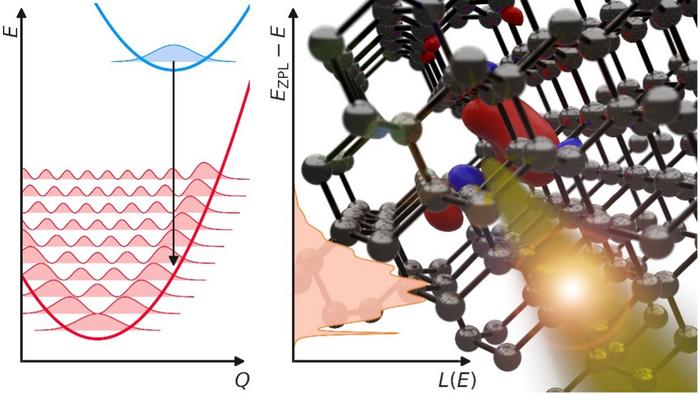
“Atoms are constantly vibrating, and those vibrations can drain energy from a light emitter,” says UCSB materials professor Chris Van de Walle. “As a result, rather than emitting a photon, a defect might instead cause the atoms to vibrate, reducing the light-emission efficiency.” Van de Walle’s group developed theoretical models to capture the role of atomic vibrations in the photon-emission process and studied the role of various defect properties in determining the degree of efficiency.
Their work explains why the efficiency of single-photon emission drastically decreases when the emission wavelength increases beyond the wavelengths of visible light (violet to red) to the infrared wavelengths in the telecom band. The model also allows the researchers to identify techniques for engineering emitters that are brighter and more efficient.
“Choosing the host material carefully, and conducting atomic-level engineering of the vibrational properties are two promising ways to overcome low efficiency,” said Mark Turiansky, a postdoctoral researcher in the Van de Walle lab, a fellow at the NSF UC Santa Barbara Quantum Foundry, and the lead researcher on the project.
Another solution involves coupling to a photonic cavity, an approach that benefited from the expertise of two other Quantum Foundry affiliates: computer engineering professor Galan Moody and Kamyar Parto, a graduate student in the Moody lab.
The team hopes that their model and the insights it provides will prove useful in designing novel quantum emitters that will power the quantum networks of the future.
Journal
APL Photonics
Article Title
Rational design of efficient defect-based quantum emitters
Article Publication Date
26-Jun-2024
Cite Scienmag News
Katie Riggs. (July 30, 2024). Bright prospects for engineering quantum light. Scienmag. https://scienmag.com/bright-prospects-for-engineering-quantum-light/
Katie Riggs. "Bright prospects for engineering quantum light." Scienmag, 30 July 2024, https://scienmag.com/bright-prospects-for-engineering-quantum-light/. Accessed 11 September 2026.
Katie Riggs. "Bright prospects for engineering quantum light." Scienmag. July 30, 2024. https://scienmag.com/bright-prospects-for-engineering-quantum-light/

