


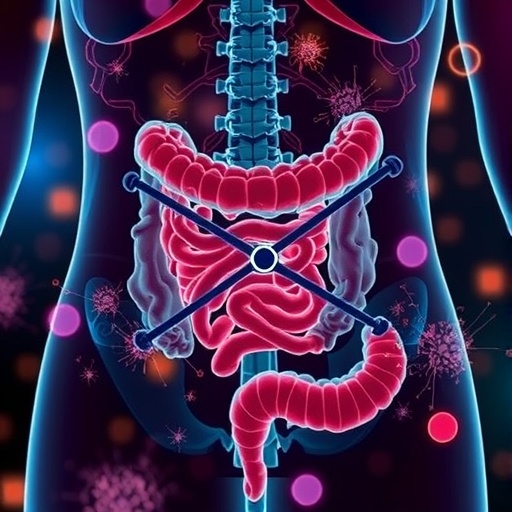
In an era where obesity rates continue to skyrocket globally, the search for novel biological insights that can unravel the complex mechanisms driving metabolic health has never been more urgent. A groundbreaking study, recently published in Nature Communications, sheds new light on the intricate network of the gut microbiome and its direct association with metabolic health outcomes in obese individuals. This research delves deep into the topology of microbial communities residing in the human gut, revealing previously unexplored relationships between microbial network structures and the metabolic profiles of obese patients.
The gut microbiome, composed of trillions of microorganisms including bacteria, viruses, fungi, and archaea, has long been recognized as a critical determinant of human health. While past research primarily focused on the diversity and composition of microbial species, the current study pioneers by examining the “network topology”—how these microbial species interact and connect within the ecosystem. Using advanced computational modeling and network theory, the researchers constructed detailed interaction maps that illuminate the dynamic, interdependent microbial relationships influencing host metabolic health.
The significance of this network-based approach is profound. Unlike traditional analyses that evaluate microbial presence or abundance in isolation, network topology considers how microbial species interact as a community, forming complex webs of mutualism, competition, and cooperation. These interactions can influence metabolic processes such as energy extraction, inflammation regulation, and insulin sensitivity, all of which are pivotal in the pathophysiology of obesity and related metabolic disorders.
Leveraging state-of-the-art metagenomic sequencing data from a large cohort of obese subjects, the investigators applied sophisticated algorithms to delineate microbial associations and identify key hubs and bottlenecks within the network. Their findings suggest that the structural configuration of these microbial networks—not merely the presence or absence of specific microbes—has a measurable impact on metabolic markers including blood glucose levels, lipid profiles, and inflammatory cytokines.
One of the key revelations of the study is the identification of distinct topological signatures correlating with favorable or adverse metabolic profiles. Healthy metabolic states tend to be associated with robust, interconnected microbial networks characterized by high resilience and functional redundancy. Conversely, disrupted or “fragmented” networks, marked by loss of key microbial connectors and diminished interaction density, are commonly found in individuals exhibiting impaired metabolic health.
The study also underscores the potential role of specific microbial taxa as “keystone” species—organisms that disproportionately influence network stability and metabolic outcomes. These keystone microbes may serve as therapeutic targets or biomarkers for personalized interventions, paving the way for microbiome-based precision medicine in obesity management.
Importantly, the research integrates multi-omics approaches, combining microbial network analytics with host genomic, metabolomic, and clinical data. This holistic perspective enables a comprehensive understanding of the host-microbiome metabolic axis, revealing feedback loops where microbial interactions influence host physiology, which in turn can reshape microbial communities, perpetuating either health or disease states.
The application of network theory transcends descriptive microbiome studies, offering mechanistic insights into microbial ecology and its systemic effects. For example, network motifs—recurrent interaction patterns—can illuminate microbial consortia that collaboratively modulate inflammation or insulin resistance. Targeting these motifs for therapeutic modulation could revolutionize treatment paradigms for metabolic syndrome and type 2 diabetes.
From a translational standpoint, the study’s insights open avenues for developing novel microbiome-based diagnostics. Network topology metrics could serve as early indicators of metabolic dysregulation, enabling preemptive interventions before overt clinical disease manifests. Additionally, dietary or probiotic strategies aimed at restoring beneficial network structures could enhance metabolic resilience in obese patients.
The researchers emphasize that while their findings provide compelling associations, further longitudinal and interventional studies are needed to establish causality and therapeutic efficacy. Nevertheless, this paradigm shift toward network-centric microbiome analysis heralds a new frontier in understanding the complex interplay between our microbial partners and metabolic health.
In conclusion, the landmark work presented in Nature Communications marks a pivotal advance in obesity research by moving beyond traditional microbiome composition studies to unravel how network architecture governs metabolic outcomes. This integrative, network biology approach not only deepens scientific understanding but also holds transformative potential for personalized medicine, offering hope for more effective strategies to combat obesity and its metabolic complications.
As researchers continue to map the vast microbial universes within us, it becomes ever clearer that the gut microbiome is not merely a collection of isolated species but a sophisticated network essential to our metabolic destiny. This study beckons a future where decoding these microbial networks provides a blueprint for health optimization, making the invisible microbial connections inside our guts visible and actionable in the fight against obesity.
Cite Scienmag News
Daisy Hatcher. (May 13, 2026). Gut Microbiome Network Links to Obesity Metabolism. Scienmag. https://scienmag.com/gut-microbiome-network-links-to-obesity-metabolism/
Daisy Hatcher. "Gut Microbiome Network Links to Obesity Metabolism." Scienmag, 13 May 2026, https://scienmag.com/gut-microbiome-network-links-to-obesity-metabolism/. Accessed 3 September 2026.
Daisy Hatcher. "Gut Microbiome Network Links to Obesity Metabolism." Scienmag. May 13, 2026. https://scienmag.com/gut-microbiome-network-links-to-obesity-metabolism/


