


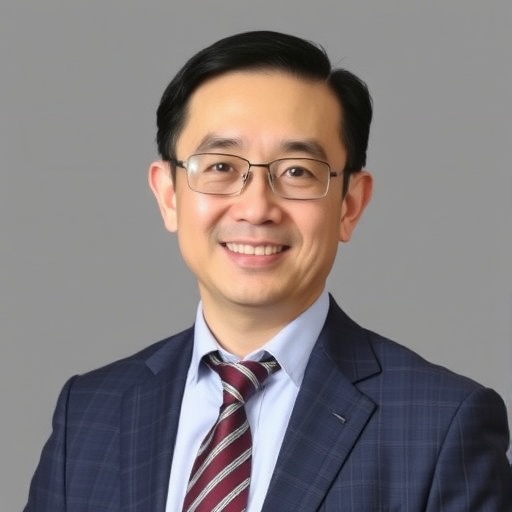
Professor Liu Bin, an eminent figure in the field of organic functional materials, has recently been honored with election as a Fellow of the National Academy of Inventors (NAI) for 2025. This prestigious designation stands as the highest professional recognition given exclusively to inventors who have demonstrated sustained innovation and tangible impact through patented inventions. Professor Liu’s groundbreaking contributions to the understanding and manipulation of organic semiconductors have opened new avenues in optoelectronic technologies, highlighting a fusion of fundamental science and practical applications.
Currently serving as the Deputy President (Research and Technology) at the National University of Singapore (NUS) and holding the distinguished Tan Chin Tuan Centennial Professorship, Professor Liu is among 16 internationally recognized inventors selected for the 2025 NAI Fellows cohort. This distinction acknowledges not only scientific excellence but also the translation of research discoveries into patented technologies with significative societal and economic benefits. These innovations reflect Professor Liu’s dual commitment to advancing knowledge and fostering technology commercialization.
Organic semiconductors, the central theme of Professor Liu’s research landscape, are materials characterized by their π-conjugated molecular structures enabling electronic conduction and photoluminescence. Unlike traditional inorganic semiconductors, organic materials offer promise for flexible, lightweight, and cost-efficient electronic devices. Professor Liu’s pioneering investigations have elucidated the mechanisms by which these materials efficiently emit light, thereby contributing to the advancement of organic light-emitting diodes (OLEDs) and other optoelectronic components.
One of the pivotal breakthroughs in Professor Liu’s work is the detailed understanding of exciton dynamics within organic semiconductor films. Excitons—bound electron-hole pairs created upon photon absorption—play a crucial role in light emission and device efficiency. By controlling molecular packing, energy level alignment, and interface engineering, her research has optimized exciton formation and recombination processes, which underpin brighter and more stable light emission. These insights have formed the foundation for highly efficient OLED displays used in modern consumer electronics.
Beyond displays, Professor Liu’s inventions have paved the way for innovative applications that extend into the domain of advanced medical diagnostics. Organic semiconductor devices can be tailored for sensitive optical biosensing, enabling non-invasive detection of biomarkers with enhanced specificity and temporal resolution. Her patented technologies include organic photodetectors and sensors with tunable spectral responses, which facilitate early disease detection and real-time patient monitoring with improved portability and reduced costs compared to conventional methods.
Optical data encryption represents another cutting-edge application stemming from Professor Liu’s research portfolio. By exploiting the unique photophysical properties and molecular interactions in organic semiconductors, her work has enabled the creation of materials that respond dynamically to environmental stimuli or encryption keys with distinct optical signatures. These innovations advance secure communication technologies by embedding complex authentication protocols directly into materials, thus offering robust protection against counterfeiting and data breaches.
The impressive scope of Professor Liu’s inventive output is reflected in her holding over 30 patents, many of which have been licensed globally. Such extensive intellectual property embodies the transition from basic research to industrial application, reinforcing her role as a leader who drives technology transfer. The commercial adoption of these patented technologies by a diverse range of companies underscores the universal relevance and scalability of her work in organic electronics and photonics.
Professor Liu’s election to the NAI Fellowship complements a succession of prestigious accolades she has garnered throughout her career. Notably, she was the recipient of the President’s Science Award in 2024, Singapore’s highest honor recognizing outstanding scientific contributions. Additionally, her membership in the US National Academy of Engineering since 2022 further testifies to her technical eminence and global influence in engineering science and innovation.
The National Academy of Inventors, known for promoting invention and entrepreneurship, convenes its 15th Annual Conference on June 4, 2026, in Los Angeles, where the 2025 laureates, including Professor Liu, will be officially recognized. This event unites leading innovators whose patented work has left indelible marks on both industry and society. The inclusion of Professor Liu in this gala assembly highlights her sustained excellence and leadership within the vibrant innovation ecosystem.
Organic semiconductor research remains a highly dynamic field at the intersection of chemistry, physics, and materials science. Professor Liu’s research exemplifies how deep theoretical understanding entwines with methodical experimentation to yield materials exhibiting novel optoelectronic functionalities. By harnessing supramolecular interactions and molecular engineering, her group advances the design of next-generation functional materials that promise applications ranging from energy-efficient lighting to biointegrated devices.
Furthermore, Professor Liu’s role as a senior academic leader amplifies her impact beyond the laboratory. By spearheading research strategies at NUS and mentoring emerging scientists, she cultivates an environment conducive to innovation and interdisciplinary collaboration. Her vision integrates cutting-edge research with translational science, accelerating the pace at which novel discoveries evolve into viable applications that address pressing global challenges in healthcare, communications, and sustainable technologies.
In summary, Professor Liu Bin’s election as an NAI Fellow is a testament to her extraordinary achievements in organic semiconductor science and technology. Her research not only deepens fundamental knowledge in light emission mechanisms but also drives the development of transformative technologies with wide-ranging societal benefits. Through her patented inventions, esteemed leadership, and commitment to innovation, Professor Liu embodies the spirit of scientific creativity and entrepreneurship in the 21st century.
News Publication Date: Not specified
Web References:
https://academyofinventors.org/nai-welcomes-2025-class-of-fellows/
Cite Scienmag News
Courtney Benton. (May 8, 2026). Prof. Liu Bin Elected Fellow of the National Academy of Inventors. Scienmag. https://scienmag.com/prof-liu-bin-elected-fellow-of-the-national-academy-of-inventors/
Courtney Benton. "Prof. Liu Bin Elected Fellow of the National Academy of Inventors." Scienmag, 8 May 2026, https://scienmag.com/prof-liu-bin-elected-fellow-of-the-national-academy-of-inventors/. Accessed 3 September 2026.
Courtney Benton. "Prof. Liu Bin Elected Fellow of the National Academy of Inventors." Scienmag. May 8, 2026. https://scienmag.com/prof-liu-bin-elected-fellow-of-the-national-academy-of-inventors/


